Monday, April 27

More flash fiction

Earlier this month I posted four 101-word stories that I had submitted to The Pacific Northwest Inlander, Spokane's own alternative weekly publication, for their flash fiction issue. They liked "That One Guy" enough to print it, and, even better, they liked enough to invite me to compete in a eight-person, single-elimination flash-fiction tournament. I had to write three new stories, one on the theme of ingratitude, another using the phrase "needless to say" and the final including a "red wagon."

Well, I went out in the first round and was only able to read one of my stories. Fortunately, the Inlander recently posted all tournament entries to its website, so anyone can enjoy any of them now. Mine are even listed first to save on scrolling time. For the curious, I read "Car Shopping," and it lost to Holly Doering's "Let Freedom Ring." Favorites on both pages include Holly's "Terminal," Matthew Netzley's "The Heels," Chris Dreyer's "Willie's Farts" and "Petting," Shanti Perez's "Gnomes on Board Ralph's Woodie," and Bob Salsbury's "The Unbearable Lightness of Failing."

Saturday, April 18

"A Cinematic Perspective" on Globalization

The globalization issue of Charter was published last year but only just recently went online. I was kind of frustrated with the delay, but the program they're using to display it now is pretty cool and especially nice for Charter because of its strong graphic element. Anyway, for the interested, my piece is "A Cinematic Perspective," an approach to globalization through the 2006 film Babel. Minorly fascinating history behind this essay. It started out as this blog post and was then adapted into a speech for my Advanced Public Speaking class which in turn provided the foundation for this essay. A long, gradual process of refining the same idea.

Favorites in this volume include Anne Pauw's "The Ethics of International Adoption," David Brandon's "iLife," Sara Turner's "Press One to Transfer Funds, Press Two to Oust your Dictator," Emmett Tribolet's "Global Transport, Economy, and Policy," and Anna-Sophia Zingarelli's "Globalization and the Museum."

Thursday, April 9

That One Guy

Enjoy my published submission here, about two-thirds the way down the page.

To be honest, I was more nervous about submitting this piece than any of the others. It seemed the most personal, the most idiosyncratic. Maybe I am the only one who ever gets uncomfortable passing people I barely know. Maybe everyone else is just that much more friendly and genuine than I am. Apparently I was wrong in that assumption. More than a few of the published stories have the same theme and tone as "That One Guy." They use snippets of dialogue or conversation forms that we are all familiar with in some style to demonstrate how banal our basic interactions with other people can be. Our talk proceeds right along and does not deviate from well-dug trenches of speech conventions. Now that we know these failures, however, I guess the challenge is to break free from them.

Personal favorites on the first page include Maria Pringle's "Pronoun Cycle," Matthew Netzley's "The Falling Man" and Ross Carper's "When I Was Hit By a Car." On the second page, I enjoyed Chris Dreyer's "Beer Run" and "The Napkin" by Matthew Netzley, again. On the third and final page, my favorites were Diane Gordon's "Labor of Love," Ross Carper's "Categorized," and Jessalynn Uchacz's "I Shouldn't Have Said What I Did"

Wednesday, April 8

Miracle by the nanosecond

Serotonin floods the postsynaptic neuron, binding with receptors and depolarizing the cell. An electrochemical signal races along motor neurons into the ventral roots of the spine. It splinters off at the brachial plexus and into the median and ulnar nerves, on through to their superficial and deep branches.

His hand grasps the cup and lifts the tea to his lips.

Chemoreceptors are activated. Sensation erupts along the tongue. Impulses burst into the gustatory area of the cerebral cortex.

It tastes good.

* * * *

Two definite inspirations for this one. The first is Tobias Wolff's short story "Bullet in the Brain." Halfway through his story, he takes a break from this tense hostage situation to describe in complex, precise medical terminology exactly what happens when a bullet enters the brain. That he could use language so unorthodox at such a violent moment and still create one of the best short stories I have ever read impressed me.

The second inspiration is this idea, I don't know whether it's a quote or what, that if we were to really pay attention to life and the world and stop taking them for granted, we would be absolutely floored by their beauty and intricacy. I'm not just talking about a sunset or coral reef or smoking hot woman but the most basic and fundamental biological processes. That taste and digestion and basic muscle coordination work at all should leave us open-mouthed astounded. Then again, this human ability to ignore the miraculousness of the common may not be such a terrible thing. If we spent all of our time celebrating the mundane, we wouldn't get very far in our other endeavors.

Tuesday, April 7

Her

He smacked the baby blue pack of American Spirits against his palm twice before pulling out a cigarette. By habit he began to roll it across his hand, filter over paper, between each finger and then under the palm to continue the cycle.

She had always hated that. She never stopped him, but she did tell him he did it just to draw attention to the fact he was smoking.

"You don't need to make a production out of it,” she would say.

But she wasn't here anymore, was she?

He cupped his hand to protect the lighter's flame.

* * * *

"Her" was the most conventional of my submissions, a pretty simple limited third-person narrative without any particularly unusual techniques. I like the ambiguity of the ending and the lack of certainty regarding her. What was her relationship with him? Family? Friends? Lovers? Did they have a falling out? Is she dead? At the same time, I like the defiance present in the final line, a nice piece of characterization for such a short story.

"Her" has a special place in my heart both as the first flash fiction I thought of and wrote. Also, when I wrote the rough draft, which received very little revision since only so much is possible with so few words, it came out to exactly 101 words. I thought then that this story was going places.

Monday, April 6

101-Word Fiction Contest & Jump

This coming Thursday will mark the first time in years that any fiction of mine will be published in something that is not funded by Gonzaga University. The Inlander, Spokane's weekly alternative newspaper, sponsored a 101-word flash fiction contest earlier this year and liked one of my submissions enough to print it in the upcoming issue. That's the good news. The great news is that they liked my pieces enough to invite me to compete in an eight-person, single-elimination flash fiction tournament as part of Spokane's Get Lit! Literary Festival. I'm not exactly sure what all that entails, though I assume it involves reading stories and advancing based on applause, or what the prizes are, but I am very excited about this. Incredibly excited, really. I literally jumped out of my seat when I read the email. To celebrate, all this week I will post my contest submissions to Spice of Life along with a little commentary on the thought process behind them. Without further ado, I offer...

"Jump"

The sun is setting. The shadows are long. They make it hard to see the gravel path, to find the soft spots which will twist and bend the bike's wheel, but I don't need to see them or the jump at the end. I've studied them all day, preparing for this moment. There isn't time for another run. This will be the last. No backing down again.

Deep breath. Both feet on the pedals. Don't wait. Go. Now. Too slow, push harder, lean forward, griptight, fasterbalancealmostthere

air...

Keep the wheel straight, be firm, bend elbows and knees. Steady and brake.

Nice.

* * * *

Content-wise, "Jump" is based on my own experiences trying to take a dirt jump with my bike two years ago. It took a few false starts, but when the shadows grew long, I finally knuckled down and hit it. It wasn't a terribly large jump, but the rush from that brief time in the air was incredible. With this story I was trying to capture my thoughts at that moment, how rationality took a well-earned break and was replaced by pure reaction.

Stylistically, I was influenced by David Foster Wallace's stories in his collection Brief Interviews with Hideous Men. You won't find anything like "Jump" in there, but his willingness to do different things with language and make the words themselves and not just their meanings integral to the story was an inspiration for me here. That, actually, was one of my joys in writing for this contest. It allowed me to be more experimental in my style. With such a strict word limit, I felt free to try some new things with my writing and was not confined to the limited third-person perspective that I am most comfortable with.

In the email which informed me of my upcoming publication, "Jump" was the only one of the four to not receive any compliments. So, if you didn't enjoy it, remember that the best is yet to come according to the contest judges.

Wednesday, March 25

Considering "Kirschblüten - Hanami"

I have a friend who says he can imagine nothing more depressing than an old married couple sitting opposite one another and having nothing to say. They've been together too long and know everything about the other. They simply can't surprise or interest each other anymore, so they sit in silence. The only reason they're still together is because they know no alternative. They've become too enmeshed in the ruts of their lives and trying to change anything at this point is simply too difficult.

I've found something more depressing still: a couple which has spent decades together and yet one still fails to begin to understand their spouse. That is the beginning of Cherry Blossoms - Hanami. Rudi and Trudi have raised three children together and shared their lives for years. In this time, Rudi has become comfortable with his life, comfortable to the point of resisting any change or deviation, even visiting his grown children and their families in Berlin. His wife's love for Japan and its culture, especially the butoh dance, is completely outside his comprehension, so he ignores it. It's not that he doesn't love her. He very much does. It's just that Japan is too different, too far from his Bavarian home.

Still, people, even those as unyielding as Rudi, are capable of change, of understanding. It may take a death to propel Rudi into regions unknown, but it is still possible. Cherry Blossoms - Hanami is, in fact, driven by death. Rudi's impending death is announced by two doctors at the beginning of the film, and it is Trudi's death that drives the final half of the movie. Suddenly without the wife he depends upon for so much, Rudi realizes how little he knew her, how much he had missed, and makes a trip to Japan to see the cherry blossoms and Mt. Fuji and all those things Trudi only dreamt of visiting herself. He is terrified of the foreign land at first, its lights and rush and press of people, but given time, he becomes more certain in his ventures outside the apartment. With the help of a young orphan girl, he begins to discover the beauty his wife saw in the culture and land.

It all drives to a single scene and dance of perfect beauty. To try and describe it would make it sound ridiculous or sentimental, but it is neither of these things. DiCaprio and Winslet on the door in the Atlantic in weren't this intimate. McGregor and Kidman singing "Come What May" to end Moulin Rouge! weren't this tender. In a word, the scene is perfect.

Beside the already heavy themes of love and death, Cherry Blossoms - Hanami touches upon family as well. Rudi and Trudi's family is not a perfectly happy one. The children have their own lives and want to be free to live them without their parents' interference. There is resentment against Rudi, and none of their children are willing to do much more than fulfill their most basic responsibilities to their parents. There is compassion and love there, too though. They are complex relationships, and I think it's a sure sign of this film's brilliance and the dedicated work of all involved that none of these scenes rings false. Not one feels less than authentic.

Yu, the orphan girl, is the only part of this film that bothers me. Society's misfit who reveals the greatest truths of life in their simple ways? It's a type that irritates me. Then again, I may just be too into philosophy which insists on describing life and death and all that in its own dense, complex language. Yu and Rudi's relationship does reveal one great truth, though. What language do the German grandfather and Japanese teenager share? The same one the young German and Turkish women share in Auf der Anderen Seite: English.

Sunday, March 22

Considering "Auf der Anderen Seite"

My political theology professor has a joke about German intellectuals. Talking with a friend after a lecture by Karl Rahner on the immanent Trinity at a conference in Regensburg, the friend says, "I was disappointed. I thought Herr Professor Rahner was more intelligent than that."

My professor is taken aback. "I thought it was pretty good," he says. "What did you think was wrong?"

"Nothing in particular. I just understood it all."

Germans, you see, think the only intelligent ideas are those which are so hideously complex that they are nigh impossible to understand. I guess I'll have to add the French, Turks and Filipinos to this list of ridiculous nationals because film competitions in all their countries handed out major awards to Fatih Akin's The Edge of Heaven.

On the basics, I understand what happened. Parents and children had fights, left one another, only realizing later, some times too late, how much they loved each other. People looking for another missed them by seconds or by glancing in the wrong direction at the wrong time. Some people died by accident. It's about revolution and love, life and death, family. What it ultimately wants to say about these things, I have no idea. Absolutely none. Things happen, and the story moves on. People sacrifice for others, and then somone else does something mean and nasty. None of it seems to mean anything, yet I do not want to easily dismiss it as some exercise in nihilism. The director, at least, seems to knows what he's doing. He carefully frames his shots to include exit signs as often as possible. There are Koranic and Biblical allusions. A guy quotes Goethe. It all must mean something so much effort has gone into it.

Still I cannot completely keep back concerns about the complexity. I have no bias against complex things. They stretch the mind more than some simple Jack Chick fable and make repeat readings more rich. The Edge of Heaven, however, is obtuse to the point of impenetrability. There is nothing interesting or compelling in it enough that I would want to spend two hours in front of it and probably another six to begin to come to grips with what it might possibly be saying. What if all the allusions and references and suggestions of depth are just a shield to protect the fact Akin actually has nothing to say? Maybe it's all just a colossal joke to see who is fooled enough to invest the time for a meaning that simply does not exist. Even if I were convinced by all the critics who put this on their top ten lists for 2008, is it worth the effort? Will my life be that more rich for finally understanding this film? Call it the Mulholland Dr. effect: Overwhelming complexity equals neither depth nor meaning.

P.S. Almost all the details in the opening joke are made up. I have no idea who gave the lecture, what it was about, where it was or even whether my professor was there. The only thing I am sure about is the punchline. Forgive me, but I thought the details made it sound better than "So a German friend of my professor tells him that he didn't think this lecture by some German theologian wasn't that good..."

Friday, March 20

Boys in Eyüp

The peak of the photographic medium, for me, is the candid shot. Photography can get no better than permanently imprinting upon 35mm of negative that moment of ridiculous absurdity or instance of perfect beauty that was taken straight from daily life. At its best, photography should put us in a state of wonder at life itself by making clear those precious moments we miss. I like portraits and landscapes, Diane Arbus and Ansel Adams, and all them just fine, but give me Henri Cartier-Bresson and his street photography any day.

By its nature, candid photography is impossible when the subjects are consciously aware of the camera, so it has always frustrated me when I pulled up my camera only for my friend to put on a funny face and strike a pose. Anybody can take that shot, and they do. Just check out Facebook. So it surprised me when I snapped the above picture and more than a few others like it while walking in the Eyüp neighborhood of Istanbul. These kids are not only posing for a shot, they're actively trying to get my attention. What could be more unnatural? A squirrel chasing a dog, I guess, but I digress. Partially, at least, I was humoring the kids, but there's more. There was a vitality and energy in their flailing that impressed me. The picture is not that great compositionally, but I think I caught some small sense of their fun with this shot. The boy whirling around and his friend looking on, bemused, from ahead, there's a unique sense of play there. And that makes me happy. Beside, even Cartier-Bresson's subjects were sometimes aware of the camera in their face, and those shots are still amazing.

Monday, March 16

Considering "Fix"

Seeing a movie is an experience mediated by the environment in which it is seen. Popping in a DVD at home and tucking into the couch with someone you love on a Friday night is a completely different experience from balancing a laptop on your knees during a trans-Atlantic flight and watching some low-quality rip you downloaded is a completely different experience from heading to a midnight release with all the cosplayers. With this in mind, Fix may very well have been the best movie experience I had for the entirety of the Spokane International Film Festival. Not to take anything way from Fix but Revanche is a better film and Kirschblüten - Hanami gives it a good run for its movey. But those films weren't screened in the the Magic Lantern Theatre which has no more than 50 seats and their directors weren't in attendance. Pair that experience with two shorts, one produced completely in Spokane and the other a hilarious piece about some potheads trying to get their dignity back after being robbed and pistol whipped, and Fix was the best time I had at the movies so far this year.

It's really unfortunate that no major distributors picked this up for a nationwide run, but I imagine their marketing departments are thanking them for that. Fix simply cannot be encapsulated in a two-and-a-half-minute trailer there is so much packed into its 93-minute run time. It's a comedy of characters and personalities. It's a drama about the relationship between brothers and depicts drug use as honestly as possible. It's a madcap adventure which propels its heroic trio, the felon Leo, his brother Milo and Milo's girlfriend Bella, all across Los Angeles from Beverly Hills to Venice Beach to Watts in search of $5000 to pay for Leo's upcoming rehab stint and to keep him out of a three-year prison sentence. Focusing on just one of these elements would exhuast a trailer, but it wouldn't honestly present Fix. Try and bring them all in, and no one will know what to make of it.

There is a lot to endear Fix (it's amazing soundtrack and rich, saturated color palette rank especially high for me), but this movie is carried all the way on the strength of its actors and actresses across the board. Shawn Andrews, as Leo, obviously, and most deservedly, gets the greatest attention and credit. He has the most screentime and makes the most of it, charismatic and desperate as the situation demands it and never less than engaging. It's impossible to imagine anyone else in the role or capturing his kinetic portrayal without the handheld camera. By no means, however, does this discount the efforts of any others in this film. Olivia Wilde's Bella and director Tao Ruspoli's Milo are perfect, understated foils to Leo. They're grounded and still keep pace with Andrews without falling into the temptation of overacting to match the him. The many, many supporting characters are more than adequate, too. The bored housewife of a Hollywood producer, the eccentric trust fund kid with delusions of boxing, the cultured chop shop owner, and the lawyer who could out insane Les Grossman from Tropic Thunder are brilliant in their own ways, and I wish they all could have had twice the screentime they received.

The real joy, though, was when Tao Ruspoli, the director, came out for questions at the end. With tact and remarkable patience he put up with a woman who wouldn't stop trying to convince him to set his next film in Spokane. He spoke about his relationship with his brother and the personal inspiration for Fix. When I asked what it was like to work with Olivia Wilde before she was cast in the lead role for Tron 2.0 and "made it," he said they were married. Cool guy. Very cool. I shook his hand afterward. At the end of the festival, it was announced that he had received the award Most Promising Filmmaker. I hope the people who own studios realize this and begin pouring funding his way, actually get him some national distribution. I want to see what else this guy can do.

Wednesday, March 4

Considering "The English Surgeon"

Searching for the essence of a doctor, I believe Socrates would arrive at something along the lines of "one who heals." Continuing with this classical philosophical thread, we could create a syllogism. All neurosurgeons are doctors. Henry Marsh is a neurosurgeon. Thus, Henry Marsh is a doctor, one who heals. His devotion to healing is exceptional, going well beyond what we may reasonably expect from doctors, and this is the subject of the documentary The English Surgeon. Since visiting Kiev in 1992 and discovering their appalling medical practices regarding the brain, he has made regular pilgrimages to the capital of the Ukraine to do what he can for the people. He makes diagnoses. He performs surgery. He brings bits actually designed for the skull instead of the over-the-counter carpentry pieces his Kiev-counterpart Igor Kurilets is otherwise forced to work with. He brings hope.

For his efforts, Marsh is celebrated. Kurilets refers to him as "King Henry" once early on. Marian Dolishny, a poor villager from western Ukraine, invests all of his hope and money in Marsh in the hopes of a cure to the epileptic fits which keep him from holding a job and foretell an early death. Marsh's visits to the Ukraine mean a lot to people whose medical system is so screwed up that patients must pay double if they don't want to wait two weeks to arrange an appointment for a critical head scan.

Still, Marsh questions the good he does. He delivers this beautiful line before departing London. "When push comes to shove we can afford to lose an arm or a leg, but I am operating on people's thoughts and feelings...and if something goes wrong I can destroy that person's character ……forever." It may not be rocket science, but it is brain surgery. It is kind of difficult, and the consequences for mistakes are extreme. Marsh himself is wracked with guilt for a surgery he fails on one of his first visits to Kiev, leaving the young girl Tanya significantly worse than before and hastening her death. At the end of the documentary, Marsh visits Tanya's family and her grave. He has no appetite, but the entire family is gathered together for as fine a meal as they can muster. The mother is nothing but grateful for Marsh's work. She holds neither grudge nor resentment.

I understand that mistakes happen. I understand, too, that surgery is a difficult practice, never offering a guarantee of success. Like Tanya's mother, I admire Marsh for his attempts and can forgive him for his failures, though he can't forgive himself. Even if he can't always fulfill the hope his arrival incites, Marsh does good. Still, I have difficulties with Marsh. It may be presumptuous to question this respected surgeon who has worked his profession decades longer than I have even been alive, but I have problems with the length to which he draws out his reliance on hope. Sandwiched between Dolishny's awake surgery and the visit to Tanya's family, Marsh meets a young woman who comes for a second opinion after complaining of minor symptoms. He takes a brief look at the scans and tells Kurilets, in English, that she has six months. No surgery or treatment is possible, but Marsh convinces him to tell her nothing in Ukranian. It's better to live with hope he says. It was the emotional peak of the movie for me despite following and preceding such intense scenes. Watching her sit passively, cheerfully, while the doctors discuss whether to tell her the truth in a language she doesn't understand is heartbreaking. Let her know of the inevitable and allow her to prepare for it? Hide the truth and protect her from the terror of inexorable death? I feel Marsh comes up with the wrong answer.

Even if I'm right about this though, it is a small failure in such a life and career. The successes still stand on their own. The failures leave no mark upon them.

Wednesday, February 25

Lent 2009

It's Ash Wednesday today, the beginning of Lent. We now have forty days of joy and repentance to prepare for the death and resurrection of Jesus Christ. I think this may be my favorite Church season. (Not that it has much competition. I can only recall three others at the moment.) I feel as though this is a time when my Catholic faith finally begins to make demands of me and intrudes on my daily life, makes itself known. There is fasting. Stations of the Cross become a weekly event. There are a pile of Holy Days which require trips to church beside Sunday morning. Receiving the cross of ashes on your forehead today is a significant marker of faith. There is a sense of urgency about my religious practices. This is a time to really claim my faith.

For my fast this year I've opted not for self-denial but a new practice. I'm going for daily prayer. I've been interested in it for a while and have even tried to make it a habit, but those, obviously, haven't panned out well. I'm still a little fuzzy on the details, though. The general plan for now is a few minutes of prayer after waking up and a few minutes before going to bed. Maybe some stock "Our Fathers" and "Haily Marys." Maybe some original stuff in the sense that prayer is a conversation with God. I might go online and check out different methods of prayer, too. Try a different style every week. Some Taizé, maybe? We'll see. I'm excited to see how this turns out and will make every effort to record my experiences and practices here.

Saturday, February 21

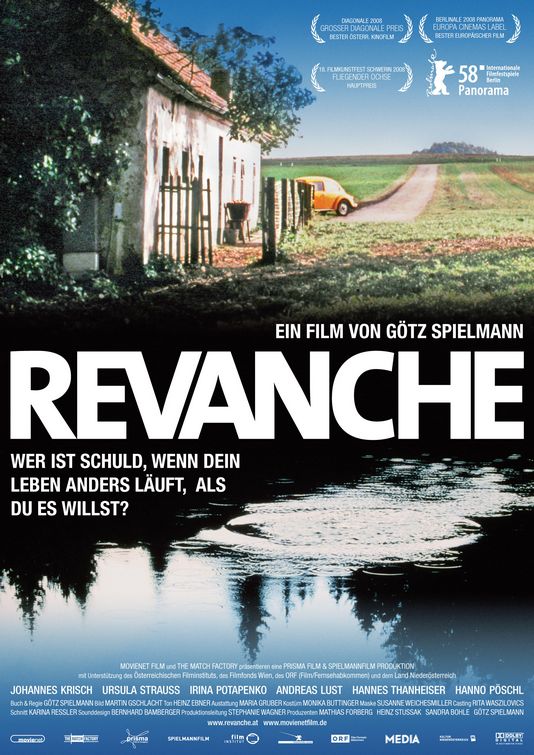
Considering "Revanche"

I readily admit that the first thing about Revanche which captured my attention was its Austrian origin. Not that I have any particular love for the nation, having only visited Salzburg, but because that means the language will be German. Since I began taking German language classes four years ago and spent five months studying in Munich, that alone has been enough to peak my interest in a movie.

The fact that this movie received a nomination for Best Foreign Language Film and is, quite honestly, a mind-blowing movie is only the kicker.

The plot, ultimately, is quite simple, and ancient. It's the same principle that finally motivates Achilles to end his hissy fit and get back onto the battlefield. It's a story of revenge. Man's girlfriend is shot. Man wants to make the one who did it feel the pain he feels. Wants to kill the one who did it. But it's really not that simple. Revenge and the vigilantism which so often springs from it are clichés of American entertainment, popular clichés if the resounding success of The Dark Knight this past year is any indication. In these popular cases the sides and intentions are clear. The victim is wholly innocent, entirely blameless. The killers are vile murderers, most likely drug dealers or rapists or spoiled rich kids of some sort. The avenger has never acted in hatred before but are forced into it by a legal system which cannot give them the justice they seek. But what happens when the killing takes place in the course of a bank robbery? When happens when the killer is a good cop who is crippled by remorse? When the shooting is an accident? When the avenger already has a violent streak? Revenge is not that simple. Perhaps more difficult than it, though, is forgiveness. How does Alex move beyond his girlfriend's death? How does Robert move beyond his first kill, a terrible accident? A crucifix appears in nearly every scene of Revanche, and all of the characters are searching for redemption in some way.

The director, Götz Spielmann, aims for naturalism. There is no background score. All music which appears in this film is courtesy of Hausner, the grandfather of the main character, as he plays his accordion. There are no musical cues to indicate how a scene might turn or what our feelings should be. There are no desperately rising strings when Alex pulls a gun on Robert as he runs by. When Alex has violent sex with Susanne, Robert's wife, there is only silence beside their sharp breathing. The lack of a score emphasizes, too, the difference between the ambient noises of red-light Vienna and the forest surounding Hausner's home.

Without a score the full emotional weight of a scene must be carried by the actors, so it's fortunate that the performances across the board are outstanding. The greatest, though, may also be the most understated. There was no acting apparent in Johannes Thanheiser's performance as Hausner he inhabitated the role so completely.

In any case, though Revanche is very deserving of the Oscar, my vote goes out to Der Baader Meinhof Komplex. The AMC Theater in Spokane has done a decent job of brining in the winner of this category of the past two years, and I would very much enjoy the chance to see another German film this year. I suppose Vals Im Bashir is the front runner since its victory at the Golden Globes, but I'm assuming Israel's invasion of the Gaza Strip earlier this year will put the Academy members off a little bit.

Update: At the Spokane International Film Festival, Revanche tied with Let the Right One In for Best Feature Film.

Thursday, February 12

Another one for the senior bucket list

Though this opinion I submitted to The Gonzaga Bulletin last week is rather specifically bounded to the past four years at this particular Jesuit university, I feel the message is a solid one and applicable to all those who ever plan on graduating from higher education. American colleges suffer from a four-year memory and so much is lost among students every time another class graduates. Seniors should make a deliberate effort to share their experiences and memories. Ironically, it's not something I'm likely to put into practice as I hate meeting new people so much.

Funnily enough, I've received more personal responses to this piece than any I've written before, news or opinion.

Saturday, February 7

Considering "Låt den rätte komma in"

The Spokane International Film Festival is celebrating its 11th year this month. I am celebrating my first year of attendance, which really is a pity. I like to consider myself something of movie connoisseur who has some standards for his celluloid-based entertainment and who also likes to see what stories people outside of Hollywood are telling on the big screen. Forgoing an event like this, one which promises films from across continents and pieces which would never otherwise play on a screen in Spokane, is really quite unforgivable. As penance and as celebration of this opportunity finally seized, I offer this blog up to my thoughts on all those feature-length films I manage to fit in over this wonderful, wonderful week.

Seeing as how this was not only my first Spokane festival but first film festival ever, I could hardly have hoped for a better film to break into it all than the Swedish Let the Right One In. For months, it had been steadily gathering exceedingly positive reviews and excellent press coverage in the States. It currently stands at 82% on Metacritic and a freaking 97% on Rotten Tomatoes. When I first checked the screening schedule, it was the first to catch my eye, and the only one I was absolutely determined to see.

All of which made finally seeing it something of a let down. Good thing Australia and The Curious Case of Benjamin Button had already gone a long way toward inuring me against this possibility earlier in the winter.

Twelve-year-old Oskar, even paler and blonder than the young Macauly Caulkin, is tormented by bullies. He wants to be strong. He wants to cut them and make them squeal like pigs. Instead he meets Eli, the odd dark-haired girl who doesn't wear shoes in the snow because she's forgotten how to feel cold. If you managed to miss it before coming to the theater, Eli's a vampire. She announces her more feral nature to the audience by latching on to the neck of some unfortunate, lonely souse early on. It's a nice switch up, with such an emphasis on predators and prey throughout the film, to see the little girl, typically the weakest and most vulnerable of the characters, become the most powerful and terrifying. Anyway, despite Eli's warnings against such a relationship, they become friends. They give one another advice. They help one another grow. They make mistakes. They do stupid things for the sake of the other. Then they go and do something brave. They even use Morse code to communicate between their apartments. All of this is great. These are the fundamentals of any great love story. The problem is the emotional connection necessary to make it fantastic never appeared for me. To be sure, the Rubik's Cube scene and Oskar's first hug with Eli have more tenderness and sweetness in them then anything that goes on between Brad Pitt and Cate Blanchett for the first two hours of Curious Case, but then Tomas Alfredson has to go and weird it all up by having Eli dive into Oskar's dripping blood and scream at him to get out, presumably before she goes after the fresher stuff.

So we come to the crux of the situation. Right One is a vampire movie. Right One also is a coming-of-age and love story. It takes both of all of these premises seriously, but that doesn't work. If vampires are at all played as something less than cool, calm, collected versions of evil incarnate, they lose their menace to the point of becoming ridiculous. Requiring an invitation to enter any building is kind of a glaring weakness. Just consider any book in the Twilight series. Totally lame vampires. When Eli unwillingly shoves her face into the pool of Oskar's blood, it has about the same level of terror as when the afflicted in The Shaggy Dog runs after cats while still human.

Make no mistake, I found Right One to be an absolutely beautiful movie. The Stockholm suburbs in the 1980's may be a joyless place in the dead of winter, but the director captured something beautiful in that stark, desolate environment. I could have watched that drifting snow for hours. It's just too bad that couldn't be translated into any sort of enduring emotional connection for me. I really wanted to love this movie.

Update: At the Spokane International Film Festival, Let the Right One In tied Revanche with for Best Feature Film.

Friday, February 6

Learning Argentine Tango: Another perspective

This video is part of an irregular series for The Spokesman-Review detailing community love stories. The couple dances at the same venues as I do, so I've seen them a few times. This is the first time I ever heard of their meeting, though. I like their descriptions of Tango at the end. They closely mirror my own thoughts on the dance and those of other people I've spoken with.

From a journalism standpoint, I honestly enjoyed the presentation of this piece, still photos matched with dialogue from interviews and minimal narration. It's a limited style and probably of not much use to any harder news, but for telling this love story, it is very nice, simply allowing the subjects' voices to weave the story and mood.

Tuesday, February 3

Marienplatz at noon

This is my first photo post since the beginning of the semester and since I enrolled in Philosophy of Art and History of Photography. Ostensibly, both these classes aim to improve my critical skills. Let's see how well those are working out.

We begin by observing, noting what is in the image. We see a crowd of tourists, digital cameras all aimed at the same spot. Some are smiling. Some are a little more intense, perhaps waiting for the exact right moment to preserve and share with their friends. Only one woman, the blonde with a white scarf in the midground, seems aware that the crowd has itself become the subject of a photo. The title reveals the location and time of the shot. By itself, this is of little help, but seeing as how I spent several months studying in Munich last year, I know that this is where and when one can observe the renowned Rathaus-Glockenspiel play and dance.

Considering all this, I believe the photographer is attempting to make a statement on the banality of photos taken while on tour. Everyone takes a picture of the same thing even when a static image on the thing lacks any interest whatsoever. The puppets on the Glockenspiel move on fixed tracks and, if they're feeling frisky, rotate. The pictures being taken in this photo even lack the personal touch one creates when they put a friend or family member into the frame alongside the primary subject. It is as though these people want to fill their digital albums with pictures they'll immediately skip over. If they appreciate the Glockenspiel that much, there are postcards readily available with images far superior to anything they could manage. It is not a bad message, but the photographer's technical incompetence distracts from it. Really, what amateur puts a street sign directly behind the head of a person?

Sunday, February 1

Public intellectuals

A November article in The Chronicle of Higher Education disputes the apparently popular claim that the public intellectual is dying out. For the curious, blogs are the alleged coup de grâce. Daniel Drezner challenges this idea and argues that blogs provide an alternative communications outlet, more accessible to those outside the ivory tower, and have thus increased the level of the conversation.

I can buy that. At their most fundamental, blogs are a communication medium and have their own unique set of attendant advantages and disadvantages. In this way, they are no different than television or magazines or any other mediums going all the way back to papyrus scrolls and stories around the fire.

The more interesting questions to me, however, are avoided by Drezner. What does it mean to be a public intellectual? What does the public intellectual do? Drezner takes the answers to these questions for granted. He makes several lists which enumerate over 30 "public intellectuals," and offers only the scantest of possible definitions. "[Those who] write serious-but-accessible essays on ideas, culture, and society." In all fairness to the following, the only two people whom Drezner lists and whom I am reasonably familiar with are Christopher Hitchens and Malcom Gladwell, and my thoughts on these two have been repeated plenty often.

Anyway, Drezner's definition. It's a good start but should only be taken as the bare minimum. I think we need to pay more attention here to the form and transmission of thoughts, ironic since Drezner spends this article defending the blog as a medium. It bothers me that Drezner makes a particular effort to include journalists and editors among his public intellectuals. It's another irony since my own major is journalism, and were I to one day be considered an intellectual, that would be a good day. However, I like to think this also makes clear to me more of our profession's collective weaknesses. We're not bad at writing, especially for mass audiences, but we tend to treat issues and ideas as finished products. We have to deliver something, and ambiguity does not fit nicely into a box. We often give some space to quotes by opponents of the idea, but that is all. We hardly ever go behind this, describe the competing arguments. Ultimately, the ideas and issues we write about end up positions to take based on anecdotes and soundbites rather than critical thought.

More important than "serious-but-accessible essays on ideas, culture, and society," public intellectuals should be framing the important debates of the day in such a way that the arguments come to the fore. They should not be giving Americans ideas but asking them to consider the ideas. We shouldn't be looking toward the quirkiness of the ideas, those most out-of-the-box, but the reasons which support them. The public intellectuals should be writing for and speaking to each other, not the masses, but making these debates open to the public. Yet another irony, I think televised debates may be the best medium for this, stained as they may be by cable news show shouting matches. In speech, jargon tends to fade. For all the thought in it, the Chomsky/Foucault debate is very accessible and demonstrates the possibilities for civil discourse. In the meantime, writing, though it permits deeper arguments, is meant for the crowd and not as often for one another. A final irony, blogs then become the worst form of public intellectualism. The opportunity for them to become insular "echo chambers," linking only to and read only by those who share their thoughts is incredible. Drezner's public intellectual may not be dead, but they could be so much more.

Thursday, January 15

Considering "Outliers: The Story of Success"

Freaking Malcolm Gladwell.

I first heard of him this past November, and the more I learned of the man and his ideas, the more I begrudged him. It began with this profile I found on Arts & Letters Daily. Despite the enormous success of his first two books, The Tipping Point and Blink, it was the first time he came to my attention. I didn't think think much of Gladwell one way or another at the time. Still, Arts & Letters kept paying attention to him and his latest book, Outliers, an exploration into the reasons of success. My ire just rose in response as I discovered the lunacy of his ideas and the accolades he attracted. Within weeks I was griping about him more than neo-atheism.

Which makes it all the funnier my parents gave me Outliers for Christmas. My dad heard an interview with him on CBC Radio One. He thought Gladwell sounded interesting.

Thus a fascinating opportunity came unto me. Until that point, all of my rancor was drawn from bitter reviews. Here was a chance to go right to the source, to test my appropriated criticisms. Put in the simplest term, they passed the test.

Gladwell wants to know why people are successful, be they as diverse as The Beatles, Bill Gates, Jewish lawyers and professional hockey players. His conclusion? They attain the highest echelons of success due to circumstances beyond their control, not some natural gift or extra effort on their part.

"Superstar lawyers and math whizzes and software entrepreneurs appear at first blush to lie outside ordinary experience. But they don't. They are products of history and community, of opportunity and legacy. Their success is not exceptional or mysterious. It is grounded in a web of advantages and inheritances, some deserved, some not, some earned, some just plain lucky - but all critical to making them who they are. The outlier, in the end, is not an outlier at all."

Children born into a culture which worked rice paddies have a cultural advantage which values hard work. Being born in the right year could make or break someone trying to enter the ground floor of the personal computer industry. Being born at the beginning of the year confers an incredible advantage to Canadian hockey players.

I agree with this basic thesis. A person is constrained by their circumstances. One will never be first-chair with the Chicago Philharmonic if no one ever gives them a violin. A well-off family can offer their children more options than a poor one. It is a simplistic idea to the point of being blindingly obvious, but I cannot fault it.

Understandably, Gladwell is not content with the mere idea. He wants to push farther and actually apply it. First of all, he wants the successful to admit their dependence upon circumstance and fortune, family and culture. He appreciates Bill Gates for admitting this and reviles Jeb Bush for running as governor of Florida as a "self-made man." I can appreciate this, as well. Were this realization to become more common, it could lead to a more compassionate society, there but for the grace of God go I and all that.

However, Gladwell wants to do even more than that. He wants "[t]o build a better world ... to replace the patchwork of lucky breaks and arbitrary advantages that determine success ... with a society that provides opportunities for all." He suggests doubling the number of hockey leagues in Canada, one for those kids born between January and June and one for those born between July and December. This way the age and size difference is shrunk and makes the leagues more competitive. He promotes year-round public schooling, so the poor do not fall behind in learning during the three-month summer break.

Whether one believes these changes would actual level would actually provide opportunities for all, this is about as much as Gladwell can suggest. The remainder of his examples of success are understood entirely ex post facto. One could never adjust society to account for them. Consider this. Gladwell asserts Gates never would have topped the software industry if he had not attended a private school with a computer system most universities of the time lacked. In effect, he succeeded because his family was rich. In this article, Gladwell says Sidney Weinberg became a marvelously successful broker because he was poor. We simply do not know what circumstances will make one successful. For another example, Carnegie and Rockefeller, Gates and Jobs could never have achieved the success they did without being born in a very small span of years which positioned them to best take advantage of new technologies. No amount of societal tinkering will ever account for that.

The second great problem Gladwell faces is his analogical reasoning. The man is incapable of making a point without telling a story. I have no problem with this, in fact it makes for engaging journalism, Gladwell's trade, and some compelling reading. Unfortunately, more often than not, that is the entirety of his reasoning. Some of his conclusions suffer for this. One of Gladwell's foundations for success he calls 'The 10,000 Hour Rule." He claims success is a result of practice and perseverance rather than any innate talent or genius. His primary evidence? The Beatles played 8-hour sets every night for months at a Hamburg club, forcing them to improvise and experiment with new styles. I can buy that instance. However, Gladwell also points out this club was open 24 hours a day, and I am sure more than a few bands were played under the same circumstances. Why have none of their songs become the basis for a movie musical? He has nothing more than a few anecdotes to support his preposterous rule.

By the end of Outliers, Gladwell is little more than an engaging writer. His most ambitious ideas are ill founded, but he makes them comprehensible and interesting. For me, Gladwell ranks alongside the late Michael Crichton: a good read whose most defensible ideas are never more exciting or original than "beware hubris in science."

If this review has failed to convince you his book is not worth the time, do yourself a favor and skip the first chapter. In it Gladwell tells a rambling story of the scientists who determined that the exceedingly good health of Italian immigrants in the Maine town of Roseto was not caused by diet, exercise, genetics or any of the usual suspects but community. Why tell this story? Because he wants to be as important as those researchers. Nothing to do with success whatsoever. I'm surprised they didn't need a smaller font and larger margins to fit his ego onto the page.

If you want to give the man a own chance without first buying one of his books, here is his website. It contains excerpts from all of his publications, a complete archive of his articles for The New Yorker and his blog. If you want to read some real venom pointed his way, check out this review.

Edit (January 29, 2009)

Isaac Chotiner of The New Repbulic agrees with me, too.

Saturday, January 3

Vegetarianism

I have been a vegetarian for nearly two years now. More precisely, lacto-ovo vegetarian because I like few things more than a quality cheese shop, a breakfast of granola and jelly mixed into plain yogurt and omelets filled with fried onions and celery. For the most part, I have enjoyed being a vegetarian immensely. It has broken old eating habits and meal standards, clearing the way for new ingredients, new recipes and new tastes. I have made extensive use of New Recipes from Moosewood Restaurant, a cookbook I would have otherwise never considered. I made my first risotto and couscous dishes. Beans are now a regular part of my diet, and I am still just beginning to explore the possibilities in them. Cutting out the meat has cut my grocery bills as well. The only real difficulties have been in the limited vegetarian options at some restaurants (I'm looking at you Outback Steakhouse), and the decision to go vegetarian just months before my semester abroad in Munich and missing out on all of Germany's wonderful meats. Bratwurst, weisswurst, kebab ... it doesn't feel like any less of a mistake in hindsight.

Since I began, the question "Why?" has been posed several times. In the beginning the answer was simple. It was my Lenten sacrifice. Before then meat was a very regular part of my diet. Giving it up was a challenge. After Easter and being meat clean for 40 days I went back to eating meat. A week or two later, I returned to vegetarianism. Had I been more honest when people asked me my reasons during Lent, I would have told them it was a test run to see whether I really could go without meat. The truth was I had been contemplating vegetarianism for some time but had never seen any reason to try it out. After the successful Lent, my direction was pretty well set.

It still strikes me as odd when someone asks me why I am a vegetarian. When I was still in high school, I assumed the only reason one would practice vegetarianism was a concern for animal rights, the desire to minimize animal pain, to not turn cows and chickens into means for an end. It turns out there are a lot of reasons people turn to vegetarianism, and Wikipedia has an impressive list of possiblities. Many people practice varying levels of vegetarianism according to their religion. Buddhists and Jains are probably the most prominent, but Eastern Orthodox fasts can be pretty core. Probably a growing number practice for environmental reasons since producing meat requires so much energy and cows produce so much methane. Some simply cannot afford meat. Some dislike the taste. Some avoid meat for health reasons.

I, however, choose vegetarianism as a form of solidarity. Put in the simplest terms, American levels of meat consumption are not possible on a global scale. In 2000, the average American ate just under four pounds of meat every week. Though I have a lot of faith in science to do amazing things, there is no way the Earth could ever sustain enough cows, pigs and chickens for everyone to eat so much. As China and India and their billions become more affluent and hungry for animal bits, this will become more apparent. I like to say that I will return to a meat diet when it is possible for all the world to eat as much as me. I expect this to be far less than is currently available to the average American.

The interesting thing is, this particular justification for vegetarianism does not preclude all meat consumption. The more reasonable conclusion from this thought process would be flexitarianism, eating a minimal amount of meat. Still, I practice full-blown vegetarianism out of a sense of fairness. It seems wrong to me to enjoy animal flesh while millions of others are happy to get their daily bowl of rice. I know the world is not fair, I know there a lot of other things I could give up which others lack and I know self-denial does nothing for others, but in this instance, I will do what I can to make the world a wee bit more fair.

Still, there are occasions in which I will eat meat, mostly when guest etiquette demands it. If someone prepares a meal without knowing I am a vegetarian or if it is that important to my host, I think it is appropriate to try a little bit of meat. I am still trying to find the perfect balance of these values, but I believe it is the right way to go. A more clear example appeared when I spent a month at the orphanage and education center in Jakarta. I had no problem then with sharing their meals of fish. I figured they were the sort of people with whom I was seeking solidarity. If they could enjoy a little flesh, I could too.

For the curious, I miss hamburgers and pork tenderloin the most. And Oma's rouladen.