Friday, November 9

Living

In my excited descriptions of my first opera experience and other recent posts, I have revealed that I am currently studying in Munich. For this post to be properly understood, more context, specifically of a temporal nature, is necessary. I arrived in Germany at the end of August, a little more than two weeks before my study-abroad program started, so my grandparents and I could visit those relatives who did not immigrate to North America (i.e. all of them). I return to the United States at the end of January in order to enroll in the spring semester at my university. Roughly, that amounts to five months abroad. Keep that in mind. Not necessary to keep in mind but fun to share, being in Germany this long requires a residency permit, and I like to think it brings some flair to my passport, certainly more than those barely visible Frankfurt/Main stamps.

It has been an exhilarating time. My hometown had a population around 1,400, and though I still maintain that Spokane is a good-sized city, it really does not compare to Munich on most fronts. Merely having a choice between movie theaters is kind of a big deal for me. Not only having a choice in that regard but also in museums, galleries, theaters, opera houses and more still is a bit much, but I have enjoyed them at every chance. The idea has been a different museum and church every Sunday and at least one live performance every week.

What is more exciting still is that though I would be quite content to solely remain in Munich for my entire European stay, that is simply impossible when all these other cities of renown and all their culture are only a short flight or train ride away and the chances of an opportunity like this ever appearing again are so slight, there is simply too much. I have been to Dresden, Salzburg and Cork. Paris, London and Istanbul are all on the schedule, and should the finances still look solid after making all arrangements for travel over the Christmas vacation, hopefully Prague or Lausanne, Switzerland can be added to that list as well.

When I bother to step back and give this a little thought, I find myself a little surprised at myself, especially in consideration of how quickly I found my habits and schedule back in Spokane and refused to break with them. In the United States, it would not be uncommon for me to decline any number of offers to shake it up a little, opting for an afternoon of reading over a canoe trip with my dad or preferring to do homework instead most any other idea that might get kicked around by my friends at Gonzaga, but that has shifted now. The question is no longer whether something might fit my schedule, but how I am going to deal with my regular schedule to make this special occasion or trip possible. More bluntly and aphoristically, to just bloody do it and work out the details later. Sure, I may have to stay up a little later to finish the assigned reading or whatever, but it is not worth missing a whole freaking city over.

Really, this is no great revelation. The imperative to "live everyday as if it were your last, without regrets of missed opportunities" has finally been grasped during since my arrival in Munich, but it has taken on a great immediacy here too. I still do not know when I will die, but I do know when I will leave Europe. For the remaining two and a half months, I intend to not regret a single missed opportunity. And this is what has been so electrifying about my time here and has been a greater lesson still than the history of Germany since 1945 or all my language work. More than anything else, it is this concept that I want to take back with me and keep with me for the rest of my life.

But how? Admittedly, this is a unique time, one might not strain themselves to call it a frivolous one in spite of the classes I am taking. Those admittedly minor responsibilities I have gathered back at Gonzaga will kick in again when I return. Eventually more serious responsibilities, like family, will be mine. Through substantial gifts, especially from my grandparents, money has not been such an obstruction to my pursuits either. I will need a job someday and support myself too. It is not so easy to mold these around every passing opportunity.

For now, I think, the simple awareness of the need to take advantage when the situation presents itself is enough. Too long have I lived without it, at least in any practiced sense. The rest will be dealt with as it arises.

Considering "Le Corsaire"

The plan to become appropriately cultured that I may someday, without trepidation, move among the types of people that attract trophy spouses is proceeding admirably well, even if timely considerations of them have been slow in coming (I sit down to write this nearly one and a half weeks after taking in the performance). To follow up my first and second operas, I finally made my first ballet. It has been a long time in coming. Never gave a thought to ballet before last fall when a bought of thinking along the lines of "Wouldn't that be cool?" prompted me to try for a Dance minor and take a class in ballet without ever before seeing a performance, much less go to a high school dance, whatever those might count for. Coming on a year since being not good enough to advance to the second ballet class, I finally took in my first professional performance.

To put it all out there, without any rising action to the climax, I enjoyed it. Despite some dragging when the girls give the sultan an extended show in the second act, it was big and flashy and wonderfully fun. The sheer athleticism of the ballerinas and danseurs was something else. The speed, the delicacy, the precision, the pirouettes. Gah. Not very much what I expected either. Okay, there was much prancing about en pointe and lifts and so on, the sorts of things anyone with the slightest of idea of ballet would reasonably expect, but I did not, however, expect pirates, slave girls and sword fights. But this works, especially after the operas. Following the plot through the emotion of the voice alone can be a tricky ordeal. Following it through body language is considerably easier, especially when it amounts to: girl who has taken the heart of the pirate captain is sold to the sultan. Girl is kidnapped by the pirate captain in return. Treachery leads to the girl's return to the sultan. Pirate captain stages a daring rescue. The good are rewarded and the wicked punished.

Besides the great milestone of being my first ballet, attendance of Le Corsaire was also notable for being my first time in the Staatsoper. The two operas previous were both presented in the Staatstheater am Gärtnerplatz, which, by no means a poor place, really does come off looking like a community theater against the magnificence of the Staatsoper. Compare their locations. Staatstheater am Gärtnerplatz is found on a round-about where several community grocery stores can be found. Staatsoper runs along Maximilian Straße where stores like Dolce & Gabanna and Louis Vuitton, the sorts of places with dedicated doormen to open the doors to customers and keep riff-raff like me out, are located. The Oper had multiple chandeliers, men to press the button of your floor in the elevator and audience members who, I am fairly certain, had their clotes personally tailored. Despite tucking my own shirt in, I somehow managed to still feel out of place. Maybe ironing it would have helped.

It goes without saying that I want to see another. There is some apprehension though. How much is left? There are only so many moves and so many combinations. Just how long can I expect to enjoy ballets until all there is left to look forward to is the particular carriage of the dancers and their ability to land with poise? My hope? Enough to keep me excited until I leave Munich and still wishing for more. Hear that the Russian National Ballet will be coming through.

Considering "Die Hochzeit des Figaro"

There is absolutely no reason I should have screwed this up again. After all, I thought I had learned my lesson at Carmen the week before, but no, once more I went ahead and attended an opera without first reading the plot. And, for an opera with a plot of Shakespearean complexity, this was a bit to the detriment of my enjoyment of The Marriage of Figaro. In comparison, even if I had not read the plot of Carmen during the intermission, I could have made my way through the fairly simple plot of love, jealousy, revenge. With The Marriage of Figaro, that was not possible. Multiple, intricate relationships and hidden agendas were the norm, and by the time they got to the disguises and mistaken identities in the final act, I was done. Again, the opera had been translated into German, so there were sections I understood, which is better than if it had remained in Italian, but totally missed the meaning of. For example, it turned out the woman in black was Figaro's mother and the man with glasses was his father (Really hard to miss when "Die Mutter? Die Mutter." is repeated several times and accompanied by pointing). No problem following that. She originally intended to marry him because he defaulted on a loan? Did not figure that out until I read the Wikipedia entry the next day. Or, take when the Countess lied to cover for the escape of the effeminate one. Could have figured that out simply through the pantomime, but I would have rather liked to know why he had to escape through the window in the first place (he was supposed to be in the military).

Not that reading the plot late was as useful as it could have been. Now I understood why the various notes and letters being passed around were so important and needed to be kept hidden, but this was, as evidenced by the above picture, a modernized production of the opera. When Figaro was not prancing in a suit, he went about in bib overalls, the Count sported jeans and a sport jacket throughout, and Susanne played her French maid outfit to the extreme. Despite my lack of experience in such operatic matters, I am fairly certain in my assumption that this is not what Mozart and Rossini originally intended. This would not be such a problem, as I normally would assume that only the costumes were updated, were it not for a woman actually playing the role of a male character. Were some of the lines changed for that role to play some new joke? I have no idea. And what was the deal with taking the Count around in a wheelbarrow? Could not afford a proper carriage and found it more stylish than a rickshaw? Merely a clever pun? So many questions remain.

Still, I do offer the cast, especially Figaro and the Countess, the greatest props for playing so big and keeping it amusing even when the words were lost on at least one particular audience member. I already mentioned it, but the revelation of Figaro's parentage, replete with the disappointment of his discovered father, the excitement of his new mother and the lawyer whose irritating jabber bridged the language barrier better than a Babelfish, was a particular high point.

Not as enjoyable as Carmen as The Marriage of Figaro relied less on emotion, good for someone who has difficulty with the language, and more on plot and lyrical cleverness, less good for me, but not enough to put me off opera. I will just have to be more careful and more prepared in going to the next one.

Thursday, November 8

Kari Practicing the Triple Jump


I want to like this picture. Really, there is nothing that I necessarily dislike about the picture or could pointedly say needs improvement except that the sky needs a little burning. There are even a number of elements I like, the use of lines especially. Moving from the top down we have fairly regular layers starting with the forest against the sky, going to the top of the chain link fence and ending at the long jump lanes. Kari's traversal of them and the unity it introduces I like too. With further consideration of lines, she is also rather nicely placed between what the two jump lines but a little off balance towards the right, thus imparting a little energy and keeping stasis from setting in. I even like the focus in that her right leg is blurred by movement while the rest of her body is caught still.

Against all those things though, this photo still lacks presence. Were it on presentation, I do not think this picture would be strong enough to give me pause between the others competing for attention. This does not bother me so much. I am still very much an amateur and certainly do not expect to be pulling off anything amazing in the near future. What does get me is that I am not sure what I need to be looking to capture to raise the next one over this picture.

Spirituality

It used to bother me when people merely called themselves "spiritual" rather than admitting to an association with some particular sect of Christianity (and I say Christianity rather than organized religion because the passage of my life from northern Minnesota to a Jesuit university in eastern Washington has generally kept me in closest proximity to and contact with people of that religious background). It seemed like a more socially acceptable answer than agnosticism or struck me as an excuse for not regularly attending any organized service. In my more charitable moods, when I was not suspecting the other of implied dishonesty or laziness, spirituality felt like a cop-out, an intentional vagary to avoid insulting anyone. Spirituality, to me, was the refuge of those educated enough to be aware of other religions and not hold them in seething hatred for taking grape juice instead of wine or believing that it was a symbol of Jesus' presence at the service rather than the Blood itself. They were aware of the great diversity even within the Christian tradition alone and did not want to risk causing offense by suggesting in the smallest manner that their tradition was superior, especially differences seem so insignificant.

But I write this because my views have changed. This post is to mark the evolution in my thought, as well as describe it. The more I read, the more I learn, the more I speak with other people on such things, the more I believe that it is perfectly possible to be a truly spiritual person, one who does not believe that any particular tradition exactly captures their experience of that which lies beyond the material world. Questions of religion and spirituality are big deals and should not be decided upon carelessly. If what there is does not work for you, they should be abstained from. If you cannot accept that all dualities are illusions or that all is one, bloody well stay from Buddhism in all its incarnations.

Still, though my tolerance has increased, this seems like an awfully difficult position to maintain. Now spirituality comes across to me as the religion of the academic who has not resorted to agnosticism or atheism. It is the choice of one has read their Lewis, Smith, Tillich, Chesterton and the apologists for every other faith and can not come to a decision as to which one is theirs yet they remain ensconced in the ivory tower. It pains me to write this because I do rather like the rationalism of Descartes and attendant optimism, but reason, and as important as that is to faith, can only take one so far. The experiential needs to be their as well. After every holy writing is read and discussed, religion must be dived into headfirst, too. Religion does not exist merely in the catechism or vedas or whatever other holy writings but in the mitzahs and Hajj as well.

I wrote this only a short paragraph ago, but I must reiterate it. Absolutely, I believe, it is possible to be a good spiritual person (spiritualist?) after having moving outside of the academic faith to the practical and still not finding that connection, but I keep my reservations that spirituality may too often be taken as the easy way out for those too timid to experience what the great faiths of the world have to offer.

Wednesday, October 24

Considering "Carmen"

It was not my original intention to see George Bizet's "Carmen" last Saturday. At first, my plan had been for an evening of Argentine Tango, my first opportunity since arriving in Germany. However, a lack of healthy women that would be around and the tendency of Tango Milongas to attract surprisingly high numbers of men and my own shyness, forced me to alter my plans. It was by good fortune then that coming back on the U-Bahn from an attempt to convince a friend to come, I met another who was attending "Carmen" at one of Munich's several state theaters. Ultimately unable to find a dancing companion, I tagged along, dressed in my only pair of jeans and a pullover my sister gave me two years back. Yeah, I had better clothes, but considering the full suits the other men in the audience were packing, I would have just come off as a poser. As it was, my wardrobe for the evening could instead be considered 'alternative.'

Perhaps I should point out that this was my first opera. The closest I ever came to seeing one, in any medium, was "Ballad of Fallen Angels," fifth episode of Shinichiro Watanabe's brilliant Cowboy Bebop, when Faye finds a dead body in one of the box seats and "Ave Maria" plays in the background. And I am in a surprisingly perky mood to be getting so tangential so quickly this evening. Huh. You do not even yet know whether I liked it or not.

Well, I certainly did. Not the mind-blowing excitement that Fight Club or, more recently, Children of Men inspired in me, mind you, but keep in mind this is a new genre for me. It certainly could have done worse, say by pushing me away from all operas forever rather than making me excited for the next one.

In all honesty, it took me a while to get into it. Though all but the most iconic songs were translated into German from the original French and despite my limited skill in both, I was forced to rely on body language to get the least idea of what was happening. And as emotionally cutting as the singers complemented by the pit orchestra could be, much of that intensity is lost when you do not know why they feel that way. Fortunately, "Carmen" lasted over two and a half hours, and there was an intermission, during which I finally read the synopsis and learned what was happening. By the fourth and final act, I was engrossed in the way that once you come out of it, you realize that for the past half hour not a single thought has passed through your mind. It has been nothing but an extended visceral response to those on stage. Caught between "Les voici! Voici la quadrille! and C'est toi! C'est moi! that is something else. And since I discovered these recordings, allow me to link to L'amour est un oiseau rebelle (Habanera) as well. I know it is iconic and perhaps just a bit cliché, but I like it just the same.

It caught me off guard, the description of "Carmen" as a comic opera. I was fully prepared to laugh along with the audience at those high culture jokes that went right past me. I was not prepared for the murder that finished the play. And that made applauding for the principals and director (and applaud we did! I think they took at least three bows.) seem wrong. Richard Gere's character in Pretty Woman was right. The music is very powerful. For all this jealousy and terror and rage to just come out, and the audience applauding only minutes later did not feel right. At that point, it would have been more appropriate to just quietly shuffle out. Do Carmen and José even want to come out at that point?

There are two elements of this production, which, while integral to the performance, do not enjoy the same recognition as the singing and orchestral performance: the physical stage itself and the costuming. I fully admit I am provincial. Stupid things like traffic lights still possess the ability to both amuse and terrify me (depending on whether I am walking or driving), and this stage was far superior to any traffic light, unless the Japanese turned out something exceptional when I was not paying attention. Several of the acts required a second set, like the bedroom in Act II. While the live theater productions I have previously attended would have been content to divide the stage, this stage literally became an entirely new set. The floor could rise, a partition from the ceiling fall and two walls from the sides move in to literally create another, smaller stage without an interruption. Most impressively, the stands which the crowds stood upon for the final act, literally reversed direction. The highest parts of the stands in the back sank, while the lowest ones in front sank to create the impression that we were now sitting behind them rather in front. Cool seems like an inappropriate word to use in describing an opera, but that was.

Then there was the costuming, more precisely, the color. The picture that leads this post gives you an idea. Every act had a dominant color, blue for the first, red for the second, green for the third, and black for the final act, with Carmen's dress always anticipating the next, resorting to white in the end. The cast was no less than 40, and by all respects, this apparently gimmicky decision should have turned them into a blurry mass. Yet the rich array of shades and tones made it work and was a joy to look upon.

I mentioned it in passing earlier, but it bears repeating and does a fair job of summarizing my response to "Carmen." I want to see another opera.

Friday, October 19

Considering "Born to Samba"

Allow me to set the scene for you. I come from small cities. Baudette, my hometown, had a population around 1,400. The auditorium at my Kindergarten through 12th grade school, performed myriad duties as our theater and concert hall and, until the single-screen, second-run Grand Theater was completed in 2001, movie theater. Spokane fairs a bit better, with both community and professional theaters, a fairly decent movie theater that brings in some foreign movies and most everything in wide release, and the INB Performing Arts Center, formerly and always in my heart the Spokane Opera House. Sadly, I did not take as much opportunity of those as I should have for the past two years. Now I am in Munich, a city that has multiple operas, theaters, art museums, movie theaters, everything befitting a cultural center and former home of royalty. It goes without saying that these opportunities excite me very much, and my plan to attend at least two operas, ballets and orchestral performances and a new museum and church every Sunday before leaving in January has been proceeding well.

And so this plan was put in motion with my attendance of the Deutsches Theater's presentation of "Born to Samba" last Thursday. Coming in, my conception of a musical was something along the lines of Sound of Music or Moulin Rouge! where the song and dance numbers exist as a means of pushing a narrative along. "Born to Samba" was more of a World Fair exhibit, proudly displaying the vast range of Brazilian music and dance, from the titular Samba to the jazzier Bossa Nova to the secret martial art Capoeira to other pieces of a more somber tone that I cannot remember, and replete with appearances by former titans of the Brazilian music scene. What narrative there was was provided by an American expatriate, speaking up between songs to say how much he enjoyed a particular genre as a segue way into the next piece. Sometimes he mixed it up by asking the band leader what his favorite music was.

More than anything else, the performance must be called fun. There was such a constant sense of exuberance and celebration in their singing and dancing, that when the dancers were forced into extended choreographed pieces, it felt stifling. When they were allowed to just go with it, the Capoeira piece being the greatest example of this as the dancers pulled off some amazing one-handed, off-balance handstands and flips that traversed the stage, the energy and sheer joy of movement was most overwhelming. Which appears to have been a wasted effort for the crowd. As the friend I attended "Born to Samba" with said, Germans are dry. It took a monumental effort by the cast just to get the crowd clapping, much less moving, to the music for the final reprise. My excuse was that on was on the first floor balcony, and only a minor mishap would have led to some theater patrons having a much more interesting evening than originally anticipated.

There are some things I have always assumed would end with high school, and I would never have to deal with again because things would be more professional then. Things like trashy cafeteria lunches and technical production problems I counted among them. Munich has proven me wrong on these things, the suspect taste of the Mensa's pushing me over to pick up ciabatta at a bakery everyday and "Born to Samba" being hobbled by technical difficulties in its opening numbers. God decided to show his displeasure of the performance by allowing the cast members only a single working microphone for the first few songs, and none of the singers had it for the opening number as the narrator still had it. Of course this just threw the dancers off as they lost their cues and did not know whether they should hurry it up and get it over with. At one point a stage hand literally danced on stage to switch out and test the lead singer's new mircrophone (still malfunctioning), and the single working one was shared between the three singers for the third song. Ridiculous. At least it all was smoothed out before the end of the first act.

All that is left now is to bide my time until "Tanguera," das Tango Musikal direkt aus Buenos Aires, opens this December.

Tuesday, October 16

Preferring film over digital

When taking pictures, using film marks you. I never really thought of this before, but a day-trip into the Alps with my study-abroad group a few weeks back made this absolutely clear. Everyone else, barring the one guy with a higher-class digital Nikon, was packing one of those pocket digital cameras, the type that challenge a pack of cards for ease of portability. In contrast, the body of my film camera alone probably weighed four times as much as any of theirs, and I was packing three lenses and three rolls of film beyond that. With everything in it, my camera bag was probably between five and ten pounds. It kind of sticks out, and the whole developing-my-own-black-and-white-film thing only sets me further apart from most people taking pictures.

Because of these choices, people may tend to think more of my skills and ambitions than I really have because, really, who is going to put that much effort into photography that they actually have to switch lenses rather than press the widen/tighten button. Still, photography, for me, remains purely a hobby. Were a single picture good enough for an exhibition or inquiries made as to a print's purchase, I would be pleased beyond imagination, but if neither happens, I will be fine. What then draws me to invest so much into film photography when digital is so much easier and more accessible?

There are a number of reasons for this. And here they are. Enjoy.

First, there is the developing process. I have alluded to this philosophy before in my rant on elliptical machines and fully plan to further develop it independently in a later post, but I believe that if you are going to do something, you ought to do it all out and take possession of it from beginning to end, not passing off the duties to someone else, because it is through that particular investment of time and energy that the ultimate result will have greater meaning to you. Performing the chemical washes, agitating the various liquids, moving the print from bath to bath, these take time and demand your attention. Of course one can accomplish much of the same through Photoshop or some similar program through a tweaking of the color saturation and levels and everything, but that brings me to the next point.

When the developing and printing is completed, you have something physical, something tangibly real. This too has become more meaningful to me as I grow used to it. Of course one can print their digital photos and make them physical in that way, but that really does not happen so often. Understandably, people are content to dump their pictures onto a CD or get a Flickr account or make an album on Facebook and load those up when someone wants to see their latest vacation to Mexico because the audience is not restrained by the normal physical limitations, but we do not look at these the same way we do even old snapshots. I have absolutely no data to back this coming assertion up, but I suspect that a great deal less time is spent perusing digital albums than shoe boxes full of 3x5's. Maybe this is a good thing when people can peruse 20 thumbnail images at once and only take a closer look at those which peak their interest, but I feel as though something is lost, some of the impact or the possibility for something to really surprise you. Besides, crowding a computer produces a much different interaction than sitting around the table and passing photos.

Then there are the economics of film. Film is expensive and, considering what I use, a pain to find at times. These costs of film acquisition, both financial and temporal, force me to be more considerate of my pictures. I do not simply take a shot and call it good, as I probably would when the cost of a digital picture is near nil. I try to find something original, something unique, and then capture it in the best possible way. Undoubtedly this has held me back from taking some risks and experimenting, but at this point, simple work on the basics is the best thing for me.

Finally, there is a simple structural fact of the camera. The viewscreen which immediately displays the picture just taken, a feature on every digital camera I have ever seen, simply does not exist on mine. As such, I cannot see the pictures I took and must sometimes wait weeks or, as the present case has been, months before seeing them. Though I have been making progress in loosening up on my perfectionism, I still fear that, given a digital camera, I would spend all of my time trying to make the picture just right and not just take it and move on.

What amuses me so much about this is that I have only reached these ideas recently. I certainly did not sit down and make out a list of pros and cons of each technology before choosing one. In fact, the camera and lenses were a gift from my dad last Christmas in anticipation of the fine art photography class I would have to take this summer for my Journalism major. If I had compared the two before making a camera purchase, I probably would have gone with the digital. Not needing to buy film appeals to my cheap side, and it is so much easier to share your pictures online with family and friends when they can be loaded directly on to the computer rather than needing to wait for the roll to be filled, the film developed, the pictures printed and a scanner found. Now I cannot imagine ever using a digital.

There is a moral in this and may be one clear to others and practiced by them for years now, but it is an important one for me. Sometimes the important thing is not so much making the right choice but simply making a choice. You cannot anticipate everything. All you can do is jump in and move out from there.

Sunday, October 14

A Young Krause at Madie's Graduation Party


And here we have the middle Krause child (Luke or Dominic, I shamefully cannot remember the name) sitting on the ground at my sister's graduation party this spring. I took a few pictures of him. The miserable boredom exuding off him offered some interest in comparison to the other people simply standing around talking. I can understand his feelings. After all, the main occupation of the people there was talking; besides his brothers, the closest people in age to him were probably a decade older; and the weather kind of sucked. Still, he is really cute when he smiles. Might actually have a shot of that, but as my contact sheets are not with me, that cannot be verified. No idea why I would not print a shot of that. Maybe I actually do not have that picture.

I am a fan of this picture. Though it certainly is not genius, I do believe this particular photo does a fine job in both technically and thematically. In a consideration of the technical aspects, there is a full tonal range (albeit, an overwhelming presence of the same shade of gray, my only specific complaint), there is a strong central element in the sitting child and it is in focus. Thematically, the sense of loneliness is greatly enhanced by the positioning of everyone around him. We have one pair of legs in the upper-left walking away from him and those nearest are directly away. What is more, I think the height difference, with his head only reaching their knees, emphasizes this further still. Then, of course, there is the expression on his face, looking for someone who will pay to him attention, but a sense too that he is not going to find that person.

Like I said, I like this picture, but it is no masterpiece. It lacks that spark to capture and hold my interest, to make me say, "Wow." Someday.

Saturday, October 13

Provoked experiences

Three nights back, when I was going through my little rant on Höfbräuhaus, I hit a wall that very nearly caused me to give up on the post. I was all prepared to rip into the famed Biergarten for creating an illusion and specifically provoking our reactions, but it occurred to me that many pieces of art very much attempt to do the same thing. A piece representing the loss of the creator's true love is not, after all, likely meant to put you into a good mood.

The difficulty in this realization? I like art but not Höfbräuhaus so much but was still seeing a parallel between the two on the very thing that led to my distaste of the latter. Obviously, I shouldered through, promising myself that I would revisit the issue. I knew the two were different, but that clarification would need more time. Now I think I know the difference.

The experiences created and maintained by places like Höfbräuhaus are all-consuming. When they are encountered, they assault every sense. Costumes and colors excite sight while music works over the ears. Even a carefully regulated temperature and smells appeal to two of our less popular senses. Literally, we are within the experience and allowed no room to step back from it. The creators seek total control, no room for the participants to deviate from the planned experience. All there can be is the expected response.

Now, the artist may want the same thing (I certainly do not want people breaking into tears and start reaching for the deluxe-size bottle of sleeping pills when I relate a story of hope), but their means are much more limited. In contrast to the omnipresence of the Höfbräuhaus experience, art, no matter its medium, is limited and the audience has control over its reception. A painter can paint his picture, the musician write her song, the director combine the visual and audio into a film, but their ultimate products do not consume in the same way. Even more, we can change the circumstances of our experience of the art. I can move the painting and those that surround it to create new points of contrast and comparison. I can listen to the song by myself in a dark room during a thunderstorm or with others during a tea party. Even if I watch the film in a theater, which attempts to absorb us into the experience as completely possible, the edges of the screen are still visible and the other audience members intrude on our experience. And, in the ultimate show of control, we can always turn it off or look away. Go to Höfbräuhaus, and you are within the experience until you leave.

Again, in the hopes of avoiding comparisons with a certain recently deceased philosopher whom I despise, I offer the disclaimer that I have strayed into hyperbole in my description of the control exhibited in these consuming experiences. Of course human agency still exists within them. It is more the intention of the consuming experience creators that I am raging against here than any practical matter.

Thursday, October 11

Volunteering

Should you be one of those extraordinary people who come to my blog neither through direct familial connections or read it through the importation of posts to Facebook, you will have not heard the most exciting news I have had in a while (Though, if you did know it, that would be pretty mind-blowing. And weird.). My application to volunteer in Indonesia through the International Humanity Foundation was accepted earlier this week. Immediately after classes end at Gonzaga, I will be helping out at an orphanage in Jakarta and teaching a class, probably on English, arithmetic or computers, for a month. It will mark my first foray across the Pacific Ocean and ought to yield one of the most displacing experiences of my twenty years upon this Earth. Yeah, I am in Munich now and will be in this foreign nation for a few months more, but it is still a developed city and Western Europe, nothing like I expect Jakarta will be, especially the part I assume I will end up in. Allow me to reiterate. Last weekend the possibility of going skiing in Austria for three days in December, all costs taken care of by this most generous family, was made available to me. I am still more excited about Indonesia.

This is kind of a big deal, leaving the States for a month this summer, and it may very well ruin my chances for an internship with a newspaper and other interesting jobs. I bloody well better have a good reason for doing it. And I think I do. I have written previously on the topics of volunteering and charity, through my anticipation of Mission: Possible in San Antonio and general experiences with student social justice clubs, and you will find within them my personal motivation for volunteering in the abstract and its expression in the practical.

To avoid redundancy, allow me to skip to my impressions of IHF and their operation thus far. There are months of planning and work to go and I have just barely entered the fringes of the entire operation, but my excitement has only found the most fertile ground in them. When I was searching for an opportunity like this earlier this year, what first attracted me to IHF was their prices. You buy the plane ticket, pay $20 a week for food and promise a month. Kind of stands out against those organizations that are asking for thousands of dollars for a week, all the while promising cultural activities and a chance to get to really know the country and do some good while you are at it which ring false with me, more of a mild upper to make you feel better about spending so much money on yourself than a genuine opportunity to help. But as more e-mails come in from IHF, reminding me of my responsibilities and duties since being accepted, I learn just how much more there is to it. This is not going to be an isolated month-long experience. Before I get on the plane, they request at least eight hours of work from me (I am currently assigned to the Photography and Online Media teams though I have no idea what all that will entail) besides all of the planning and contacting I need to do myself. When I get back to the States, my work will hardly be over. There will be experiences to record and people to share them with, and I suspect that my team membership will continue on and still keep me involved with IHF. They expect me to truly invest myself in this and not just be done after a month. I hold that ideal in the highest regard. If you are going to do something, do it all out and make it matter to yourself.

But there is still more. My memory fails me at the moment, and I cannot remember whether I have mentioned on this blog that I am a Journalism major, though, considering my imagined readership, you probably know that already. Not surprisingly, the industry right now is trash as no one has figured out a good way to make money with online journalism. Over the summer I lived in the same house as an intern for the local paper, and she went to a conference in Miami one weekend. She had just graduated and of course was looking for a job, so she checked out the recruiting area. Absolutely no one was hiring. Now this must have been a major conference as she came from one of the farthest possible points in the continental United States for it, so the likelihood of newspapers not being represented there is slim. Even though I consider myself a lucky person, I do not like those odds. I kind of need a job and may need to expand my outlook. Really, getting a job with an organization like IHF does have a certain appeal to me. This could be a chance to look more consciously consider it.

Tuesday, October 9

Tourism

This evening, the option of going on a Schnitzeljagd was made available to all the students in my study-abroad program. If you have more than a passing knowledge of German, you might, understandably, translate it as "meat cutlet hunt." A search for the best Schnitzel in all of Munich, perhaps? No, actually it means "scavenger hunt," which works out just fine for this vegetarian. Not surprisingly, not all of the students participated, and half of those who started dropped out shortly thereafter, disappointed by the lack of Schnitzel eating. Personally, I enjoyed it. Yeah, the scavenger hunt should have held a few hours earlier when certain museums and churches were still open, but I went down a few streets I didn't know about, a few I forgot about (including the street with the most expensive stores in all of Munich. I really need to get back and see if anyone will politely ask me to leave a store, as it is bleeding obvious from my clothes and hair that I lack the funds for any of it.) and learned a little more of Munich's history.

The ending, however, was a disappointment, the final item of the hunt was to record a saying on an inner wall of Höfbräuhaus. Höfbräuhaus is in the most touristy street in the city. Directly opposite Höfbräuhaus , where Oktoberfest continues on through November and all those other months, is a Hard Rock Café. Further down the street one can find the obligatory soccer store and a few souvenir stores of the despicable sort that sell Oktoberfest shirts playing off of more recognizable designs and ridiculously ornate and unusable beer steins. Mercifully, this street is buried a few blocks back from the far more interesting parts of the city.

What caught my attention the most about Höfbräuhaus house was, of all things, the band. All men, none younger than 50, carefully groomed facial hair was the norm, and each of them was completely decked out in lederhosen. A thought that occurred to me then. You would never see a woman in that band. It would break the image of Bavaria that the establishment is trying so hard to maintain.

Why is it then that this is such an attraction? The people who go there have to know that the Munich of Höfbräuhaus is an illusion. It takes work to find the place, and I find it incredibly difficult to believe, though certainly not impossible, that one would go only there and miss out on Odeonsplatz or Marienplatz, both less than half mile away and major traffic hubs. If nothing else, the dominance of English there has to tip one off that something is a little wrong about this place. Why are people so eager to jump into this illusion? Is it adult dress-up, an opportunity to play in a fantasy land that does not exist by normal rules?

Höfbräuhaus is not selling food and drink. It is selling an experience with "real" Munich culture, no different than Disneyland's invitation into a land of imagination and magic.

Screw that. You want the real Munich culture? You walk the streets for a month and meet people and go to the bars where the Bayrisch is so thick a native Berliner could not understand the people. Experiences come about no matter what and get the most interesting when they exceed our sadly limited expectations and imagination. Businesses, do not railroad people into some sort of packaged experience, and people, do not buy into them. Give the kids their blocks to play with and discover the possibilities. Do not show the little guys how they go together and then make them do it like that every time.

And before I stray too far into hyperbole and come off like some T-Ball Baudrillard, I remain thankful that these places lack the ability to control every aspect of your experience. Things slip through, and people respond differently than expected.

Thursday, October 4

Considering "Sophie Scholl: Die Letzten Tage"

To keep in mind before anything further is written, my viewing of Sophie Scholl: Die Letzten Tage was not the most typical. As one might infer from the title, this is a German movie. My German, though improving dramatically since arriving in Munich, is not the strongest, especially in the oral. Thankfully, the movie was shown with German subtitles. Unfortunately, trying to keep with them turned most of my attention away from the action, and my understanding was not always top flight, though an earlier discussion of what to expect did help immensely. Like I wrote earlier, just keep this all in mind as I may not be the most trustworthy reviewer because of that.

Suffice to say, this movie is one of brave resistance, particularly that of Sophie Scholl, in the face of tyranny and evil unto death. Sophie, the titular character and her brother, Hans, along with other student friends and a professor published and anonymously distributed the White Rose, a series of fliers advocating resistance to the Nazi government. Upon distributing the final flier in their university, the Scholls were seen and arrested. They and their friend Christoph Probst underwent three days of interrogation before being found guilty of high treason and were executed by beheading. The film has a high claim to factual integrity as so many records in the form of the group's writings and documents concerning the interrogation and sham trial are available, though is does make clear in the beginning that creative license was taken.

Really, this movie did nothing to excite me. There is nothing to specifically criticize about the film. It is competently put together, but no special effort to make it stand out seemed to be taken. It appears as though the director was content to rely on conventions, a final meeting with the parents that cements our assurance that what Sophie has done is right and the possibility that her determination made a concrete difference in the beliefs of her interrogator, without reaching for greatness. University students were put to death simply for the things they wrote. Not only that but their executions were hastened. Typically, the condemned had 99 days. The Scholls and Probst were killed the day of their judgment. These are powerful things, and instead of drawing on them, the director has Sophie, the lone voice of reason and lover of freedom, calmly face her interrogator and, later, the judge, both tools of the system and prone to outbreaks of shouting. Except for the language and German courtroom style, this does nothing to distinguish itself from any number of hack courtroom dramas or dystopian science fiction.

But is it true? Is this really how it all came down? If that is the case, then my previously stated concerns are inconsequential and my response to the movie can then be marked up to an inadequate director, actors, etc. or my own coldness to others' emotions. But the film did come out and say that it took liberties. A consideration of the relationship between historical truth and entertainment seems like an appropriate topic for a future post because I bloody well do not intend on overwhelming a purported review with that.

Nothing illustrates my lack of excitement in the film itself more than what interested me the most in the film: the fact that I had been in entrance hall to Ludwig-Maximilian-Universität earlier that day, the site of Hans and Sophie Scholl's capture following their most daring release of White Rose fliers. Yes, it is utterly provincial of me to get some thrill for having a minor relationship to a movie, but it is there. And I thought that the possibility of a little filming for a little romantic comedy with Snoop Dogg and Joe Pantolian (not together, as I understand it) in the house I lived in this past summer was exciting.

The thing that sticks in my throat the most about Die Letzten Tage and possibly the historical event itself, is the treatment of the Holocaust, and this is undoubtedly related to my American perspective. Excepting a brief moment when Sophie and her interrogator consider the rightness of the Nazi government, no mention is made of the forced migration of Jews into concentration camps or their mass execution. Taking my understanding from the movie, the impetus for the White Rose was the time Hans spent on the Eastern Front as a doctor and his realization that Germany could not win the war. For the majority of Americans, the Eastern Front is a non-issue with respect to World War II, certainly nothing compared to the Holocaust, Pearl Harbor, D-Day or the dropping of the atomic bombs. Sympathizing for the White Rose is more difficult when its resistance seems founded on the more pragmatic belief that Hitler was a moron for waging war on two fronts than for hating the Holocaust, the far greater tragedy. Is it reasonable to assume that the members of the White Rose might have known what was happening? I do not know. I realize that there is some debate as to just how aware the German populace was of what was happening to the Jews and am not sure on the timing of the founding of extermination camps, but this is a question better answered by a World War II scholar. The answer does nothing to tarnish their courage, but it certainly does affect our perceptions of them.

I had never heard of the siblings or their resistance before, so I have no idea just how big of heroes they are for Germany as a whole. LMU's celebration of them though certainly cannot be denied . The two fountains directly in front of the main building were renamed in both their and Probst's honor and reproductions of the White Rose are permanently embedded in the stone work around them. There is even a permanent exhibit just past the main entrance, and a projector constantly displays quotes and passages by the members of White Rose above it.

Wednesday, October 3

An argument in favor of Facebook

It is not terribly difficult to find diatribes against social networking sites, MySpace regularly taking criticism for being a haven for predators and Facebook picking up proportionally more heat, both in the practical and more theoretical realms, in accordance with its insane growth and popularity. Just check out Virtual Friendship and the New Narcissism, A Dad's Encounter with The Vortex of Facebook and this video clip. And though there is no dearth of supporters, those who see social-networking sites as the herald of Web 2.o and great democratizer of the Internet, I would like to add my own voice here in consideration of another aspect of Facebook, the only social-networking site I have any experience in.

Outside these arguments on narcissism and privacy, Facebook simply remains a valuable communication medium, one whose additional means suggest different levels of intimacy in our correspondences. Consider this simplification, without Facebook one's primary means of personal communication are most likely face-to-face, phone and e-mail (with some generations, possibly an instant messenger as well but letter writing fell out of favor before I even knew enough people well enough that I wanted to keep in touch). Facebook adds Wall posts, comments and messages into the mix. In a fundamental essence, they all are simply ways of exchanging information. If I wanted to know what the homework assignment in literature was or how someone enjoyed a concert, I could glean the information through any of these means. The thing is, I do not use just any of them, and the responses I receive would not be the same either.

I specifically use certain means in certain situations. I would never ask someone why they broke into tears and ran from their wedding on their Wall just the same as telling a friend they need help would be inconceivable in any form that was not face-to-face. How we communicate suggests a lot. Face-to-face communication may be the most intrusive as telling someone they have no time to talk when they are looking into the other's eyes is highly impolite, but it is also the most honest when there is no time for self-editing and body language to consider on top of tone of voice and mere words. Telephone calls and instant messenger are also highly intrusive, though less so than face-to-face and it is easier to ignore them, claim that you were not around, but there is less intimacy and no problem with making them quick. E-mail, Facebook messages and letter writing, the least intrusive as they demand no immediate response, demonstrate great intimacy because of the time it takes for one to organize their thoughts and lay them down. Wall posts are interesting. Suitable only for brief messages, maybe a "Hey, I was reminded of you after watching Lost last night," or "Check out this link" (albeit with poorer grammar and many more exclamation points), Wall posts are also public to all who check the Facebook profile, changing their use entirely. You might arrange a concert outing over a Wall in the hopes that others might see it and ask to come along or keep its arrangement strictly over more private lines if it is to be a more intimate evening together. Strangely enough, Wall posts may be considered the most casual of the forms of communication I listed, perhaps because they are so unintrusive and often so short. I distinctly remember a friend trying to convince another that she should get an account because she did not know the other well enough to give a random call but did want to stay in touch through Wall posts.

Lines of communication are loaded with meaning outside of the words alone. They suggest the level of intimacy between the correspondents, the importance of the message and more still. This consideration must not be pushed to the side.

Wednesday, September 26

Madie preparing for track practice


Despite a disappointing lack of promotion, I managed to learn of and visit an exhibition of the master street photographer Henri Cartier-Bresson this afternoon. If you don't know him, you're wrong. Allow me to rephrase. You may not know of the man, but it's fairly unlikely that you have never seen his work. His are some of the most famous photographs ever, and they are the sort that stick in your mind. You see one for the second time, years later, and it won't be, "Gee, that looks familiar." No, it's going to be, "Wow. That is still amazing even though cold, hard reality has crushed my spirit in the intervening years." I see his pictures, and what blows me away is that they can never be duplicated. Cartier-Bresson captured the "decisive moments" in his life, those that lasted only seconds but revealed what lay beneath, and preserved them for the rest of us. That and the strength of the lines one finds in his urban landscapes make me want to run from my camera screaming, "Unworthy!" Check out a portfolio at Magnum Photos, an organization which Cartier-Bresson helped to found.

And yet I feel inspired to once again share a piece of my own, one that no one in their right mind would ever mistake for a Cartier-Bresson. Still, this makes a good run for being my favorite. On the technical level, this shot covers the bases fairly well. The primary element, being Madie tying her shoe, is balanced by the incoming runner, and there is a full range of value, running from the white of her shirt to the black of the track with her skin and the grass providing intermediary tones. It's even in focus, and the folds on her rolled-up sleeves are crisp and clean.

But those are the minimum. It takes more than that to be decent. For me, it's the energy contained in her actions. That reads ridiculously. She is only tying her shoes. In a few minutes she will be running 800s with, I'm guessing here, 3:20 splits. That's energy. Shoe-tying? Not so much. But that's not what I see when I run through the contact sheet of the photos taken at that practice. Maybe it's because framing up and focusing the running shots is more difficult, but this is better than all of them. Here there is energy. Her hands move in to tighten the laces. Her free leg is not lolling on the ground but straight and taut. The few strands of hair that have been caught up in the wind and might otherwise prove a distraction to be pushed behind an ear are allowed their play. She is intent and ready.

The only flaw that seriously detracts from this photo for me, is the shadow on my sister's face. Madie says it makes her look like she's crying, which she definitely is not here. I find the sudden darkness distracting as it certainly is not what you would expect after considering the rest of the picture. I guess I could print it again and dodge it a little, but the idea of manipulating my pictures outside of adjusting the frame after shooting has become repulsive to me. I should not be making up for an inadequate original shot with more time in the dark room. It is a feeling not unlike sliding a essay into a clear plastic folder to guarantee an 'A.' Then again, I have not seen the inside of a darkroom for weeks and have some nine rolls of film to develop. We will see what happens then.

Sunday, September 23

Approaching art

Until late January, I'm studying in Munich, Germany. This marks the first time I have ever spent a significant amount of time in a city where there is not a museum or a gallery but multitudes, over 60 galleries and 20 art museums or institutions. One Euro entrance fees on Sunday make it all the more beautiful. This is kind of a big deal. Needless to say, I have been and am going to take advantage of it to the max before my departure. Last weekend was Open Art, an initiative by the city arts council which resulted in free entrance to all, extended hours, and hors d'oeuvres in the final two galleries I visited. Today I hit up the Pinakotek Moderne for the design gallery and photography exhibition, "Humanism in China."

Visiting these places and seeing all that they have to offer and being only a novice appreciator of the visual arts has caused me to wonder what the best way to come to art is. Is it better to be utterly unfamiliar with the field and movements that a piece was created within, a master in the medium, an amateur who has feet in both worlds or even something completely different that I failed to consider?

My initially, my thoughts were in favor of having more than a cursory knowledge of the field and perhaps having dabbled a little bit oneself if not making it a serious hobby, much less a career. Only enough to keep the fool from saying, "I could do that if I wanted to." Maybe a few months of casual study or reading of several books on the field of art and experience with comparable pieces. Prepared with this specific awareness, one could do more than say, "It's pretty" or "It looks like ..." With a practiced awareness, one could recognize truly creative works or fascinating new syntheses and recognize the magnitude of such. Even if the works are not on that scale, one should still know enough to tell one a piece is blatantly ripping off another and no effort has been expended at all.

But then this thought occurred to me following a reading of the blogs on Top Chef kept by the Anthony Bourdain, a frequent guest judge. I watched a few episodes and have kept up online in this way since losing access to American TV. It's such a strange feeling to see him tear into the individual contestants and explain exactly what failed with their respective dishes, how they were some of the most unpalatable things he has ever had to face, but still be aware that I will never have the skill of the participants and would probably melt if I tasted even the vilely decried curry. Part of this may be part of his language. Because he is so familiar with the subject, he can say something like "The balance of acids in their ceviche left me to seriously questioning they had ever used lemon juice before," while I would be straining myself to say, "It's too salty."

And that's where this nagging thought is founded. He has a developed palate. For the most part, I don't. You put it in front of me, and I'll eat it. There is a lot more food that I'm going to enjoy than he is. Though he may be able to better enjoy the best foods more than me, I don't have to be picky. He doesn't want to finish it? I will and be satisfied. So what if I can't detect the subtle fragrance of saffron in a fine tomato soup, much less appreciate it? The chef may be disappointed that their extra skill and care go for naught, but I'm content.

The problem now is further questions precede this one and demand answer first. What is the appropriate relationship between the artist/chef/writer/sculptor/actor/whatever and their audience? Should the audience look to meet the artist at their level or the artist the people? Is it even possible to control this? Should art be simple or complex? How much is too simple? Too complex?

And, ultimately, what is the ideal of art? Pure aesthetics? Revelation of emotion? A challenge to the audience?

I promise to write on these things, but don't be expecting them anytime soon. I've been thinking on them for months now and still have yet to find the faintest idea that satisfies me.

Thursday, September 20

Reviews

Well, it's later now, and I did write that I would cover the topic of a review's purpose in my last post. Here we go.

Why review this? That's the sort of question, or some variation of such, that attacks me when I find myself at a loss for words when I try to describe my reactions to art. Who cares? Is revealing my opinion and putting so much time and effort into explaining it in a public forum without invitation not one of the highest possible forms of arrogance?

The first question truly is a stupid one. Already, when I began at that simple point of deciding whether or not I enjoyed that art, I had reviewed it. Now, I may not go into full blown criticism by considering the art's relation to current events or what the many sources of inspiration are for it and how it comments upon them, but a review, the description of a reaction, is instantaneous and uncontrollable. One cannot deny the review's existence, spoken or otherwise. The only appropriate response is to dive and learn what things terrify you or make you burn with passion. That nagging question of "Why review?" is simple laziness, an unwillingness to fully explore my reaction and discover the nuances to it, why it left me cold, why I was fighting off sleep, why I laughed against my will.

As to publicly publishing such explorations, the question of "Who cares?" is a bit more interesting. In my online wanderings I have found the necessity of movie reviewers questioned as critically-panned summer blockbusters still find ways to make a profit despite record setting production costs and the highest acclaimed independent films are fortunate to break $5 million. Or your reactions can be to art on a much more local level, where opponents will chew you out for not absolutely loving their or their close friends' work, like this fellow. Really, all reviews are completely personal and ought to be written only for oneself. Reviews, as I have already written, are fully considered explorations of our reactions. To try and write for an audience is to write for the lowest common denominator, and we lose what makes the review worthwhile to us when we pursue this path. The reason we make them public is to introduce our language to the greater discussion, give another the words or, at least, a starting to point to elaborate upon their own experience.

Wednesday, September 19

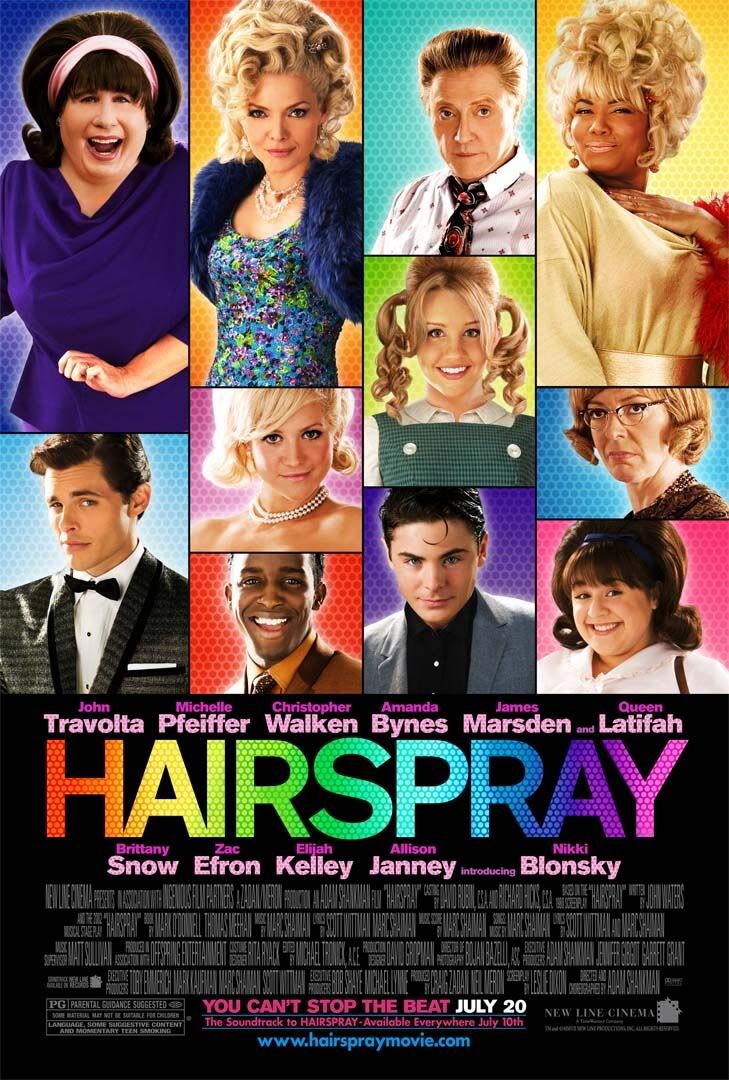
Considering "Hairspray"

What's the point of reviewing a movie that has been out for over a month? That's a good question. A better one is "Why review art at all?" but that is a subject for a later post. For now, be content that I promised my mother, who has commented upon the film to me multiple times, to review it, and I desire to make reviews of the art I experience a regular part of this blog.

Reducing experiences to a simple metaphor is not something I think particularly highly of, as doing so tends to obscure the nuances and wrinkles, but unfortunately, Hairspray deserves it. Hairspray was Mountain Dew. Actually, considering its length, it was more like a 12-pack. (Do these even exist anymore or are we now doomed to burial by 24- and 36-packs from now on?) This movie was a rush of sweet. The colors are bright, the jokes are frequent and less subtle than a slasher movie, and the only thing you can ultimately fault the characters for are being too nice and cheerful. Of course absolutely everything works out in the end, the good guys get what's coming to them and so do the villains.

Which makes the decision to build the plot around black-and-white integration on a afternoon television show an interesting one. Doing so is safe as it ranks near abolition and the right to vote on hot-button racial issues today, but that just makes the two overweight lead female characters such a tease when nothing is really said about that. American obesity is a much more popular issue these days than integration, but it's only played for laughs in Hairspray through Travolta's weakness to it. Effectively, the movie's silence on the issue endorses acceptance but says nothing definite, which is disappointing but not terribly unexpected in something playing for such a large audience.

As this is a musical, Hairspray lives and dies on its song and dance numbers, and one bubblegum song blows full force into the next and the next after that. There was no time to recover in between them. Moulin Rouge!, which ranks very highly on my list of all-time favorite movies, can be fairly accused of the same thing, for the first half hour or so, but it at least has the intelligence to break the songs up a little, distinguish them. Hairspray fails in this department. Barring Walken and Travolta's duet and the protest song, the others just kind of merge into a single mound of gummi bears and are difficult to remember individually now. Even that might not have been such a sin, if it had not been so long. There's a song for everything: Tracy's ride to school, her first advertising spot, her daydreaming of her crush, her escape from the police and that's only one character in this ensemble film. By the end, it begins to feel like they're trying to justify the presence of all the A-list stars in this by giving them their due screen time.

Speaking of such, the acting in this movie was a treat. Everyone, known and unknown, seems to truly enjoy being in this film and it comes out in the zest in their acting. The only reason no single character doesn't overpower the others is because all the rest are pushing back and playing it up just as hard. Travolta as Tracy's shut-in mother deserves special mention for giving it his all in what must have been absolutely miserable pieces of make-up and costuming to act in.

On the topic of musicals, I've heard that both Moulin Rouge! and Chicago were both supposed to revive the genre. Does this make Hairspray another aborted start or part of the revival these earlier Oscar nominees preciptated? As I'm on the topic, if this the beginning of a revival, I am interested to see if they go in the direction of this remake of a Broadway remake in brashness or that of the more realistic Once, which I still bleeding want to see.

Monday, September 17

Opa waiting for Lake of the Woods graduation 2007


After an extended break, I present to you this picture. Similar to the previously posted picture of Oma, which was taken at the same event as this, I like this one despite some major flaws, both in the shot itself in the printing. Opa's body is lost behind the blur that is my father's intercepting body, and the program he is reading, a major element as all of his attention and eyes are directed towards it, is washed out, something a little burning could have helped with. When I first showed this print to my instructor, he suggested that as the only reason for trying a second print. Seeing some of the other students struggle with their own dodging and burning at this point and a desire to print still more pictures kept me off, but I kind of regret that now. At least it's something I can always come back to.

I did, however, say I liked this picture. Ultimately it's not terribly complex, a man waiting for an event to happen, burning time with a rather disinterested look at the order of events. Barring the shoulder blur, there is only a foreground and two elements. Still, I think the relationship between the two is strong and keeps the picture interesting. And it's in focus. I'm still enough of an amateur to be amazed by that.

In closing, I would like to apologize for my tardiness in posting. I offer the not as excuses but as explanations. Last two weeks of summer were busy ones, replete with writing four articles for the university's newspaper, preparing for a semester in Germany, seeing friends and spending time with them before leaving for Germany, and traveling to Germany. Since my arrival, I've been on vacation with my grandparents, and Internet access has only just become regular. It is my hope that this transplant proves to be a strong ferment for future posts.

Friday, August 17

Oma waiting for Lake of the Woods graduation 2007


Apparently public critiques of my own pictures are popular. Through a variety of sources, I received four comments on the last one. Farther and further then.

Second picture I ever developed. It's of my grandmother while we were waiting for my sister's graduation. I was fiddling with exposure and leaned back to take a few shots of the family I was sitting with. Took one of my grandfather that turned out well enough for me to print, and that will also make it's eventual way up here. I chose this one to fulfill the "Depth of field" assignment for my photography class. Ended up using another one because, in the simplest possible terms, this one is pretty weak. It's a bit too out-of-focus to possibly called "soft," and the blur, my dad's back, in the bottom-left quadrant is too large.

Really, there are only two things to recommend this picture. First, Oma does present a strong central element. The row of arched backs and the contrast of her dark shirt draw the eyes to her. Second, it's a good smile. It's honest and bright. Even better, my dad says that her smiles aren't too often captured on camera.