Saturday, February 21

Considering "Revanche"

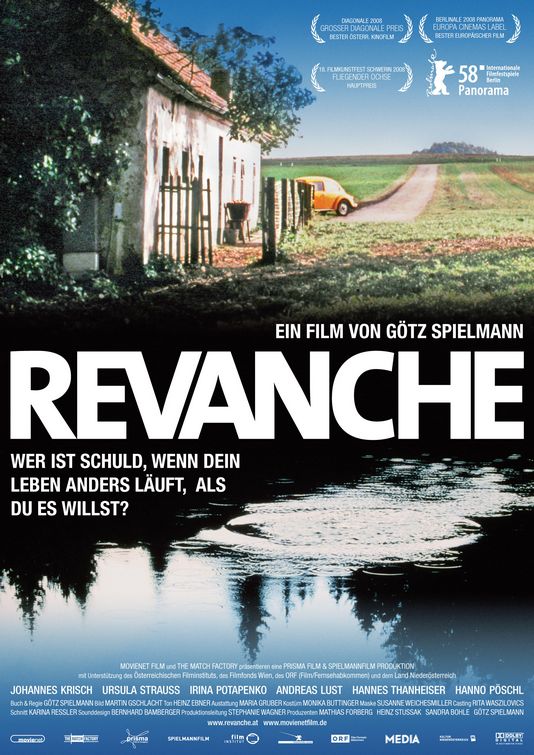
I readily admit that the first thing about Revanche which captured my attention was its Austrian origin. Not that I have any particular love for the nation, having only visited Salzburg, but because that means the language will be German. Since I began taking German language classes four years ago and spent five months studying in Munich, that alone has been enough to peak my interest in a movie.

The fact that this movie received a nomination for Best Foreign Language Film and is, quite honestly, a mind-blowing movie is only the kicker.

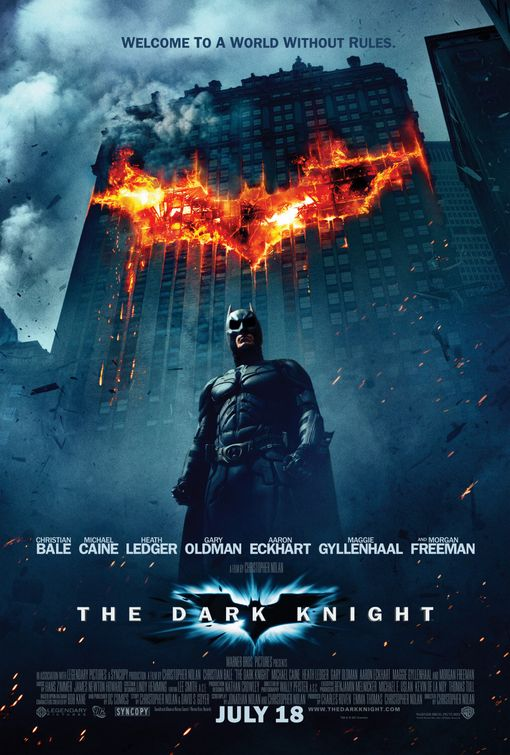
The plot, ultimately, is quite simple, and ancient. It's the same principle that finally motivates Achilles to end his hissy fit and get back onto the battlefield. It's a story of revenge. Man's girlfriend is shot. Man wants to make the one who did it feel the pain he feels. Wants to kill the one who did it. But it's really not that simple. Revenge and the vigilantism which so often springs from it are clichés of American entertainment, popular clichés if the resounding success of The Dark Knight this past year is any indication. In these popular cases the sides and intentions are clear. The victim is wholly innocent, entirely blameless. The killers are vile murderers, most likely drug dealers or rapists or spoiled rich kids of some sort. The avenger has never acted in hatred before but are forced into it by a legal system which cannot give them the justice they seek. But what happens when the killing takes place in the course of a bank robbery? When happens when the killer is a good cop who is crippled by remorse? When the shooting is an accident? When the avenger already has a violent streak? Revenge is not that simple. Perhaps more difficult than it, though, is forgiveness. How does Alex move beyond his girlfriend's death? How does Robert move beyond his first kill, a terrible accident? A crucifix appears in nearly every scene of Revanche, and all of the characters are searching for redemption in some way.

The director, Götz Spielmann, aims for naturalism. There is no background score. All music which appears in this film is courtesy of Hausner, the grandfather of the main character, as he plays his accordion. There are no musical cues to indicate how a scene might turn or what our feelings should be. There are no desperately rising strings when Alex pulls a gun on Robert as he runs by. When Alex has violent sex with Susanne, Robert's wife, there is only silence beside their sharp breathing. The lack of a score emphasizes, too, the difference between the ambient noises of red-light Vienna and the forest surounding Hausner's home.

Without a score the full emotional weight of a scene must be carried by the actors, so it's fortunate that the performances across the board are outstanding. The greatest, though, may also be the most understated. There was no acting apparent in Johannes Thanheiser's performance as Hausner he inhabitated the role so completely.

In any case, though Revanche is very deserving of the Oscar, my vote goes out to Der Baader Meinhof Komplex. The AMC Theater in Spokane has done a decent job of brining in the winner of this category of the past two years, and I would very much enjoy the chance to see another German film this year. I suppose Vals Im Bashir is the front runner since its victory at the Golden Globes, but I'm assuming Israel's invasion of the Gaza Strip earlier this year will put the Academy members off a little bit.

Update: At the Spokane International Film Festival, Revanche tied with Let the Right One In for Best Feature Film.

Thursday, February 12

Another one for the senior bucket list

Though this opinion I submitted to The Gonzaga Bulletin last week is rather specifically bounded to the past four years at this particular Jesuit university, I feel the message is a solid one and applicable to all those who ever plan on graduating from higher education. American colleges suffer from a four-year memory and so much is lost among students every time another class graduates. Seniors should make a deliberate effort to share their experiences and memories. Ironically, it's not something I'm likely to put into practice as I hate meeting new people so much.

Funnily enough, I've received more personal responses to this piece than any I've written before, news or opinion.

Saturday, February 7

Considering "Låt den rätte komma in"

The Spokane International Film Festival is celebrating its 11th year this month. I am celebrating my first year of attendance, which really is a pity. I like to consider myself something of movie connoisseur who has some standards for his celluloid-based entertainment and who also likes to see what stories people outside of Hollywood are telling on the big screen. Forgoing an event like this, one which promises films from across continents and pieces which would never otherwise play on a screen in Spokane, is really quite unforgivable. As penance and as celebration of this opportunity finally seized, I offer this blog up to my thoughts on all those feature-length films I manage to fit in over this wonderful, wonderful week.

Seeing as how this was not only my first Spokane festival but first film festival ever, I could hardly have hoped for a better film to break into it all than the Swedish Let the Right One In. For months, it had been steadily gathering exceedingly positive reviews and excellent press coverage in the States. It currently stands at 82% on Metacritic and a freaking 97% on Rotten Tomatoes. When I first checked the screening schedule, it was the first to catch my eye, and the only one I was absolutely determined to see.

All of which made finally seeing it something of a let down. Good thing Australia and The Curious Case of Benjamin Button had already gone a long way toward inuring me against this possibility earlier in the winter.

Twelve-year-old Oskar, even paler and blonder than the young Macauly Caulkin, is tormented by bullies. He wants to be strong. He wants to cut them and make them squeal like pigs. Instead he meets Eli, the odd dark-haired girl who doesn't wear shoes in the snow because she's forgotten how to feel cold. If you managed to miss it before coming to the theater, Eli's a vampire. She announces her more feral nature to the audience by latching on to the neck of some unfortunate, lonely souse early on. It's a nice switch up, with such an emphasis on predators and prey throughout the film, to see the little girl, typically the weakest and most vulnerable of the characters, become the most powerful and terrifying. Anyway, despite Eli's warnings against such a relationship, they become friends. They give one another advice. They help one another grow. They make mistakes. They do stupid things for the sake of the other. Then they go and do something brave. They even use Morse code to communicate between their apartments. All of this is great. These are the fundamentals of any great love story. The problem is the emotional connection necessary to make it fantastic never appeared for me. To be sure, the Rubik's Cube scene and Oskar's first hug with Eli have more tenderness and sweetness in them then anything that goes on between Brad Pitt and Cate Blanchett for the first two hours of Curious Case, but then Tomas Alfredson has to go and weird it all up by having Eli dive into Oskar's dripping blood and scream at him to get out, presumably before she goes after the fresher stuff.

So we come to the crux of the situation. Right One is a vampire movie. Right One also is a coming-of-age and love story. It takes both of all of these premises seriously, but that doesn't work. If vampires are at all played as something less than cool, calm, collected versions of evil incarnate, they lose their menace to the point of becoming ridiculous. Requiring an invitation to enter any building is kind of a glaring weakness. Just consider any book in the Twilight series. Totally lame vampires. When Eli unwillingly shoves her face into the pool of Oskar's blood, it has about the same level of terror as when the afflicted in The Shaggy Dog runs after cats while still human.

Make no mistake, I found Right One to be an absolutely beautiful movie. The Stockholm suburbs in the 1980's may be a joyless place in the dead of winter, but the director captured something beautiful in that stark, desolate environment. I could have watched that drifting snow for hours. It's just too bad that couldn't be translated into any sort of enduring emotional connection for me. I really wanted to love this movie.

Update: At the Spokane International Film Festival, Let the Right One In tied Revanche with for Best Feature Film.

Friday, February 6

Learning Argentine Tango: Another perspective

This video is part of an irregular series for The Spokesman-Review detailing community love stories. The couple dances at the same venues as I do, so I've seen them a few times. This is the first time I ever heard of their meeting, though. I like their descriptions of Tango at the end. They closely mirror my own thoughts on the dance and those of other people I've spoken with.

From a journalism standpoint, I honestly enjoyed the presentation of this piece, still photos matched with dialogue from interviews and minimal narration. It's a limited style and probably of not much use to any harder news, but for telling this love story, it is very nice, simply allowing the subjects' voices to weave the story and mood.

Tuesday, February 3

Marienplatz at noon

This is my first photo post since the beginning of the semester and since I enrolled in Philosophy of Art and History of Photography. Ostensibly, both these classes aim to improve my critical skills. Let's see how well those are working out.

We begin by observing, noting what is in the image. We see a crowd of tourists, digital cameras all aimed at the same spot. Some are smiling. Some are a little more intense, perhaps waiting for the exact right moment to preserve and share with their friends. Only one woman, the blonde with a white scarf in the midground, seems aware that the crowd has itself become the subject of a photo. The title reveals the location and time of the shot. By itself, this is of little help, but seeing as how I spent several months studying in Munich last year, I know that this is where and when one can observe the renowned Rathaus-Glockenspiel play and dance.

Considering all this, I believe the photographer is attempting to make a statement on the banality of photos taken while on tour. Everyone takes a picture of the same thing even when a static image on the thing lacks any interest whatsoever. The puppets on the Glockenspiel move on fixed tracks and, if they're feeling frisky, rotate. The pictures being taken in this photo even lack the personal touch one creates when they put a friend or family member into the frame alongside the primary subject. It is as though these people want to fill their digital albums with pictures they'll immediately skip over. If they appreciate the Glockenspiel that much, there are postcards readily available with images far superior to anything they could manage. It is not a bad message, but the photographer's technical incompetence distracts from it. Really, what amateur puts a street sign directly behind the head of a person?

Sunday, February 1

Public intellectuals

A November article in The Chronicle of Higher Education disputes the apparently popular claim that the public intellectual is dying out. For the curious, blogs are the alleged coup de grâce. Daniel Drezner challenges this idea and argues that blogs provide an alternative communications outlet, more accessible to those outside the ivory tower, and have thus increased the level of the conversation.

I can buy that. At their most fundamental, blogs are a communication medium and have their own unique set of attendant advantages and disadvantages. In this way, they are no different than television or magazines or any other mediums going all the way back to papyrus scrolls and stories around the fire.

The more interesting questions to me, however, are avoided by Drezner. What does it mean to be a public intellectual? What does the public intellectual do? Drezner takes the answers to these questions for granted. He makes several lists which enumerate over 30 "public intellectuals," and offers only the scantest of possible definitions. "[Those who] write serious-but-accessible essays on ideas, culture, and society." In all fairness to the following, the only two people whom Drezner lists and whom I am reasonably familiar with are Christopher Hitchens and Malcom Gladwell, and my thoughts on these two have been repeated plenty often.

Anyway, Drezner's definition. It's a good start but should only be taken as the bare minimum. I think we need to pay more attention here to the form and transmission of thoughts, ironic since Drezner spends this article defending the blog as a medium. It bothers me that Drezner makes a particular effort to include journalists and editors among his public intellectuals. It's another irony since my own major is journalism, and were I to one day be considered an intellectual, that would be a good day. However, I like to think this also makes clear to me more of our profession's collective weaknesses. We're not bad at writing, especially for mass audiences, but we tend to treat issues and ideas as finished products. We have to deliver something, and ambiguity does not fit nicely into a box. We often give some space to quotes by opponents of the idea, but that is all. We hardly ever go behind this, describe the competing arguments. Ultimately, the ideas and issues we write about end up positions to take based on anecdotes and soundbites rather than critical thought.

More important than "serious-but-accessible essays on ideas, culture, and society," public intellectuals should be framing the important debates of the day in such a way that the arguments come to the fore. They should not be giving Americans ideas but asking them to consider the ideas. We shouldn't be looking toward the quirkiness of the ideas, those most out-of-the-box, but the reasons which support them. The public intellectuals should be writing for and speaking to each other, not the masses, but making these debates open to the public. Yet another irony, I think televised debates may be the best medium for this, stained as they may be by cable news show shouting matches. In speech, jargon tends to fade. For all the thought in it, the Chomsky/Foucault debate is very accessible and demonstrates the possibilities for civil discourse. In the meantime, writing, though it permits deeper arguments, is meant for the crowd and not as often for one another. A final irony, blogs then become the worst form of public intellectualism. The opportunity for them to become insular "echo chambers," linking only to and read only by those who share their thoughts is incredible. Drezner's public intellectual may not be dead, but they could be so much more.

Thursday, January 15

Considering "Outliers: The Story of Success"

Freaking Malcolm Gladwell.

I first heard of him this past November, and the more I learned of the man and his ideas, the more I begrudged him. It began with this profile I found on Arts & Letters Daily. Despite the enormous success of his first two books, The Tipping Point and Blink, it was the first time he came to my attention. I didn't think think much of Gladwell one way or another at the time. Still, Arts & Letters kept paying attention to him and his latest book, Outliers, an exploration into the reasons of success. My ire just rose in response as I discovered the lunacy of his ideas and the accolades he attracted. Within weeks I was griping about him more than neo-atheism.

Which makes it all the funnier my parents gave me Outliers for Christmas. My dad heard an interview with him on CBC Radio One. He thought Gladwell sounded interesting.

Thus a fascinating opportunity came unto me. Until that point, all of my rancor was drawn from bitter reviews. Here was a chance to go right to the source, to test my appropriated criticisms. Put in the simplest term, they passed the test.

Gladwell wants to know why people are successful, be they as diverse as The Beatles, Bill Gates, Jewish lawyers and professional hockey players. His conclusion? They attain the highest echelons of success due to circumstances beyond their control, not some natural gift or extra effort on their part.

"Superstar lawyers and math whizzes and software entrepreneurs appear at first blush to lie outside ordinary experience. But they don't. They are products of history and community, of opportunity and legacy. Their success is not exceptional or mysterious. It is grounded in a web of advantages and inheritances, some deserved, some not, some earned, some just plain lucky - but all critical to making them who they are. The outlier, in the end, is not an outlier at all."

Children born into a culture which worked rice paddies have a cultural advantage which values hard work. Being born in the right year could make or break someone trying to enter the ground floor of the personal computer industry. Being born at the beginning of the year confers an incredible advantage to Canadian hockey players.

I agree with this basic thesis. A person is constrained by their circumstances. One will never be first-chair with the Chicago Philharmonic if no one ever gives them a violin. A well-off family can offer their children more options than a poor one. It is a simplistic idea to the point of being blindingly obvious, but I cannot fault it.

Understandably, Gladwell is not content with the mere idea. He wants to push farther and actually apply it. First of all, he wants the successful to admit their dependence upon circumstance and fortune, family and culture. He appreciates Bill Gates for admitting this and reviles Jeb Bush for running as governor of Florida as a "self-made man." I can appreciate this, as well. Were this realization to become more common, it could lead to a more compassionate society, there but for the grace of God go I and all that.

However, Gladwell wants to do even more than that. He wants "[t]o build a better world ... to replace the patchwork of lucky breaks and arbitrary advantages that determine success ... with a society that provides opportunities for all." He suggests doubling the number of hockey leagues in Canada, one for those kids born between January and June and one for those born between July and December. This way the age and size difference is shrunk and makes the leagues more competitive. He promotes year-round public schooling, so the poor do not fall behind in learning during the three-month summer break.

Whether one believes these changes would actual level would actually provide opportunities for all, this is about as much as Gladwell can suggest. The remainder of his examples of success are understood entirely ex post facto. One could never adjust society to account for them. Consider this. Gladwell asserts Gates never would have topped the software industry if he had not attended a private school with a computer system most universities of the time lacked. In effect, he succeeded because his family was rich. In this article, Gladwell says Sidney Weinberg became a marvelously successful broker because he was poor. We simply do not know what circumstances will make one successful. For another example, Carnegie and Rockefeller, Gates and Jobs could never have achieved the success they did without being born in a very small span of years which positioned them to best take advantage of new technologies. No amount of societal tinkering will ever account for that.

The second great problem Gladwell faces is his analogical reasoning. The man is incapable of making a point without telling a story. I have no problem with this, in fact it makes for engaging journalism, Gladwell's trade, and some compelling reading. Unfortunately, more often than not, that is the entirety of his reasoning. Some of his conclusions suffer for this. One of Gladwell's foundations for success he calls 'The 10,000 Hour Rule." He claims success is a result of practice and perseverance rather than any innate talent or genius. His primary evidence? The Beatles played 8-hour sets every night for months at a Hamburg club, forcing them to improvise and experiment with new styles. I can buy that instance. However, Gladwell also points out this club was open 24 hours a day, and I am sure more than a few bands were played under the same circumstances. Why have none of their songs become the basis for a movie musical? He has nothing more than a few anecdotes to support his preposterous rule.

By the end of Outliers, Gladwell is little more than an engaging writer. His most ambitious ideas are ill founded, but he makes them comprehensible and interesting. For me, Gladwell ranks alongside the late Michael Crichton: a good read whose most defensible ideas are never more exciting or original than "beware hubris in science."

If this review has failed to convince you his book is not worth the time, do yourself a favor and skip the first chapter. In it Gladwell tells a rambling story of the scientists who determined that the exceedingly good health of Italian immigrants in the Maine town of Roseto was not caused by diet, exercise, genetics or any of the usual suspects but community. Why tell this story? Because he wants to be as important as those researchers. Nothing to do with success whatsoever. I'm surprised they didn't need a smaller font and larger margins to fit his ego onto the page.

If you want to give the man a own chance without first buying one of his books, here is his website. It contains excerpts from all of his publications, a complete archive of his articles for The New Yorker and his blog. If you want to read some real venom pointed his way, check out this review.

Edit (January 29, 2009)

Isaac Chotiner of The New Repbulic agrees with me, too.

Saturday, January 3

Vegetarianism

I have been a vegetarian for nearly two years now. More precisely, lacto-ovo vegetarian because I like few things more than a quality cheese shop, a breakfast of granola and jelly mixed into plain yogurt and omelets filled with fried onions and celery. For the most part, I have enjoyed being a vegetarian immensely. It has broken old eating habits and meal standards, clearing the way for new ingredients, new recipes and new tastes. I have made extensive use of New Recipes from Moosewood Restaurant, a cookbook I would have otherwise never considered. I made my first risotto and couscous dishes. Beans are now a regular part of my diet, and I am still just beginning to explore the possibilities in them. Cutting out the meat has cut my grocery bills as well. The only real difficulties have been in the limited vegetarian options at some restaurants (I'm looking at you Outback Steakhouse), and the decision to go vegetarian just months before my semester abroad in Munich and missing out on all of Germany's wonderful meats. Bratwurst, weisswurst, kebab ... it doesn't feel like any less of a mistake in hindsight.

Since I began, the question "Why?" has been posed several times. In the beginning the answer was simple. It was my Lenten sacrifice. Before then meat was a very regular part of my diet. Giving it up was a challenge. After Easter and being meat clean for 40 days I went back to eating meat. A week or two later, I returned to vegetarianism. Had I been more honest when people asked me my reasons during Lent, I would have told them it was a test run to see whether I really could go without meat. The truth was I had been contemplating vegetarianism for some time but had never seen any reason to try it out. After the successful Lent, my direction was pretty well set.

It still strikes me as odd when someone asks me why I am a vegetarian. When I was still in high school, I assumed the only reason one would practice vegetarianism was a concern for animal rights, the desire to minimize animal pain, to not turn cows and chickens into means for an end. It turns out there are a lot of reasons people turn to vegetarianism, and Wikipedia has an impressive list of possiblities. Many people practice varying levels of vegetarianism according to their religion. Buddhists and Jains are probably the most prominent, but Eastern Orthodox fasts can be pretty core. Probably a growing number practice for environmental reasons since producing meat requires so much energy and cows produce so much methane. Some simply cannot afford meat. Some dislike the taste. Some avoid meat for health reasons.

I, however, choose vegetarianism as a form of solidarity. Put in the simplest terms, American levels of meat consumption are not possible on a global scale. In 2000, the average American ate just under four pounds of meat every week. Though I have a lot of faith in science to do amazing things, there is no way the Earth could ever sustain enough cows, pigs and chickens for everyone to eat so much. As China and India and their billions become more affluent and hungry for animal bits, this will become more apparent. I like to say that I will return to a meat diet when it is possible for all the world to eat as much as me. I expect this to be far less than is currently available to the average American.

The interesting thing is, this particular justification for vegetarianism does not preclude all meat consumption. The more reasonable conclusion from this thought process would be flexitarianism, eating a minimal amount of meat. Still, I practice full-blown vegetarianism out of a sense of fairness. It seems wrong to me to enjoy animal flesh while millions of others are happy to get their daily bowl of rice. I know the world is not fair, I know there a lot of other things I could give up which others lack and I know self-denial does nothing for others, but in this instance, I will do what I can to make the world a wee bit more fair.

Still, there are occasions in which I will eat meat, mostly when guest etiquette demands it. If someone prepares a meal without knowing I am a vegetarian or if it is that important to my host, I think it is appropriate to try a little bit of meat. I am still trying to find the perfect balance of these values, but I believe it is the right way to go. A more clear example appeared when I spent a month at the orphanage and education center in Jakarta. I had no problem then with sharing their meals of fish. I figured they were the sort of people with whom I was seeking solidarity. If they could enjoy a little flesh, I could too.

For the curious, I miss hamburgers and pork tenderloin the most. And Oma's rouladen.

Sunday, December 28

Istanbul lamp shop

It occurs to me that I only rarely, if ever, do not express great fondness for those photographs I post here. In that respect, this photo is no different, however, this time I have objective proof the shot is a good one. After it was published in Gonzaga's literary journal, Reflection, (which, unfortunately, has not yet been made available online), a fellow student with whom I had never before spoke sent me a Facebook message expressing their compliments. Their exact words were "love, love, love." Sounds like pretty definitive evidence of excellence to me.

But what makes this shot so spectacular? For me, it is the powerful sense that this was a moment which will never again occur. For only a fraction of second, the man stood like this, looking back. Then it was he gone. He left in the other direction. In that moment, though, there is energy. The opposition of his eyes and feet begs for release. Behind him stands an explosion of background. The sheer insanity of that clustered mass of hanging lamps in all their shapes, all their textures, all their designs, all their variety is so different from the clean and ordered aesthetics of a Wal-Mart or Pier 1 Imports. I will say this for Istanbul shops: they do one product and they do them well.

Of course, all this self-praise is not to say this photo does not bother me in some ways. Mostly, it's the composition. It's terrible, really. The man's eyes are near the center of the image, a dead-zone for energy and no-no taught at the beginning of every photography course. His entire body is just off from the center, unbalancing the entire visual weight in a bad weigh. The cropping the bodies on both sides feels sloppy. The whole image seems tilted, but that may just be the scan job.

Still, I like it. Probably one of my better ones. Which just goes to show how much farther I have to go.

Considering "The Gulag Archipelago"

I have never been much of one for Holocaust literature. Somehow I left high school without ever reading The Diary of Anne Frank, and I have never bothered to pick up Eli Wiesel's Night. I don't know why. I guess I have always figured that it is enough to understand that systematically murdering entire populations is bat insane and evil. The rest is merely details. Still, it is odd that my first taste of holocaust literature was Alexander Solzhenitsyn's The Gulag Archipelago, possibly the most unreadable of the bunch. A friend's father suggested to me when I was still in high school and an active proponent of communism. I found my copy during a moving sale at a used bookstore two summers back. Solzhenitsyn's death this August and the accompanying accolades were the final push I needed to start it.

Solzhenitsyn's "experiment in literary investigation" yields three volumes (the first of which, and only one I read, running over 600 pages) of anecdotes and stories from him and hundreds of other prisoners and accounts from Soviet officials, on every aspect of the purges. Make no mistake. It may not have the capital 'H,' but this is holocaust literature, an account both personal and historical of the purges in the Soviet Union which left millions dead and sent millions more into prison and work camps for years. Entire chapters are devoted to methods of torture, means of transportation to the many prisons, the public sham trials and the inane laws under which the people were prosecuted. If mass deaths are not enough to convince you that these were messed up times, consider the following:
  • After a party meeting, the members broke out into applause for Stalin, but no one was willing to stop clapping first because that would demonstrate disrespect for the Dear Father, a sign of possible revolutionary tendencies. Eleven minutes later some guy finally quit and sat back down, and everyone was relieved to follow suit because that was a lot of clapping. That night the NKVD arrested him.
  • Section 6 of Article 58 permitted the arrest of those engaged in espionage. This did not have to be proven. Suspicion of such activities was enough an arrest. Furthermore, one could be arrested for having simply having contact with one of these people.
  • In 1922 V.V. Oldenborger, chief engineer of Moscow's water supply for 30 years, was prosecuted for wrecking the system. His manager hadn't allowed him to replace the wooden water holding tanks with concrete ones. Oldenborger committed suicide before the trial began, but the prosecution took place nonetheless.
  • To meet a prisoner quota of 200, an officer in Tashkent arrested all gypsy men who had arrived in the city earlier that day.
Every once and a while though, Solzhenitsyn takes a break from these encyclopediac accounts of evil and offers instead some insight into what made the purges all the worse and what made them tolerable. To do evil one needs justification, Solzhenitsyn wrote. "Ideology - that is what gives evildoing its long-sought justification and gives the evildoer the necessary steadfastness and determination. That is the social theory which helps to make his acts seem good instead of bad in his own and others' eyes, so that he won't hear reproaches and curses but will receive praise and honors."

Of the daily, 20-minute walks permitted to political prisoners, Solzhenitsyn wrote, "Spring promises everyone happiness - and tenfold to the prisoner. Oh, April sky! It didn't matter that I was in prison. Evidently, they were not going to shoot me. And in the end I would become wiser here. I would come to understand many things here, Heaven! I would correct my mistkes yet, O Heaven, not for them but for you, Heaven!"

Solzhenitsyn went through a lot to write this, to make sure these stories and memories gained a world-wide audience. In the mid-60's, the outspoken writer of One Day in the Life of Ivan Denisovich became very interesting to the KGB, and he was forced to literally write Archipelago in parts. He would hide chapters in the homes of friends and could only work on them while visiting. When one of Solzhenitsyn's friends was terrorized into revealing the location of the manuscript in the Soviet Union (a microfilm copy had been delivered to the West years earlier), he had no choice but to publish. The friend hanged herself the next day. Solzhenitsyn himself was eventually exiled for his works.

In a letter sent to the Swedish Academy following their announcement of the winner of the Nobel Prize for Literature Solzhenitsyn permitted his readers to some insight into what would lead a man to run such risks. Literature is the living memory of the nation, he wrote. It transcends borders and teaches the inexperienced the mistakes of those who have gone before. Literature stands against and makes clear the lies which make violence possible. Once literature and art destroy the falsehoods, violence will not be far behind.

It is a nice ideal, beautiful really. Whether it is true is another matter. Ivan Denisovich was published with Khruschev's approval and despite resounding success and popularity did nothing to alleviate authoritarian practices in the Soviet Union. By the time Archipelago was released, the Gulag had been dismantled as part of destalinisation. It is not just Solzhenitsyn and the Soviet Union either. Even the impact of George Orwell, the oft-quoted Brit who after 1936 wrote only against totalitarianism and for democratic socialism, is questionable. Surveillance by both the government and private groups only increases, and Big Brother is more popular as a reality show than real political concern. Still, given the choice, I think I would prefer to follow Solzhenitsyn rather than one of the other celebrated writers who died this year, David Foster Wallace. "One word of truth shall outweigh the whole world" well before "The next real literary 'rebels' in this country might well emerge as some weird bunch of anti-rebels, born oglers who dare somehow to back away from ironic watching, who have the childish gall actually to endorse and instantiate single-entendre principles."

If nothing else, Archipelago does put things into perspective while one is riding America's own train system. A train which arrives three hours late and loses another three en route does not seem nearly so bad when one reads about train booths built for four and stuffed with over 20 for multi-day journeys. The prisoners managed it by sliding a few of them on to the shelves meant for luggage. Those were the most desirable spots because on them one could actually sit.

Tuesday, December 23

Learning Argentine Tango: Astor Piazzolla's "Tango: Zero Hour"

Astor Piazzolla considered Tango: Zero Hour his finest work, according to AllMusic.com. The editor calls it the culmination of Piazzolla's career. Piazzolla transformed tango, pushed to it to its limits, introduced elements of jazz and classical. Listen to some of tango's early 20th-century staples like "La Cumparsita" and "Seguime, si podes," and then spend a few seconds with his most popular song "Libertango." That is what Piazzolla did to tango. An analysis and proper contextualization of this album is much better suited to a grad student at the very least, but please bear with me as I attempt to explain what Piazzolla's music means to this one.

This album struck me personally. It made me privy to someone else's feelings, normally hidden, and in them I found something not entirely unlike my own. There is no grand sweep of a Romantic orchestra, no dare to marvel in sublime nature. There are no Wagnerian gods and heroes. There is merely Piazzolla's Quinteto Tango Nuevo playing the sorrow and excitement of an unknown man, one unsure of the time, unsure of where he is in the city's back alleys where the fog obscures the coming corner. The longing spoken of by the violin and bandoneón is piercing in "Milonga del Angel," but it lacks the youthful exuberance behind that of a Romeo and Juilet. There is more than a hint of resignation behind it, too. The man took his shot at making the dream real and failed. The chance will never come again. Be it in love or some other aspiration, the feeling is not so far from what we have known.

Perhaps the strongest of the emotions present in Tango: Zero Hour, longing is hardly the only one. The excitement and anticipation, you can feel the man almost tripping over his own feet in his haste, in "Milonga Loca" counter the loss, offer hope. Some small contentment is found in "Contrabajissimo" after surviving another round of challenges and threats. It comes to a close with "Mumuki. The sadness for lost times and opportunities remains, but there is a growing strength there now, an acceptance that this feeling exists and will come again but that it will not dominate. The dreamlike sense which had permeated the songs before is lifting and the man must awaken, return to life.

My experiences with tango and even music is not enough to declare Tango: Zero Hour a masterpiece, but I will offer this: it is a beautiful work. Should you decide to put your good money toward the album's purchase or borrow it from a friend, do it the favor of not putting it on as background noise but give it your full attention. It deserves it.

Saturday, November 1

Knightly Families

The following is a piece I wrote for my Literary Journalism class. I eventually plan on looking around to see if anyone wants to publish it, but until that time, I hope you enjoy "Knightly Families."

Every Saturday the Bowl of Manito Park becomes a battlefield. Students and professionals, men and women, members all of the Grand Duchy of StormHaven, come together for an afternoon of Amtgard.

Bearing weapons, wearing garb they crafted themselves, the warriors challenge one another during sparring matches. A single hit to the torso, and they are dead. One strike to a limb renders it unusable. Those hit in the leg drop to the ground. A struck arm is held behind the back. Second hit to a limb and they are dead until the next round. Attacks to the head count for nothing because they are too dangerous.

At the end of one match, a boy breaks away and walks to a man and a woman watching from lawn chairs in the shade. Except for a lion in profile on the center of the man's tunic, his and the boy's are the same: four alternating, square patches of purple and yellow meeting at the center.

“Do you have any wizard sheets?” the boy asks. “My last one got soaked.”

The man rummages through a plastic file carrier and pulls a paper from the file marked 'WIZARD.' The boy sits down and begins to fill out lines and write in numbers. After a while he pauses.

“What else should I take?” he asks. “I've maxed Iceball.”

“Just take Magical Bolt,” the woman says as she leans closer.

“Which weapons are you using?” the man asks, taking a look at what the boy already wrote down. The boy's parents continue to ask him questions and offer suggestions as his character begins to take shape.

To the few who pass by the Bowl on their way back from the gardens for which the park is best known, Amtgard is about the fighting, swinging and dodging homemade swords, and pointing and chanting “Charm, charm, charm” to force a player off the field. What the players stay for, however, is a community, one which can be as tightly bound as that of blood. The heart of Amtgard is found on the periphery of the battlefield where the family comes together.

Amtgard began in Texas in 1983 as a recreational and educational opportunity to engage the premodern world. Players are encouraged to perform period research as they build their era-appropriate garb and weapons. The rules of combat allow players to adopt personas with special abilities like Archers and Paladins and magic users like Druids and Bards.

Gonzaga students started StormHaven, the Spokane chapter of Amtgard, in 1995, and many members came to it through an interest in medieval times and fighting styles. Jeff McKinsey is a former member of the Society for Creative Anachronism. He was interested in the fighting system employed by Amtgard, more realistic than the linearity of sport fencing. What he become a part of, however, was not a mere combat group but a community, a family. When his yard needed landscaping several years ago, McKinsey put on a barbecue. Over 40 fellow players descended upon his home, and within a weekend, the landscaping was begun and finished.

The sparring is over now, and a game is about to begin. Leah and Dan French watch their son grab a sword, the shaft of a golf club covered in foam and cloth, and join in. Mrs. French's wrist shattered in an accident last New Year's Eve, and the 17 metal plates in her wrist prevent her from fighting. Though she and her husband wait now on the sidelines, they are pillars of the community. They have both served multiple terms as Grand Duke and Prime Minister of StormHaven, and outside of the Saturday battles, they spend countless hours arranging meetings and coordinating events ranging from feasts to the multi-day Thousand Stars.

For their great service to the community, both were permitted to join the Order of Flame Knights and granted the ability to confer the titles. Perhaps more importantly though, the title of knight confers upon them the responsibility of leading a knightly family one whose duties and relationships extend well beyond Amtgard. Though they may have reached the highest title within Amtgard, it is their duty to mentor the newest members, to teach them to better their standing in Amtgard and the greater world. Once a month, Mr. and Mrs. French and all their pages, men-at-arms and squires, the members of their knightly family, come together for breakfast and discuss their lives.

If someone is having a problem, they help one another to solve it. Logan Wherli, now on the field, lives with the Frenches during the week to attend school, and Mr. French recalls another player who needed help. After his mother died, he dropped out of high school, began to get into gangs. Mr. French wanted to see something positive come from the boy's life. Through Mr. French's influence, the boy re-enrolled in school and graduated and now has a wife and child.

A young blonde woman in a maroon tunic, Sami Kampster, stands in the field and explains the rules of the game.

There will be two teams, she says, an offense and a defense. The objective of the offense is to flip over five shields scattered across the field in under 15 minutes. Before a shield can be flipped, a team member must keep both hands on it and count 15 seconds aloud without being struck. During this time, they depend completely upon their teammates to defend them.

As a game, players are allowed to play with special abilities and weapons besides short swords. McKinsley, takes a red sash to identify himself as a Healer, able to cast curative spells. Adam Smith, clothed entirely in black and wielding two short swords, is an Assassin and can set traps.

After the captains choose their teams, they form at opposite ends of the field. At Kampster's sign, the game begins. They rush forward. The shield closest to the offense's end is easily taken. They have already counted five seconds before the first defenders arrive, and the offense easily holds them back. Taking the other shields will be more difficult. The offense runs to the next. A team member drops his sword, begins to count. His teammates form a perimeter. It is not enough. Javelins are thrown. Spells are cast from afar. The line is breaking. A defender is killed when he comes to close to a player wounded only in the leg. It is not enough. The counter is struck before he reaches 15 and must walk back to the offensive end before he can return to combat. The offense surges en masse this time. They target the ranged attackers and hold the line. The offense wins another shield.

Kampster stands apart from the action watching for rule violations. She is a reeve, a referee. Mrs. French named Kampster woman-at-arms over three years ago, but she is a member of new knightly family now.

Kampster had a greater interest in fighting than Mrs. French could fill, so the Flame Knight paired her with Eric Devine. For this game he is playing his favorite class, Monk, unable to wear armor or use a shield but able to deflect projectiles with his hands. He earned his knighthood with the Order of the Sword last year by winning 21 consecutive one-on-one tournament matches.

Taking on a squire is a serious commitment for Devine. The knightly family should be as close as blood, and before agreeing to mentor Kampster, he wrote a family creed, describing how to represent it and what appropriate conduct is. Kampster is the first and only member of his knightly family. Outside of the Saturday battles, Devine and Kampster spend time together talking and spar at least once a week at Fighter's Practice. After each round, they discuss what they did wrong, how they could improve their footwork and when to raise or lower their shoulder.

The shield-flipping game is over, and a game of Amtgard-style Capture the Flag begins. Teammates walk in pairs, one with a ranged weapon and another with a sword, for protection from attacks both near and far. This game is slower. The field is larger, offering few melee opportunities, and ranged attacks are difficult against wary opponents. Quickly and quietly they move from cover to cover, hoping to take their opponents unaware.

Sometimes the close relationships make it hard for new players to get involved.

Jeff Hamilton, walking quietly through the trees, alert and armed with a spear longer than him, moved to Spokane a few years ago. He was a member of the Kingdom of the Inland Ocean in Seattle and wanted to get involved with the Spokane chapter but felt uncomfortable, apart at meetings. It took him a long time before he felt as though he were a member of the “in-group.”

Making new members feel welcome, then, has become a priority. Four of the youngest now on the field are playing Amtgard for only the second time. Their tunics and short swords were loaned to them by veteran members, so they can get in the mood, fit in.

The last round of Capture the Flag winds down around 4 o'clock. The group began at noon, and people are beginning to leave in ones and twos. Those who haven't left yet are sitting together, talking. Mr. French and Devine discuss work, and McKinsey suggests they all get together for paintball later in the week. It is another week before many of them will don garb and take up their short swords again, but the community, the family, does not stop.
Monday, October 20

Considering the short stories of Philip K. Dick

Reading the short stories of Philip K. Dick today is a trip and not in the mind-bending, dear-God-you-were-so-out-of-your-mind-on-LSD-when-you-wrote-this sense I expected after reading Do Androids Dream of Electric Sheep? They were a trip in time. The stories featured in The Philip K. Dick Reader are amazing products of the 1950's and Cold War tensions. In those few stories in which the Russians are not an opponent either as the outright antagonist or malevolent background figure, some alien race or model of robot or human mutation now plays much the same role. That's ignoring, too, how many stories feature H-, C-, Q-, U-, the entire alphabet of bombs. As you might guess, imminent apocalypse and extreme levels of paranoia are common themes. Having not lived through the '50's myself, I do not think I could find a better way to understand the mentality then.

Unfortunately, temporal dislocation is about as about the greatest value I found in most of these stories, and that is really too bad since I was looking forward to reading them so much after immensely enjoying Electric Sheep. For the most part, characters are underdeveloped and interchangeable. Not much distinguishes the heroes and their allies from one story to the next, and it is a struggle to remember much about them at the end. Instead the stories depend on plot conceits. A beetle has devoured and replaced a boy's father, and only the child knows. A colony preparing to wage war on the galaxy discovers the ship logs which reveal they are all actually paranoid schizophrenics. A veteran of a war yet to come appears in the past, and the top military officials try to figure out how they can win what he says they will lose. More than a few feel like old hat today, but if Dick is the reason we feel like we've already read them, that's alright. The greater problem, for me, is that they put too much emphasis on some twist in the final paragraph, and the whole piece ends up feeling like a cheat, as though it came right out of an episode of The Twilight Zone.

I think the problem is the medium. Dick simply does not have the opportunity to really develop this paranoia and sense of a world shifting beneath our feet in under 20 pages. He did this brilliantly in the novel Electric Sheep. By the end, you're not sure who is an android and who is not, who can be trusted, who cannot, who is who, what is real, what is illusion, what it means to be human and even whether any of it matters. It was mind blowing. When he tries the same in a small fraction of the original space, the tension disappears.

Still, Dick is able to pull off some amazing work. My absolute favorite of the collection is "Foster, You're Dead." Once again, America is threatened by imminent desctruction, and various security companies are more than willing to exploit their constant terror for maximum profit. They design shelters for installation in the backyard and constantly release improvements, all available for monthly installments, for the trickiest of potential Russian weapons. Dick's decades-old social commentary remains relevant, and he concisely evokes a society utterly overcome by fear through classes where students fashion their own knives in case of nuclear armaggedon and gym periods where children run without taking a breath as practice for an onslaught of chemical weapons. Even better, there is a hefty emotional punch in the father's final confrontation with his son and last scene. It is too bad Dick could not capture more of this spirit in his other short stories.

Though four of his novels recently became part of the The Library of America series, Dick is probably better known today for the movies his works have inspired, ironic since he died before the first was released. Since Blade Runner in 1982, nine of his novels and short stories have been the basis for feature films and another three are set to come out. These range from the classic Blade Runner (based on Electric Sheep) to the middling Minority Report (same name but with 'The' at the beginning) to the very deserving of the Rifftrax treatment Next ("The Golden Man"). For what it's worth, his written work is way better than what has appeared on the screen. We Can Remember It For You Wholesale (source for Total Recall) has a ridiculous final twist but actually manages to create some honest tension before it. Paycheck the short story beats Paycheck the film in every possible way, except for the ninja robot arm. I still want to see A Scanner Darkly with Keanu Reeves and Robert Downey Jr. in all their rotoscoped greatness.

Wednesday, October 8

The Basilica Cistern of Istanbul

Are there problems with this picture? Oh my, yes. It is (very) dark and lacks the sharpness I have come to expect from black and white film. More egregious though, it does not seem much like the cisterns I remember from my December visit to Istanbul. It looks like something completely different, which is a problem for me. I consider photography a medium for capturing the moment, the scene with the greatest truth. When a photo does not lead back to its source, it has failed.

However, I appreciate the mood created by this shot. The harsh lighting and ancient subject matter give it some sense of gravitas. The reflection of the pillars on the water at their base is pretty cool, too. Mostly, though, I am just proud that this photo turned out at all. I had the exposure time set to over a second and had to balance the camera on a hand railing because there was no way my hands would keep it still enough for that long.

Sunday, September 7

Learning Argentine Tango: The dance

So far in this series, my attention has been almost completely focused upon the music of tango. I find this odd. Though I can better pursue the music on my own since it requires neither studio nor partner, it is the dance which introduced me to the genre and remains foremost in my affections. I only came to listening to tango for itself recently, yet when someone mentions 'tango,' my first thought still goes to the dance. It was in the spring of sophomore year during Beginning Social Dance that the instructor decided that we ought to know the Ballroom Tango. I think it was the dance's drama that first caught my attention. The swift, powerful steps and drastic dips stirred something within me such that once the semester ended and summer began, I kept my eyes open for other lessons and even actively searched for options.

It was in this way I came upon the now-defunct CenterStage's Thursday Tango and was introduced to the Argentine style. By the end of that first night the rigidity of the Ballroom Tango's slow-slow-quick-quick-slow became obvious. By the end of the second Thursday, the Argentine Tango had become my favorite of the social dances, easily overcoming the Salsa and East Coast Swing with which I was far more familiar.

No single reason can be pinpointed for this initial wave of attraction. The fact that it is one of the less popular social dances in the Spokane area no doubt played a part. I call it the devilstick process. Pick something esoteric which few are familiar with. Learn to do it marginally competently and any audience will be blown away because they have no standard to hold your own skills against. No doubt a friend who studied the dance in Buenos Aires for a month will disagree with the next point, but I also found the dance easier. The basic step was a slide, little different from a typical walk, and the dance itself was more improvisational the others I knew. The moves followed one another more organically and did not require the same mental preparation and planning that the more advanced Salsa and East Coast moves demanded.

But appreciation evolves. Turns out, there is a pretty solid Argentine Tango community in Spokane, but it remains small, never attracting the numbers of Salsa in dancers or regular venues. The dance still seems easy to me, too, but now I mark that up to the fact I have never practiced it under the eye of a personal teacher who could point out all the mistakes but a group instructor who is more interested in getting the idea of the basics down than getting them right.

The greatest attraction the Argentine Tango has for me now is its intimacy. Far and away, I believe it to be the most intimate of the social dances. Not outright sexual like so many of the Latin dances or so carefully restrained as the Ballroom dances, Argentine Tango puts the dancers closer to one another than any other dance and does not easily allow them to separate. Open turns, a common enough move in every other dance I know are near non-existent in Argentine Tango.  It is adamantly not flashy.  The dancers' only concern is their partner.  The two are constantly in contact physically and emotionally.  That is where the strength of tango comes from.

One instructor described the ideal of the tango dance as creating a dream and drawing your partner into it. You listen to the music, capture its essence in movement and share that with your partner.  It is not a bad goal for most dance to aspire to, but the emotional range of the tango music and the fluidity of the movements makes it the best suited to actually attempt this.

Thursday, September 4

Dating

To date is to enter a state of confusion.

Perhaps this is obvious. Perhaps I have come later to this revelation than most. That is understandable seeing as how I only began my first serious relationship late this spring. Not that there was much of anything in the way of romantic relationships before that. I never really sought one in high school. I had long anticipated going out of state for college, and since most of my classmates went no farther than six hours from our hometown, I just assumed that maintaining anything long-distance, especially over these very changing years, would be impractical. Besides, the possibility of dating someone I had known since kindergarten just seemed weird. Arrival in college and becoming actively interested in pursuing a relationship did little to change the fact I lacked a girlfriend. Just under three years of college yielded a couple of rejections and a single date last April.

But this spring I realized I wanted a different sort of relationship with a certain friend. That is when the confusion began. How to put this desire to her? We had known each other and been friends since entering Gonzaga in 2005. In fact, my first memory of her is from a show on orientation weekend when she pulled a nail from the magician's nose. What is more, mutual friends had thought we were dating earlier in the semester because, in an attempt to catch up on our Oscar nominees, we had gone to more than a few movies alone together. They were right, I suppose, to suspect as much. Our movie nights certainly did resemble dates even if we did not go beyond that. But things changed. I found myself in the waning weeks of the semester trying to figure out how to ask her out. "Do you want to go on a date?" just sounded stupid since we had already done as much. "Do you want to go out with me?" seemed to have the same problem. I settled on "Would you like to date for real?" At least, I that is what I think I said. Certain portions of that evening are a blur now.

The important thing, though, is that it worked. And the euphoria lasted about a week, maybe a little less. I realized then I had no idea what dating is. That put me into a downward spiral for a while. For the life of me, I could not define it, could not even figure out how a dating relationship differed significantly from simple, common friendship. I was taking long walks at night and coming up with nothing but more agitation. As I wrote before, I had no experiences of my own from which to draw a definition. Popular entertainment was of no help either. In those instances where a relationship was followed past the agreement to begin it and the first kiss, the trend seemed to be on couples who had only met each other a short while before rather than long-standing friends. In the end, I went to my own friends for help. One said that dating is an invitation to emotional intimacy. She said it was the desire to be open with one another. That helped. A lot. They gave me a direction to look towards. I still do not know what the right thing to do at every moment is, but at least I have now something look towards. It does not mean that every time we get together there has be some great outpouring of hopes, fears, secrets and all else, but we are open to giving and receiving it. We spend time together, do things together and talk.

I do not like writing about my personal life here. It is not LiveJournal but my blog. Ideas and critical analyses belong here, not self-indulgent diary entries, but I felt this post is necessary. This relationship is important to me and deserves reflection, but I also know what it is like to be worried and concerned at the beginning of it all and to be searching for understanding, guidance, anything someone will offer. I hope this post can relate an experience others might find themselves in and find some assurance in knowing that others have gone through it as well.

There is one idea, though, I have noticed since this relationship began that is more typical to this blog. Dating changes one's self-image. To actually think of oneself as a person who dates is something else entirely from a person who does not. To say "my girlfriend," be it among friends who know this my first such relationship or among more casual acquaintances who, for all they know, believe I am a playboy and have had girlfriends on the side since I was 16, is a difficult thing. It is an unfamiliar word when applied to myself. In no way am I ashamed of her or us together but to call her "girlfriend" is hard. First relationship? A girl I like? They are kind of a big deal to me and not something I want to talk about. If it all falls apart, it will hurt, and it will hurt even more if others know I cared about it. What I need to come to grips with is that it is not unusual to date or to care about it. I guess this post, too, is an effort to accept that.

Thursday, August 28

Reviews across pop culture genres

I like to read reviews. It started out just with movie reviews, particularly bad movies. Reviewers always seemed to have more fun savaging the most insipid, most banal, most blatantly commercial dreck possible. At their absolute best, these reviews could make me laugh out loud when the right phrase was found to capture the inanity of some plot point or absolute lack of acting talent. Consider this little chestnut by A.O. Scott of The New York Times. "Watching [Smokin' Aces] is like being smacked in the face for a hundred minutes with a raw sirloin steak. By the end, there’s blood everywhere, a bad smell lingering in the air, and vegetarianism — or starvation or blindness — starts to look like an attractive option." Screenwriters on their best days might pull something like that off. Even better, I do not have to worry about reviewers going on strike. Their jobs are tenuous enough as it is already.

I like to think my review-reading habits have matured a little. Now I enjoy the reviews of more lauded movies as well. While these can still make me retch when they stray into straight up worship, it is something beautiful when someone finds theirself transported by film and manages to capture some of that feeling in words. As you might guess, Rotten Tomatoes and Metacritic are major time sinks of mine. They are composite sites, offering little or no original content but fairly comprehensive lists of and links to reviews from other websites. While Rotten Tomatoes is solely concerned with movies and offers links to news items and some original writing in the form of lists and commentary on the film industry, Metacritic only links to reviews from professionals and offers reviews of music, television and video games besides film. I originally preferred Rotten Tomatoes for its much larger directory of reviews, but Metacritic has risen in my esteem as my appetite for music has increased.

It was in pursuing this latest interest that I came to an interesting discovery. Within the divisions of its site, Metacritic offers the average rating and links to recent releases. Idly perusing them a week or so back I was surprised to find an incredible disparity in the ranges of reviews between genres. Currently the movie ratings run from 93 (WALL-E, which bloody well deserves it) to 24. Video games top out at 85 and rush down to 18. Recent music albums? The highest rated sits at 90 and the lowest at 39 (the 11th lowest-rated album of all time according to Metacritic). The disparity is even more obvious if you take a quick glance. Metacritic colorcodes its average scores to offer a general suggestion on its value. Green means a score of 60 or higher, yellow is between 40 and 60, and red is all that remains. A fair mix of all three colors can be found on the movie and game lists, but there is only a single red score in all recent albums and a definite bias towards green for the rest. Assuming we are not in midst of a musical Golden Age or Dark Times for film and games, this discrepancy interests me.

In conversation, my friend Emmett suggested this may be because people are not as attentive towards music as they are towards games or movies. If they were, they would have no problem finding entirely distasteful albums as easily as the other pop culture genres. I am willing to accept this thesis in general, but it is not explanation enough. The reviewers on Metacritic are professionals, people who listen to a lot of music, watch a lot of movies and play a lot of games and are paid not so much to do it well. They are definitely attentive people.

Yes, attention does have an impact, but I would suggest that the demands of attention a medium puts upon its audience are a more significant cause for this disparity in general preference than anything else. In a theater you can do little but pay attention against the onslaught of surround sound and a freaking huge screen. From experience, if you are not paying close attention when playing a game, you will lose, and that is incredibly frustrating. Meanwhile, music, engaging only a single sense, does not immediately demand as much from its audience and leaves them freer to wander in thought and body. Even if we are compelled to listen to Kevin Federline's Playing With Fire, the lowest-rated album of all-time on Metacritic, we can at least put it on in the background, focus on something else and idly tap a foot to the beat. In the same way, bad movies are a lot more fun when watched at home where we are no longer restrained by theater etiquette and can move and mock as the wont takes us. Video games, unfortunately, always force the player's attention. Maybe someone standing by can laugh when an idiotic collision detection system causes another loss, but the player will likely be less amused.

It is a lot harder to hate something when we can so easily avoid it or, at least, distract ourselves, and if we do not take those opportunities, I guess it is our own fault for being miserable then.

Monday, August 25

Learning Argentine Tango: Gotan Project's "Lunático"

By virtue of its appearance on the soundtracks of several popular television series including Nip/Tuck and most especially So You Think You Can Dance and its instantly recognizable sound, Gotan Project has greater license than most to call itself the most popular Tango group active today. Which is rather a pity because they are not the Tango that first entranced me but something very different. That is not to say I dislike them, far from it in fact, but they are tango electronica. Bandoneons and beats come together on the fringe of the tango tradition I am more interested in and must be considered on a much different level than something by Piazzolla. For those who enjoy it, this album and Gotan Project's work as a whole are more likely an entrance into electronica than tango.

For my part, I enjoy Gotan Project and Lunático, its second and most recent studio album. The songs on the album encompass and effectively present a wide spectrum of moods, and their range appears in my two favorites. The slow burn of "Diferente"'s beginning flares into something forceful, an aggression restrained by the rules of the dance floor. At the other end of the spectrum lies"Paris, Texas." Downtempo, "Paris, Texas" is dominated by a meloncholic mood but a strain of resilience, one that admits of sorrow but is willing to overcome it, emerges as the song progresses. Gotan Project is not afraid either to stretch its songs in surprising directions. "Mi Confesión" features a rap and "Domingo" uses the human voice as more of an instrument than anything else.

The music on this album is particularly interesting to me in that the tone is better described as ambient than anything else. It is not so demanding of the listener's attention as Piazzolla or any classical composer in the Western canon and neither as catchy as most rock and pop tunes, perhaps because the vocals are entirely in Spanish and French, both languages I lack any level of fluency in. Though I believe the attentive audience will not be disappointed by a close listen of Lunático, it is natural and appropriate for this music to stay in the background and can very easily be appreciated from that distance. The music does not often force itself upon you. Rather, it is content to remain on the periphery of your consciousness until you finally realize you have moving to the rhythm for the past three songs.

As far as dancing the Tango goes, Gotan Project works better than many. Its emphasis on a steady rhythm makes finding and keeping the beat unnaturally easy. The electronic sounds, too, offer some excellent audio contrast to a night of dancing otherwise dominated by works from the '40's and '50's.

That all said, I also believe that the music video for "Diferente" is one of the greatest I have ever seen. Never before have I seen a mirrored screen, use of which always before screamed "novice who is way too excited by all of the special effects on Final Cut Pro" to me, put to such beautiful artistic and even thematic use.

Saturday, August 23

Concerts

For the vast majority of my life, I had no interest in concerts. I imagine this was a combination of living hours from the nearest venue and inheriting the musical tastes of my parents, which included few actively touring groups. Then I made it to college and a bigger city (though still a hinterland by the standards of those friends from Seattle and similarly sized cities). My musical tastes expanded to groups still crafting and recording new songs, and actually seeing them in concert became a real possibility. This past weekend, I attended my fifth concert in the past eight months and, incidentally, my life. In order, these concerts by Bloc Party, Rodrigo Y Gabriela, the Young Dubliners, Andrew Bird and Josh Ritter, and Tom Petty and the Heartbreakers. I apologize for the low quality, which really is to be expected as they all are illegal recordings made with handheld sub-par equipment, but as this is a post on the concerts, it seemed more appropriate to link to these than music videos or anything professional. By way of recompense, I offer these links to earlier posts dedicated to my first and second concerts. Part, too, of what I believe kept me from concerts so long, even after arriving in Spokane, was a general confusion. What is the point of attending of attending a concert, shelling out enough money to buy another album or two, to listen to music which you more than likely own? To take it even farther, more often than not we attend concerts already with a favorite song in mind. If that song is not part of the set, we suffer some disappointment, minor as it may be.

The trick, I have discovered, is that while both attending a concert and turning on the mp3 player are both ostensibly about listening to music, the experience is completely different. A concert is immersive. It is only about the group and music. Cell phones and the other distracting accroutement of our daily lives are (hopefully) discarded to limit intrusions into the next few hours. Technics and lights and smoke machines come together to increase the suspense of an extended introduction and enhance the mood. It is something special, I believe, to simply listen to music. Far too often, and I am as guilty of this as anyone, we put music on as background noise, a rhythm to run or eat to. To actually tune in to what you are hearing and revel in the melodies and lyricism and whatever is lost in a casual listen and to enjoy it in such a forum is something special indeed. Let us not forget that the sound quality of a live performance, even on weak equipment, is many factors better than the best recording. Nothing drove this in better for me than my attempts to find a decent recording of Carmen's "L'amour est un oiseau rebelle" after seeing it at the Staatstheater am Gärtnerplatz. I eventually came across the scene from the 1984 film version with Julie Migenes and Placido Domingo. Despite the presumably superior singers (at least more famous) it could not touch what I saw there in Munich.

There are other elements, too, of course, that make the concert a completely different experience from just picking out a good album. Most obviously, there is the sense of community, publicly coming together with others of a like mind. To find guys in Mannheim and be able to start a reasonable conversation with them over a common interest and see the lighters (put to a different use during "Mary Jane's Last Dance") come out for "Learning to Fly" and "Free Fallin'" are just cool experiences.

The rest of this kind of delves (even deeper) into reminscing and all that. If you have been bored by this post so far, nothing that remains will redeem it. In that case, I suggest you now visit Arts & Letters Daily and find something of more interest. Still I write this because these are the moments stuck out to me, that made the concert special, moments I do not want to forget. Like actually seeing Rodrigo y Gabriela play live and realizing all the more how amazing their playing was and hearing Gabriela tell the story behind "F.T.U.S.V.D." in her surprisingly small voice. Like watching the entire dance floor take five steps closer to the stage when the Young Dubliners took a break but the electric bagpipes stayed on and broke out the most entrancing solos. Like Keith Roberts inviting everyone out for a drink after the Tuesday night gig because he is so excited about opening the tour. Like seeing Josh Ritter get to play in the city that was his equivalent of Paris in school and repeatedly the lighting operator that he really did want all the lights all the way down and not bumped up until the end of his solo piece.

Recorded music is good, but it never offers memories like this.

Sunday, August 17

My dad atop Mt. Kit Carson


This photograph was taken over a year ago when my parents came out to Spokane for a little visit last summer. Little fans of the city's attractions, we spent most our time outside of it. On this day, we opted for Mt. Spokane State Park and went to the summit of its little brother, Mt. Kit Carson. Not a hard hike, it does offer a nice view at the end and is not so popular that one is constantly running into others. There is a nice breeze on those rocks too which dries the sweat right off.

Generally I am in favor of this picture. Not so much for its compositional elements, though. Excepting the very overexposed sky, which I believe is more the fault of a poor scan job than printing, I feel they are solid if not particularly exciting. Few elements make it a little boring, but there are clear lines leading to my dad and distinct fore- and backgrounds. No, I prefer this picture because it is an honest portrayal of my dad. That is what he is like: fully engaged and prepared for whatever he is doing at the moment. You can be sure that backpack is sagging because it is loaded with our lunch, snacks, extra water, rain gear, first aid kit, GPS and all else. He has all the appropriate gear (and then some) and carefully considered every piece before buying it. The clothes, from the hat down to the socks, are probably designed wick moisture right off. I bet the backpack was one personally used by Cliff Jacobson or Colin Fletcher or one of their rugged ilk. And really, at most, we might have spent three hours there.

This picture was also included as part of a set I gave to my sister as a (incredibly) belated birthday present but on-time welcome-to-college gift.

Learning Argentine Tango: Leonard Bernstein's "The Joy of Music"

Before immersing myself in the music of Tango, I wanted a firmer grasp on the art of music itself. I can read music. I sang in the children's choir at my hometown church and played French horn in the school band for four years, but music and its vocabulary is beyond me. Good grief, in my original post on the Rodrigo Y Gabriela concert, I mixed up melody and harmony. I absolutely lack the understanding to say much more than I like a piece of music. If I stretch myself, I might be able to say something about the poetry of the lyrics, but that is as far as I go. I was hoping Bernstein's little book, which I was told is very friendly to beginners, would be a good start in general.

Leonard Bernstein is passionate about music. That much is apparent. What is unique though is his ability to express this passion on a wide variety of topics from the unique talents of Gershwin to the necessity of the orchestra conductor to the defining traits of opera, jazz and classical music since Schoenberg clearly to the layman. The writing is simple and clear. The only disappointment is that the final seven chapters are transcripts from his Omnibus television program, and they rely heavily upon musical excerpts. Obviously more than a little was lost in the translation from screen to page, but the spirit is still there. For anyone else starting with nothing but looking to begin their own journey into music, I would most heartily suggest The Joy of Music.

But there is serious thought in this book too. It is, after all, The Joy of Music instead of A Beginner's Guide to Music. In the very first chapter, I found one of the most troubling and powerful ideas with regard to art I have ever read. In the first chapter Bernstein imagines a conversation between himself and an imaginary poet. The poet makes a poorly considered remark on the hills and Beethoven, and Bernstein tears into him. Every time the poet tries to defend Beethoven's exalted place in the pantheon of composers, Bernstein matches him. The melody of his Symphony No. 7 is static. His Fifth Symphony is nothing but the same three chords and variations on them over and over again. Yet Bernstein ultimately admits that Beethoven still deserves the highest regards. As he says, "When you get the feeling that whatever note succeeds the last is the only possible note that can rightly happen at that instant, in that context, then chances are you're listening to Beethoven."

Music is inscrutable. We may know through and through or, in the wise words of the Oracle, balls to bones that a composition is beautiful, transcendent, perfect, and everything else good, but when it comes to the particulars, we are completely at a loss to explain why. Every attempt to explain what makes Beethoven's or any other composer's work great has to come after listening. There are no progressions of notes or tonal scales or juxtapositions of forte and piano that guarantee a beautiful work. There are no rules, and the only standard is that the work and its performance draw something from us.

I wrote that this idea is both powerful and troubling. On the one hand, it means that music and its beauty are open to everyone. Of course one with a background in music theory and history may be better able to appreciate a truly original composition. Another who plays an instrument can discern between superior soloists. This does not mean that I, with the little formal knowledge of music I have, am any less swept up in the final movement of Beethoven's Ninth. At worst, those others appreciate it in different ways.

On the other hand, if music truly is inscrutable, if our response to it is visceral, then how can we talk about it in a meaningful way? Yes, a musical vocabulary has been developed. We can talk about melody and harmony and the like, but these are nothing more than identifiers. In and of themselves, they carry no trace of quality. We may be able to better identify and explain what part of the music we are reacting to, but we still cannot explain why.

But perhaps that is not such a terrible thing. Even if we cannot wholly express our response, by no means does it suggest that we are the only ones who ever felt that way. It is just beyond language to express. Instead, upon further reflection, I find it an invitation to celebrate our humble and majestic humanity. Music is so basic and primal that we can hardly conceive of a culture entirely bereft of it, yet total comprehension of it will never be within our grasp. No matter the analysis the great symphonies are subjected to, no one will ever be able to use these conclusions to devise a program that creates comparable music. Within ourselves, humans have a creative ability which lies beyond our imagination to impart to anything else. I find that rather exciting.

Tuesday, August 5

Residency

Earlier this week I became a Washington resident. In anticipation of my coming 21st birthday and the expiration of my Minnesotan driving license, I went to the local Department of Licensing to ensure my continued legality. After cresting the one major hill between my house and the department, I realized that I had forgotten my passport. Still, I biked on in the hopes that my soon-to-be expired license was proof of identity enough. It was not. A few days later I returned with all of the appropriate documents and even a few extras, waited for over an hour, spoke with the clerk, had my photo taken and received a temporary paper license. Upon closer examination, I realized this license was also an under-21 license. Thus, I get to repeat the whole procedure in two weeks. Freak.

Anyway, like I wrote, I am now an official Washington resident. It feels strange to write that. I lived in Minnesota for roughly 15 years and have physically been in Spokane for only about two years, but my state's next big election will be between Christine Gregoire and Dino Rossi instead of Norm Coleman and Al Franken. I have only spent two nights in Seattle, do not fully appreciate "You might be from Washington if ..." jokes and have little interest in Starbucks. Even if my accent is not so bad as that of Fargo's Marge Gunderson, it is not unusual, either, for people to make fun of how I pronounce long "o's" or "bag." Still, I have held two different jobs in the state, and that is enough for proof of address and residency.

For those not paying attention, I do not feel much like a Washingtonian. In its own peculiar way, though, it is a relief to have this new residency. It makes concrete a break I have known was coming since I accepted entrance to Gonzaga. I never really expected to return to Minnesota, much less my hometown, for any significant length of time when I made that decision. There was no spite in that. I am fond of Minnesota, and even Baudette despite being hours from anything. However, I wanted to leave and find something new, something different. There is, after all, a lot to the world beyond Minnesota. Then again, the decision to leave was not so hard to make. I am an immigrant from upstate New York myself and simply have no roots in the state. The only other relatives to live there followed my family.

At the same time it is strange to declare myself a citizen of Washington. At the very least, I have another eight months here before graduation, but a year or two of volunteering overseas is definitely on mind after that. And after that? I do not know. I have a general preference for those states with four seasons and distinct winters, but more than likely, I will follow the job opportunities. Over the course of my travels this past year I do not even find it so hard to envision a future where I do not live in the United States. The future is wide open, and it seems presumptuous to even change my residency when the current situation is so temporary.

What does this all mean? Not much. While Minnesota may not be my home now or anytime in the near future, I know Minnesota. My driver's license may say something different, but there will always be the rider "... but I come originally from Minnesota." If we are to dip into cliché, a Washingtonian by name but Minnesotan by heart.

What I am more curious about is how long I will consider myself a Minnesotan, an American. How many years will I have to live in another state, another country before that becomes my home and part of my identity? Or can any number of late years ever overcome those formative ones of youth and adolesence? Those are questions which only experience will answer, utterly unanswerable in this blog now. I have reached a limit.

Friday, August 1

Considering "The Dark Knight"

I was not really interested in posting my thoughts on this latest entry into the Batman franchise at first. Really, what more was there to say? I was there on opening weekend and enjoyed the movie an awful lot. The pacing was frantic in the best possible way, the imagery was terrific and the acting, especially that of the late Heath Ledger, was spot on. What impressed me most, perhaps, was how the movie made the most of the briefest, most understated scenes. When Wayne turns his scarred back past the camera, when the Joker rides through Gotham, his head outside the window and the street lights glowing something like a carnival behind him, I caught my breath. But Rotten Tomatoes currently provides links to 235 other people who think the same thing and have communicated the sentiment with greater eloquence and a superior background in film.

Then I came across these two articles, one an opinion found in The Wall Street Journal and a feature in Spokane's The Pacific Northwest Inlander, on consecutive days. For those lacking the will to read the pieces themselves, let me summarize the most important points. In the Journal, Andrew Klavan argues that the hero of The Dark Knight is a metaphor for the Bush administration which has been forced to take morally questionable actions in its defense of America and been declared vile for performing them. In the other article, Steve Schneider suggests that Batman and Harvey Dent represent the literal black and white halves of Obama and his politics of hope.

Something had to be written. Thus, the post.

Both articles take The Dark Knight in unexpected directions. Both articles do so with more-than-competent writing. Both articles, unfortunately, are also trash. Klavan's interpretation offers far more self-justification than any analysis of the movie. Klavan takes a very simple and clear theme of the film, the need for evil to sometimes be committed in pursuit of good, and applies it to a modern situation, President Bush and his War on Terror. There is nothing wrong with the appropriation. The problem lies in the application. Why Bush? Why not Steve Jobs? I hear the man is a jerkwad, but he does turn out some terrific products. The extent of Klavan's reasoning is that the Bat signal kind of looks like a "W."

Schneider's article just confuses me. "... Our collective anxiety over the resurgent politics of hope."? Obama is the freaking presumptive Democratic nominee. If America' citizens were really that bothered by the core of his campaign, why did they vote for him in the first place? Because they thought he looked good? I doubt it. And do you really want to compare your favored candidate to Dent and Batman, characters who respectively go insane and become a fugitive?

It is obvious that neither man is truly interested in engaging the film, merely looking to justify their ideologies by finding them in the film and wallowing in the typical citizen's supposed agreement as demonstrated by Knight's record-breaking box office returns.

Big whoop.

Rebuttals to the articles were not the main point originally. By themselves, they really are not worth the time. Who cares if two politically-minded writers drag some pop culture by the barest threads into their arguments? I do not, and I wrote the stupid post. What these articles represent, the elasticity of interpretation, does, however, matter to me. I thought I would write some grand indictment of the deconstruction which allowed these interpretations to arise, but once I thought about it, that post became far more difficult. The Dark Knight is not an ambiguous movie. There is evil, there is good and the difference between the two is obvious because death is always on the line. Evil crosses that line without a thought, and good, though it may be tempted, stays on the right side. Where does the ambiguity arise that two men are able to interpret the film in such radically different ways? It does not. Then again, neither article provides a convincing argument, much less a valid one. What I needed to accept is that people will do stupid things and look for reasons in the wrong places. Bigots will base arguments on Biblical passages, and Al-Qaeda terrorists will find inspiration in the Qur'an. It hardly means they are right. It is no different for Klavan, Schneider and The Dark Knight. All we can do is be reflective and retain the ability to discriminate between the good and true and the false.