Sunday, September 23

Approaching art

Until late January, I'm studying in Munich, Germany. This marks the first time I have ever spent a significant amount of time in a city where there is not a museum or a gallery but multitudes, over 60 galleries and 20 art museums or institutions. One Euro entrance fees on Sunday make it all the more beautiful. This is kind of a big deal. Needless to say, I have been and am going to take advantage of it to the max before my departure. Last weekend was Open Art, an initiative by the city arts council which resulted in free entrance to all, extended hours, and hors d'oeuvres in the final two galleries I visited. Today I hit up the Pinakotek Moderne for the design gallery and photography exhibition, "Humanism in China."

Visiting these places and seeing all that they have to offer and being only a novice appreciator of the visual arts has caused me to wonder what the best way to come to art is. Is it better to be utterly unfamiliar with the field and movements that a piece was created within, a master in the medium, an amateur who has feet in both worlds or even something completely different that I failed to consider?

My initially, my thoughts were in favor of having more than a cursory knowledge of the field and perhaps having dabbled a little bit oneself if not making it a serious hobby, much less a career. Only enough to keep the fool from saying, "I could do that if I wanted to." Maybe a few months of casual study or reading of several books on the field of art and experience with comparable pieces. Prepared with this specific awareness, one could do more than say, "It's pretty" or "It looks like ..." With a practiced awareness, one could recognize truly creative works or fascinating new syntheses and recognize the magnitude of such. Even if the works are not on that scale, one should still know enough to tell one a piece is blatantly ripping off another and no effort has been expended at all.

But then this thought occurred to me following a reading of the blogs on Top Chef kept by the Anthony Bourdain, a frequent guest judge. I watched a few episodes and have kept up online in this way since losing access to American TV. It's such a strange feeling to see him tear into the individual contestants and explain exactly what failed with their respective dishes, how they were some of the most unpalatable things he has ever had to face, but still be aware that I will never have the skill of the participants and would probably melt if I tasted even the vilely decried curry. Part of this may be part of his language. Because he is so familiar with the subject, he can say something like "The balance of acids in their ceviche left me to seriously questioning they had ever used lemon juice before," while I would be straining myself to say, "It's too salty."

And that's where this nagging thought is founded. He has a developed palate. For the most part, I don't. You put it in front of me, and I'll eat it. There is a lot more food that I'm going to enjoy than he is. Though he may be able to better enjoy the best foods more than me, I don't have to be picky. He doesn't want to finish it? I will and be satisfied. So what if I can't detect the subtle fragrance of saffron in a fine tomato soup, much less appreciate it? The chef may be disappointed that their extra skill and care go for naught, but I'm content.

The problem now is further questions precede this one and demand answer first. What is the appropriate relationship between the artist/chef/writer/sculptor/actor/whatever and their audience? Should the audience look to meet the artist at their level or the artist the people? Is it even possible to control this? Should art be simple or complex? How much is too simple? Too complex?

And, ultimately, what is the ideal of art? Pure aesthetics? Revelation of emotion? A challenge to the audience?

I promise to write on these things, but don't be expecting them anytime soon. I've been thinking on them for months now and still have yet to find the faintest idea that satisfies me.

Thursday, September 20

Reviews

Well, it's later now, and I did write that I would cover the topic of a review's purpose in my last post. Here we go.

Why review this? That's the sort of question, or some variation of such, that attacks me when I find myself at a loss for words when I try to describe my reactions to art. Who cares? Is revealing my opinion and putting so much time and effort into explaining it in a public forum without invitation not one of the highest possible forms of arrogance?

The first question truly is a stupid one. Already, when I began at that simple point of deciding whether or not I enjoyed that art, I had reviewed it. Now, I may not go into full blown criticism by considering the art's relation to current events or what the many sources of inspiration are for it and how it comments upon them, but a review, the description of a reaction, is instantaneous and uncontrollable. One cannot deny the review's existence, spoken or otherwise. The only appropriate response is to dive and learn what things terrify you or make you burn with passion. That nagging question of "Why review?" is simple laziness, an unwillingness to fully explore my reaction and discover the nuances to it, why it left me cold, why I was fighting off sleep, why I laughed against my will.

As to publicly publishing such explorations, the question of "Who cares?" is a bit more interesting. In my online wanderings I have found the necessity of movie reviewers questioned as critically-panned summer blockbusters still find ways to make a profit despite record setting production costs and the highest acclaimed independent films are fortunate to break $5 million. Or your reactions can be to art on a much more local level, where opponents will chew you out for not absolutely loving their or their close friends' work, like this fellow. Really, all reviews are completely personal and ought to be written only for oneself. Reviews, as I have already written, are fully considered explorations of our reactions. To try and write for an audience is to write for the lowest common denominator, and we lose what makes the review worthwhile to us when we pursue this path. The reason we make them public is to introduce our language to the greater discussion, give another the words or, at least, a starting to point to elaborate upon their own experience.

Wednesday, September 19

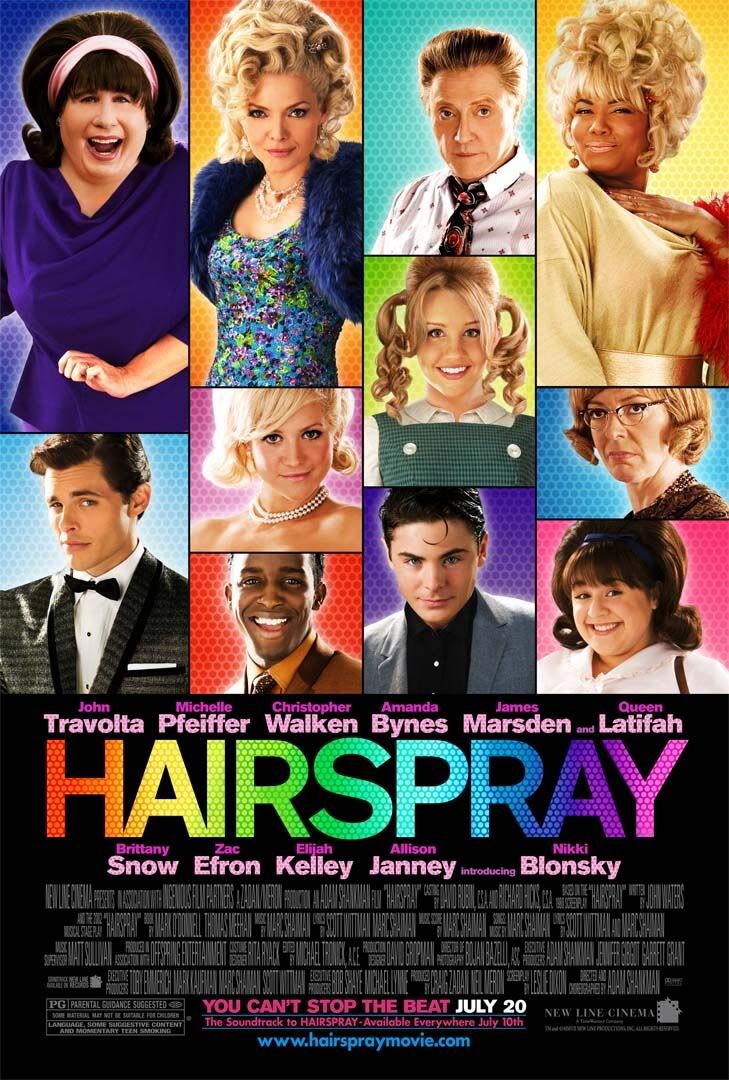
Considering "Hairspray"

What's the point of reviewing a movie that has been out for over a month? That's a good question. A better one is "Why review art at all?" but that is a subject for a later post. For now, be content that I promised my mother, who has commented upon the film to me multiple times, to review it, and I desire to make reviews of the art I experience a regular part of this blog.

Reducing experiences to a simple metaphor is not something I think particularly highly of, as doing so tends to obscure the nuances and wrinkles, but unfortunately, Hairspray deserves it. Hairspray was Mountain Dew. Actually, considering its length, it was more like a 12-pack. (Do these even exist anymore or are we now doomed to burial by 24- and 36-packs from now on?) This movie was a rush of sweet. The colors are bright, the jokes are frequent and less subtle than a slasher movie, and the only thing you can ultimately fault the characters for are being too nice and cheerful. Of course absolutely everything works out in the end, the good guys get what's coming to them and so do the villains.

Which makes the decision to build the plot around black-and-white integration on a afternoon television show an interesting one. Doing so is safe as it ranks near abolition and the right to vote on hot-button racial issues today, but that just makes the two overweight lead female characters such a tease when nothing is really said about that. American obesity is a much more popular issue these days than integration, but it's only played for laughs in Hairspray through Travolta's weakness to it. Effectively, the movie's silence on the issue endorses acceptance but says nothing definite, which is disappointing but not terribly unexpected in something playing for such a large audience.

As this is a musical, Hairspray lives and dies on its song and dance numbers, and one bubblegum song blows full force into the next and the next after that. There was no time to recover in between them. Moulin Rouge!, which ranks very highly on my list of all-time favorite movies, can be fairly accused of the same thing, for the first half hour or so, but it at least has the intelligence to break the songs up a little, distinguish them. Hairspray fails in this department. Barring Walken and Travolta's duet and the protest song, the others just kind of merge into a single mound of gummi bears and are difficult to remember individually now. Even that might not have been such a sin, if it had not been so long. There's a song for everything: Tracy's ride to school, her first advertising spot, her daydreaming of her crush, her escape from the police and that's only one character in this ensemble film. By the end, it begins to feel like they're trying to justify the presence of all the A-list stars in this by giving them their due screen time.

Speaking of such, the acting in this movie was a treat. Everyone, known and unknown, seems to truly enjoy being in this film and it comes out in the zest in their acting. The only reason no single character doesn't overpower the others is because all the rest are pushing back and playing it up just as hard. Travolta as Tracy's shut-in mother deserves special mention for giving it his all in what must have been absolutely miserable pieces of make-up and costuming to act in.

On the topic of musicals, I've heard that both Moulin Rouge! and Chicago were both supposed to revive the genre. Does this make Hairspray another aborted start or part of the revival these earlier Oscar nominees preciptated? As I'm on the topic, if this the beginning of a revival, I am interested to see if they go in the direction of this remake of a Broadway remake in brashness or that of the more realistic Once, which I still bleeding want to see.

Monday, September 17

Opa waiting for Lake of the Woods graduation 2007


After an extended break, I present to you this picture. Similar to the previously posted picture of Oma, which was taken at the same event as this, I like this one despite some major flaws, both in the shot itself in the printing. Opa's body is lost behind the blur that is my father's intercepting body, and the program he is reading, a major element as all of his attention and eyes are directed towards it, is washed out, something a little burning could have helped with. When I first showed this print to my instructor, he suggested that as the only reason for trying a second print. Seeing some of the other students struggle with their own dodging and burning at this point and a desire to print still more pictures kept me off, but I kind of regret that now. At least it's something I can always come back to.

I did, however, say I liked this picture. Ultimately it's not terribly complex, a man waiting for an event to happen, burning time with a rather disinterested look at the order of events. Barring the shoulder blur, there is only a foreground and two elements. Still, I think the relationship between the two is strong and keeps the picture interesting. And it's in focus. I'm still enough of an amateur to be amazed by that.

In closing, I would like to apologize for my tardiness in posting. I offer the not as excuses but as explanations. Last two weeks of summer were busy ones, replete with writing four articles for the university's newspaper, preparing for a semester in Germany, seeing friends and spending time with them before leaving for Germany, and traveling to Germany. Since my arrival, I've been on vacation with my grandparents, and Internet access has only just become regular. It is my hope that this transplant proves to be a strong ferment for future posts.

Friday, August 17

Oma waiting for Lake of the Woods graduation 2007


Apparently public critiques of my own pictures are popular. Through a variety of sources, I received four comments on the last one. Farther and further then.

Second picture I ever developed. It's of my grandmother while we were waiting for my sister's graduation. I was fiddling with exposure and leaned back to take a few shots of the family I was sitting with. Took one of my grandfather that turned out well enough for me to print, and that will also make it's eventual way up here. I chose this one to fulfill the "Depth of field" assignment for my photography class. Ended up using another one because, in the simplest possible terms, this one is pretty weak. It's a bit too out-of-focus to possibly called "soft," and the blur, my dad's back, in the bottom-left quadrant is too large.

Really, there are only two things to recommend this picture. First, Oma does present a strong central element. The row of arched backs and the contrast of her dark shirt draw the eyes to her. Second, it's a good smile. It's honest and bright. Even better, my dad says that her smiles aren't too often captured on camera.

Thursday, August 9

Harry Potter paraphernalia (mostly of interest to fellow Gonzaga students)

Later today (hopefully within an hour or two) I will finally post on Harry Potter, my personal response to the last in the series and the phenomenon on the whole. I've been intending on doing this since I finished Deathly Hallows, but for reasons which will be more thoroughly explained in that particular post, I have failed thus far. Yesterday perhaps offered the best opportunity to accomplish this, but I lacked immediate inspiration and made the mistake of going to YouTube to find some of that elusive thing. Before the YouTube Time Vortex kicked in and wasted the rest of my morning, I made the fantastic discovery of a clip from the upcoming Wizard Rockumentary, an exploration of the wizard rock aspect of Harry Potter culture. Intrigued, I visited the wizardrockumentary channel for more and found this most incandescent of gems, the Switchblade Kittens' "Ode to Harry Potter."

»http://www.youtube.com/v/Gi9duM3N26Y

Yeah, it's set at Gonzaga, the entrance and main staircase of the administration building and just outside in particular. Doesn't necessarily put me in mind of Hogwarts, especially at that point where you can see Pope John Paul II, but I still think it's cool. Okay, for those of you with histories in New York or Chicago or Los Angeles where, much less cities with their own television news studios, seeing the places you know recorded on film may not be a big deal, I must remind you that I'm provincial. Good grief, I tweaked out when the city two towns over made the national nightly news because it flooded, and the hockey team of the town in between us and the entire culture surrounding it was the lead story of The New York Times' Escapes section a few weeks back. Tweaking out in the latter case was exasperated by learning this story was first covered during winter break, and I missed the chance to meet a Times reporter.

But it gets cooler, and I think anyone can appreciate this. Why anyone would choose to film something like that here intrigued me, so I dug deeper. My investigation initially focused upon the Kittens as I was surprised that I had never heard of them before if they were a local band. Searching for them yielded nothing. A follow up on Wizard Rockumentary proved more fruitful. The twin sisters who are creating it and, apparently, are only waiting on the opportunity for an interview with Rowling before finishing, both live and work in Spokane, at least I assume they both do. Their website says the one with a greater interest in the actual filming and editing works for a local production company, a company which also called me yesterday because they were interested in looking at the house I'm renting as a set for a romantic comedy they will be filming in September.

Now those are some fun coincidences just piling on top of one another.

Regarding the music video, the assumption I'm operating under now is that the documentarists met the Kittens over the course of filming and offered their help in creating this music video. Operating independently, the Kittens did their bit in Los Angeles and the sisters did their bit here. What's more, filming took place late this January after classes had started. I checked my journal. I spent the day writing papers in my dorm and probably didn't even pass by Admin. Nuts.

Tuesday, August 7

Skateboarders at Under The Freeway Skatepark


Two posts back, I wrote of my burgeoning interest in black-and-white film photography, my ideal of capturing the beauty of daily life and need to get better. Here is one of those steps, taking the time to really look at my pictures, finding what I like and dislike about it and moving myself a little farther along that path of improvement. I choose to do this in a public forum to attract criticism, so please do not rest your fingers if you have some comment. Should you care, these pictures are roughly being published in the order they were printed. Enjoy.

Before the composition or printing are considered at all, I must say that I am proud of this picture because it represents one of the earliest times I asked permission before taking pictures. Far too often I either just ignore that or give up without trying. On to the picture.

Strong central elements in the two skateboarders is good, there are no other elements vying to be at the center of attention, and clutter is at a minimum. I filled up a roll on skateboarders and learned something important in shooting them, they never look up. Their eyes are always on their boards. You know you've caught something special when that's not happening, or you'll just have to learn to deal with it.

Washed out background with the harsh line on the diving barrier is irritating, but a symptom of shooting subjects under a freeway, completely in shadow while the sun merrily shines away on everything else. Could be negated by shooting so the background is always under the freeway or pushing the horizon to an extreme edge of the picture and not right down the center. Not much I could do during printing to salvage that.

By and large, this picture doesn't impress me so much. However, it stands out among my mass of skateboarding shots for an important reason. There are two skateboarders in it. I realize that sounds ridiculous, but the right skateboarder provides an invaluable contrast and context for the left skateboarder. You can actually tell he's doing something. Without shadows to give some sense of their jumps, he just ends up looking ridiculous. The second skateboarder grounds him and gives us a way to understand the other's achievement. It's a lesson I've try to keep in mind not only for photography but journalism as well. Let the viewer/reader understand what's happening and, if necessary, why it matters.

Wednesday, August 1

Art

For the longest time I've wanted to write on this subject. Currently, I have two drafts on the topic saved on my Blogger account, and I've intended on writing on the presence, or lack thereof, of morality in art for months. Why have none of these been published? Because I keep getting tripped up on a rather foundational idea. I don't know what art is. Try to write on art's morality or the difference between a review and criticism without a definition of art is not so much like trying to walk before you crawl. It's more like trying to walk without any freaking feet. So, here I am, trying to find a definition of art that encompasses it all, from music to movies, from Pollock to Da Vinci and grow some feet.

Art is that which is appreciated for what it is and created through human intention. Not for what it does or can do. Not what it means. Simply what it is.

In all honesty, this definition of mine does not sit well with me. It doesn't seem quite right, not precise enough. Still, I need something to start with and this has been a choke point for a week or two now. In all likelihood this definition will change as I further consider it and find definitions others use, but I at least have a point to move out from now.

Sunday, July 15

Photography

After a brief perusal of the first quotation collections that came up on a Google search, I couldn't find an attribution for, "History is just one damn thing after another," so I'll instead open this post with a similar line from The History Boys. This gem is delivered by Rudge while being questioned in preparation for his Oxford interview (you'll have to imagine the thick English accent). "How do I define history? Well it's just one fucking thing after another, isn't it?"

History, if taken as the summation of all recorded events, may be that way but only because there is no end it is moving towards, no philosophy of action. An article I recently read did postulate the necessity of perceiving populations as super-super-organisms for evolutionary studies, which suggest the possibility of some observable guiding consciousness, but that's beside the point. Our lives don't have to be just one fucking thing after another, but they will become that way if there is no intention in our lives, if we do things without a reason.

Recently, I've taken up black-and-white, film photography as a hobby. My dad gave me one of his old camera bodies and a few lenses for Christmas, and I finished a photography class a few weeks ago. The practice has appealed to me immensely, and I've kept up with it, having spent three hours developing four rolls and printing negatives last night.

Why do I do it? What makes it more than a distraction, another fucking thing that just marks the time before I die? What is my philosophy of photography?

From what little reading of done of some the masters, Arbus wanted to peer into the relaionship between the subject and the photographer and their environment. As much as anything else, it seems like Uelsmann just wanted to see what he could pull off.

As for me, I want to capture some of the beauty of everyday life. I want to frame something that one sees everyday but continually fails to notice so they do notice it and how wonderful it is. The phrase, "Stop and smell the roses" is cliche, but the sentiment is the same. If someone sees one of my pictures and leaves to find something on their way home, that's about all I want, as far as photography goes at least.

The only difficulty now is getting that good.

Thursday, July 12

The Gutenberg Galaxy

If you haven't heard of the above work, no big deal, unless, that is, you fancy yourself some manner of media theorist. In that case, for shame. Having heard of it and never read it is not such a problem. The thing's a beast; dense and requiring a fairly decent background in both history and philosophy to understand the nuance of his philosophy. It's a seminal work in the field, written by the inestimable Marshall McLuhan. No matter your position or interest in the subject though, you have doubtless heard the phrase, "the global village" or, possibly, "the medium is the message," from its sequel Understanding Media.

In all likelihood, the source you heard this from is either arrogant or moronic, though a combination of the two certainly is not out of the question. Perhaps they knew of the phrase's source and were trying to garner some respect or thought they understood the phrase without reading Galaxy. Let me make this clear: "The global village" is not a self-explanatory concept. It means a bloodly lot more than the world is getting smaller. It's not witty or clever. It's dense and complex. The idea of the global village goes deep into McLuhan's theories of civilization, orality and literacy, ideas that simply aren't captured in those two words. In using that phrase, McLuhan was doing a lot more than ramming some words together. He was capturing the essence of a philosophy.

Want a moral from this post? Know what you're talking about. I offer this three-step program. First, stop speaking of "the global village." You don't know what it means. If you still want to use it, read freaking The Gutenberg Galaxy. Once you're finished, read commentaries on it or get into an involved discussion with someone who has because it is very doubtful you, like it, have a complete grasp of it, much less understood it in its entirety. Or, you can take the lazy route and just modify all comments upon "the global village" with, "Keep in mind I've never read McLuhan."

Just needed to get that little bout of misanthropy out of my system.

Monday, July 9

A modest proposal as regards education

Turns out having more free time in the summer does not necessarily translate into more blog posting. I don't even intend for this to be much of a post. Am, however, pressing on with my short fiction. Sorry if you were greatly anticipating whenever I said I would have a rough draft up, but yeah. As you can see, that didn't happen. Instead, I am now opting to work on four stories simultaneously. Quadruple the fun, that is, if I get them to a point I like.

To get to the title of this particular post and away from my less interesting plans, I would like to propose that the classic works in all the arts, from creation and criticism, to journalism, be given less attention at all levels, excepting 300- and 400-level undergraduate classes and all graduate programs. but the highest levels of education. In their place, absolutely abysmal works should be presented. I'm thinking Catwoman alongside Kubrick's best and soft-core grocery store porn in between Vonnegut and Updike.

Besides the fact that these sorts of things have their own quirky charm for me, I feel I do have a couple of legitimate reasons for this call. First of all, how are you supposed to judge the highest summits attained when you don't have no idea what it's possible to scrape off the bottom. Freshman year of high school, Shakespeare was really underwhelming. A playwright and poet popular enough to warrant his own section at Barnes and Noble really did nothing for me. I could appreciate that he has a way with words, but that's about it. How could I respect a man when I have no idea what drivel he rose above and continues to do so? Just a little context would be nice.

For people with aspirations in some art or another who have finally realized how great some of these people and their creations are, there is an opposite problem. They/I become overwhelmed. The screw-me-because-I-have-no-chance-of-measuring-up-to-them-in-any-possible-way mindset takes hold. Seeing the lazy/insipid/uninspired attempts of other artists serves to mediate this feeling a bit. Besides, good art typically only reveals competence. Those artists we still study today are the revolutionaries. Holding up their works as the greatest the world has e'er seen will inspire more imitators than true artists. Show the budding writer a lifetime of cliches and the young composer something that has been done a hundred times before, and let them run wild, knowing what not to do.

Wednesday, June 20

On the morality of elliptical machines

So, having more time doesn't necessarily translate to increased posting. Huh. Have been writing though. Pounded out a solid framework for a short story that's been going through my mind since classes ended. Hopefully, I'll have revised it to the point I'm happy with it by this weekend and will be putting up an open request for criticism at that point. Something to look forward to if this blog matters that much to you.

On with the post that actually pertains to the title.

I'm not quite sure how this one transpired. A month or two back a friend started going to the gym, and in accordance with my own practices, I suggested running as a superior alternative to weights and machines. She rejected the idea. This is where it gets fuzzy. Since then, I have been called out three or four times for calling elliptical machines 'immoral.' I don't remember and really hope I didn't say that because it's stupid, though it wouldn't surprise me if I said as much hyperbolically. Still, I ought to clarify my position. Even if I didn't call elliptical machines immoral, the conversation did lead my friend to identify my thoughts as such, and my thoughts on the subject need to be better explained. Besides, this discussion provides a good segue into a greater life philosophy of mine. So...

To begin, I don't like elliptical machines. I prefer to run outdoors. The weather has to be pretty extreme to send me to the gym. Why is this? On the material level, it's because I'm used to running and don't like being inside during exercise (it's just an unpleasant environment I'd rather avoid). On a more philosophical level, I see elliptical machines as pure means to the end of health, better body, etc. Yeah, running often does have these same ends, and I certainly have no complaint about them. Running, however, I also do because I like to do it. It's not a chore. I don't have to force myself to do it because it's pleasurable.

I don't see that with elliptical machines so much. Even people who say that they enjoy them, I'm wary of because of the way I've seen people use them. When I have gone to the gym to stretch after finishing my route, those people who aren't listening to their iPods or other MP3 players are watching TV, and I must ask, "How much can you enjoy something when you seek distraction from it?" This may be unavoidable as the machines do face a series of TVs and one can't really ask them to run with their eyes closed but still. I'm not so hot on treadmills for the same reason. At our gym, they are actually in front of the ellipticals and have a better view.

In an attempt to anticipate responses, I'd expect one to ask, "What about multi-tasking? We're busy people and need to do as much as possible at all times." At a point not so distant in the past, I would have been very sympathetic to this, but that's been changing since I began college. I think the concept is 'intentionality,' possibly with Eastern origins and undoubtedly mutated by my own readings and understandings. When we do something, we mean it. We don't waste ourselves on petty things of no consequence or meaning that are neither right nor joyful to us. Neither do we distract ourselves during our pursuit of it. To use a common formulation in a modified sense, if it's worth doing, it's worth doing right. If we're going to exercise, which does have valuable ends, we're going to do so because we enjoy it. If we're going to do anything, we're going to focus all of our attention on it, turn off the background music and eliminate all distractions. Besides, life's too short to pursue good ends with bad means.

If one truly does enjoy the elliptical machine, I have no quarrels with that. But, like I wrote, I don't see that so much.

Please, if you want to argue about this or whatever, get in touch with me. The example is kind of unspectacular, crass even, but the greater philosophy it leads to is important to me.

Thursday, May 31

Quiet

I'm surprised this post has been so long in coming as it has its origins in a colloquium discussion on the Quakers just after spring break.

As nearly as I can remember, the progression went like this. In the Quaker service my friends attended, there was an extended period of quiet prayer, maybe 20 minutes long, broken only if someone felt the spririt move them to say something. There might have been a specific name for this, but I have since forgotten. To give us all a sense of it, the class as a whole was invited to participate in this. No one quaked or felt compelled by the spirit to say anything during our foray into Quaker prayer. After sometime it was ended, and we were asked to share our experiences and thoughts on it.

I eventually raised my hand and questioned what exactly we meant by quiet and silence. True silence, in that there is nothing to be heard, is an awfully artificial quality. In nature there is always animal life or wind to play upon the ears. And people frequently complain of the constant din of city life. The only way I know of to find it is through a purely human initiated sound-proof chamber.

I left my question at that, and a few people offered their suggestions. The only one I remember involved a person saying that they felt at peace in nature, even if there wasn't complete silence.

I've had some time since that presentation and would now like to offer my own answer to it. What I believe we are truly searching for when we say we are looking for silence, short of a retreat to that sound-proof chamber, is better described as stillness, being aware of and acknowledging all that audible information and accepting it. It doesn't shock us or distract us. It is simply there, alongside us, not to be resisted or understood as an irritation because we cannot control it. In this way, stillness can be found anywhere. Absorption into a forest or on the shores of some lake is not an atypical occurrence as one falls into their respective rhythms. Similarly, one can eventually fall into the pulse of the city as well. A friend of mine once told me a story about his younger brother. Their family had moved from a major city to the outskirts of my small town. That first night, the brother woke his parents and complaining that the crickets were too loud. I find it difficult to imagine that the crickets were truly louder than passing traffic, but their rhythm was different from what he was used to. Thus his personal stillness was broken. Some settings, though, are certainly more conducive to stillness. A piped truck can pass by one's home and disrupt any calm, and if one is in a state of fear because of an unfamiliar location, every sound indicates a possible threat and prevents any possibility for becoming still.

Saturday, May 19

Perfection

All we can ever expect of perfection, not being able to improve something in anyway, in our own lives is a but a fleeting moment, if that. (I think that may be paraphrased from the novel Fight Club, but I digress because I can go on about Fight Club for a long bleeding time.) The most skilled and talented among us may be fortunate enough to experience more than a few such moments. Perfection in anything, moral action, creative works, athletic activites, whatever, is nigh impossible because it depends upon more than that which is within our ability to control. For a painting to be perfect the paint must be just right, and short of making one's own paints, there is very little one can do to guarantee this short of becoming intimately familiar with a specific type and producer. For a violin performance to be perfect, not only must the instrument and performer be at their best but the acoustics of the auditorium must be perfectly suited as well, and those are not odds I like.

We cannot guarantee perfection, no matter our own efforts. What then should our relationship be to it?

I say we continue to strive for it. We acknowledge its veritable impossibility but continue on because we can never attain it without trying. The moment striving ends, the opportunity for perfection is absolutely out of our reach. Because of this ultimate goal, we will fail again and again. We just learn the best we can from these mistakes and try again. Besides, the result is of secondary importance. It's in the process and means where true value lies.

In counter, perfectionists, those who put the most effort into finding perfection, are disdained. In my experience, many of these criticisms are directed against those who are fastidious in their homework habits and small work duties. At these times, such criticisms are warranted. In their pursuit of perfection on such small things, they waste time on items of little consequence, directing their attention away from greater matters like morality and artistic creation.

But what about those who pour their beings into charity organizations and enter politics to aid the downtrodden? Schindler broke down at the end of his movie because he could have saved more by selling his car and cuff links and whatever else he still had. Is it appropriate to direct criticisms of perfectionism against them as well? I say yes but must first define perfection beyond 'not being able to improve something in anyway.' Perfection is not found in a single element but a system. One can spend all of their time perfecting their individual skill with a paint brush or violin, but they must still have experiences outside of their craft as sources. They must still maintain their health to perform at the utmost of their abilities. Perfection, when it is found, is found through many practices, not merely some clearly identifiable, central thing like skill with a paint brush in painting.

To return to perfection in matters of social justice, at least my earlier examples were quantitative and could be said that one completed some assignment perfectly. Perfection in such matters is still dependent, even more so than artistic and creative endeavors, upon the choices of others, whether its people aiding in the improvement of their own situation or others choosing to act evilly. As such, failures of perfection here are even more common. One can still do everything in their own power and fail miserably. Thus, before they even begin to work towards that goal of perfect justice and goodness, they must come to grips with their inevitable failure lest they breakdown and entirely forsake the project.

Thursday, May 17

Should I follow my head or my heart?

Another piece that wasn't originally written for "Spice of Life." This one was written in response to the above prompt for the Great American Think-Off. It's a trash question, one that can hardly be answered in 500 words or less and enraging to a philosophy minor, but hey, there was a chance at a $500 reward. Unfortunately, that reward was not mine. I still like this essay though. Enjoy.

REO Speedwagon asked that question in Hi Infidelity. Ilsa faced it at the end of Casablanca, and strands of the question can be found in The Odyssey when Odysseus attempts to reconcile his cunning and impulsiveness. Now the Great American Think-Off poses a close variant of it. It is fair to call it an enduring question, albeit a poorly framed one. The heart is a muscle and the mover of the circulatory system. Except for the potent combination of an increased pulse and the release of adrenaline that forces the mind into a ‘flight or fight’ response, the heart really offers no guidance in decision making. It is more appropriate to ask whether we should base our decisions upon reason or instinct, the former being the capacity to use logic and contemplate the distant consequences of a choice and the latter being an impulse to act firmly grounded in the present. Head, the center of thought, is reason, and heart, that organ to which we attribute those ideas not arrived at through logic, is instinct. These paired terms can be used interchangeably for the remainder of this essay.

Things exist for a reason. Reason and instinct are no different. Both are means of survival. Instinct, present in all forms of animal life, provides instantaneous decisions that increase the odds of survival in cases of immediate danger. There is no time for reason when one is pursued by a dangerous animal, so it is instinct that keeps one alive. For humans, whose physical capabilities are less than those of most animals, reason allowed for the creation of tools and other methods to overcome their physical deficiencies, thus increasing survival rates. An unarmed human stands little chance to defeat a buffalo, but working in tandem with others armed with weapons, humans can defeat the animal and enjoy all the benefits it provides.

Likewise, both instinct and reason have times and places where they are more useful. Instinct’s ability to provide one with a rapid response is critical in situations where time is of the essence while reason is necessary when one has adequate time and is attempting to find a solution that works in all situations and not just the present moment. In situations like sports and battle where time to react is measured in increments smaller than a second, decisions based on instinct are the only way to go. However, instinct will provide little help in finding a solution to a scientific problem because it only considers the present moment and cannot consider the full possibilities and limitations of different circumstances. In long-term projects reason dominates.

Clearly, both reason and instinct have their places in life and to give one such heavy preference that the other is completely excluded would be a grave mistake. As depicted in popular media, humans have a strong aversion to being reduced to a computer or animal, the respective epitomes of dominance by reason and instinct. But, as is the case of many dualities, granting greater weight to one is appropriate. Aristotle in his formulation of the Golden Mean, an idea that continues to inform our practice of virtue today, admitted that courage is not found square in the middle of foolhardiness and cowardice but more on the side of foolhardiness.

Thus I give priority to reason. Between it and instinct, reason is the only one that can take advantage of the benefits of each. Should the situation demand it, reason can recognize the instinctive choice, abdicate decision-making to it and take control again when the situation has changed. In contrast, should preference be given to instinct in the decision-making process, reason will not have the opportunity to surface and its advantages will never be known because instinct is instantaneous and offers no time for the reflection required for reasoned choices.

Furthermore, reason can form positive instincts, but instinct can never make reason sharper. For example, many aspects of the martial arts are antithetical to a natural, instinctive response; one steps into an attack rather than flees, attacks are carefully restrained to prevent a powerful counter. One fails in the martial arts not only if they trust completely to their natural instincts but also because they are too slow if they attempt to reason through every move. Through practices constructed and guided by reason, however, poor instincts can be replaced with superior ones. Thus instinct retains its usefulness through the use of reason.

Tuesday, May 15

Charter submissions

So, finals are over, and all those friends whom I will not see for the next few months have left, so I am not trying to spend as much time as possible with them anymore. Expect more frequent posts now, as long as the ideas keep coming.

Actually, this post is a bit of a cop out. I have a good idea fermenting and want to give it some more time to mature and not simply be blathering. Thus I offer links to already published work. Enjoy my submissions to the two lastest issues of Charter: Gonzaga University's premier journal of scholarship and opinion, Language and Machines. A bit more thought and time went into these pieces than my typical post, but should you have access to Gonzaga, hopefully you would have already picked up your own issues, which include a number of other fine essays and some wonderful graphic design.

Thursday, April 26

An aphorism

"Change never happens one says, 'This will be,' but when they say, 'That was.'"

Take a person who is trying to stop eating so many cookies or whatever. If they keep saying, "This will be my last cookie," they have failed to create the change. It still exists in the future but not now. The person who says, "That was my last cookie," however, now looks upon their actions from a different vantage point. Their choices and actions are now cast in a different light because the change has been made.

You could make a compelling argument that this is simply a matter of semantics, but I disagree. It's a fundamental change in your structural understanding of a system because, as mentioned only two sentences ago, your choices and actions can be seen in a different way once a change has been asserted by saying, "That was." If one continues to say, "This will be," the structure they are operating within remains.

Of course, this still depends on the individual capacity to make choices. Either way of discussing one's choices is only as good as their ability to make the choices they want to make. I just feel that the second method provides a better structure to act from.

Sunday, April 8

No meat

I gave up eating meat for Lent. For the most part, I succeeded in this, accidentally eating a slice of pizza with Canadian bacon because it was covered by cheese once and picking up a seafood wrap without thinking another time. Now it's Easter. I've already had lamb and am anticipating lasagna later today. What about it all then? What did it mean to give up meat? Could I live this way?

To begin, I have no compunction against killing animals. I've heard that there are some highly liberal colleges which have the freshman class communally raise a pig or something over the year and then kill it for a barbeque at the end of the year. Wouldn't bother me. I've gone hunting, though I never shot anything myself, and seen plenty of animals die. As long as it were killed quickly and with minimum pain, I would have no problem with it. Rather than ethical, my concern with vegetarianism is economic. The world population rises exponentially, and somehow everyone has to be fed. With respect to that, the amount of energy put into raising animals for their flesh cannot be defended. Personally, I believe that within my lifetime, barring a population stagnation or a drop, we will all become vegetarians for this very reason.

One question I was asked several times over the 40 days was if it were hard. I guess the implicit assumption there was that I missed the taste. Really, that wasn't such a big deal. Since I began cooking my own food at college, my meat intake in general has drastically gone down. Meat's expensive and a pain to store with my limited refrigerator space. I immediately have to do something with it, so it wasn't such a great change in the first place. The only times it became really difficult were when I was at a restaurant, there were maybe two or three vegetarian options and everything else looked so bleeding tasty. Good thing then I don't go out to eat very often.

On a related note, I could never go vegan. I could live as a vegetarian, but I like my eggs and cheese too much. Besides, when you need to take pills for vital nutrients, you've gone over the edge.

Sunday, April 1

Night

In posts past I have written on sunrise and the snow. All of those came from my experiences back in Minnesota. None ever originated from Gonzaga, mostly because it's an urban school, in the middle of a residential neighborhood and only a mile or so from downtown. It's really not so bad. Spokane is hardly a metropolis, and the streetlights aren't so plentiful that they completely block out the stars. Still, the campus is such a controlled environment, so any time I'm able to completely remove myself from campus and the city itself, it's a beautiful experience.

This weekend, we had a retreat out at Bozarth, a mansion on the outskirts of Spokane. And I mean outskirts. Just down the hill from where Bozarth stood was a minor marsh, the kind of place where the trees weren''t transplanted, the terraforming is minimal, and there's grass that has never been touched by a lawnmower. The kind of place I could bike to in maybe ten minutes back in Baudette but need a car to reach now.

First of all, the sunset was beautiful. I'm so used to sunsets on the plains where I can watch the sun go all the way down and nothing obstructs the view, but here it fell behind the mountains first. The mountains were covered in trees made golden by the setting sun and cast shadows that seemed to be miles long. The colors caught by the clouds? Rich and warm, colors that would have taken Picasso out of his Blue Period early.

But that wasn't the capstone of it all.

Around midnight, I took a walk into the marsh, hoping for a little stargazing. I hadn't even reached the path down the hill when I realized that wasn't going to be much of an option. The moon was full and bright enough to cast shadows of its own. Freaking shadows. I've seen it before, but it still amazes me. Do people even know that can happen? Still, I felt the need for a walk, so continued my way down. The hill was steep enough to need switchbacks, and everyonce in a while the trees were open enough that I could get a decent view of the valley and marsh. It didn't so much take my breath away as make me forget to breath for a few moments, which really is funny. I had made the walk earlier in the day and commented to friend that it would have looked so much better had it been later in the spring or summer because it was still all drab and brown from the recent winter. But there is no color in moonlight, and all that remained was a magnificent intensity to the landscape. Details were lost, and the focus turned to other elements. A stream ran through the marsh. In the sunlight you could see all the way to the bottom and all the life and litter that were in it. At night I only had a sense of motion. I couldn't tell if it's depth were measured in inches or yards, but the light captured the little breaks in the surface and the rapid flow of the stream.

It was beautiful.

Saturday, March 10

Further thoughts on volunteering

I'm going to San Antonio for spring break this year. In fact, I leave for the airport in two hours. Stereotypically, this vacation from college is associated with playing hard, blowing off steam and letting loose after an intense week of midterms and grade-making papers. That's not me, though. I'm going to San Antonio as part of Mission: Possible, a university program that places students in some city where they can offer community organizations and projects some help. My group, for example, will be helping out at the Good Samaritan Center, Children's Shelter and a third place that has yet to be determined as far as I know. Not exactly sure what form this help will come in, but those are who we'll be offering our services to.

Why do I do this? I bloody well know that I and my brief presence are not going to affect some great change that ends all poverty and unhappiness in San Antonio. Good grief, I'll be happy if all I manage to do is make someone's life a little more tolerable for a little while. Trips like these almost seem like a placebo, at times, for those of us who realize how materially fortunate we are, feel bad about those who lack our good luck and need to assuage our guilt somehow. On top of all that, it certainly was not cheap to participate. For the price, which I'm not exactly sure of but is several hundred dollars, I could have gone on a decent roadtrip, not that I paid any of it personally. The objects of my letter writing were very generous.

I found my answer earlier tonight, at Mission: Possible's spending-off ceremony. All of the participants gathered in the student chapel where we made bracelets with four beads to symbolize the pillars of this trip (simplicity, spirituality, community and social justice) and received T-shirts which boldly announced our participation. As may be expected, there was a speaker to guide us in reflecting on this trip, and what he said actually meant something to me.

Really, Mission: Possible isn't about our placements and those organizations we volunteer for. If we didn't come, they'd muddle through. No, Mission: Possible is about us, the participants. It looks to make us more aware of ourselves and others and develop our empathy, understanding and desire to offer help where it is needed. Sure, some people in San Antonio may benefit from my time there, but if that's all that comes from my participation in Mission: Possible, it'll have been a failure. I must become a better person as well.

Sunday, February 25

Weather

I know I've spent time on the subject of nature's beauty before when I recently waxed poetic over snow and, to a lesser extent, when I wrote about watching the sunrise this summer, but I think I may have found the underlying principle, the one that ties my appreciation for all of these together. With respect to this post, three important things happened yesterday afternoon and last night. First, during a run I spoke with a friend about technology and what it has been to humanity. The second, I read this article about Disney World and the new American paradigm on NationalGeographic.com. On a sidenote, you should just visit the National Geographic Magazine Web page anyway because it is so well designed and the content is of such high quality.

Thirdly, I took a long walk outside as the snow fell. It was snowing again, but different from the last tiem I wrote about it. There were flakes, but they were very wet and didn't stick to the ground at all, melting almost immediately. Despite the fact that the air was full of snow, there was very little white on the grass, only a thin layer of slush. But I still thought it was beautiful. Really, it was cold, wet and disgusting to walk through, but the greatest painters in history would have been hard pressed to capture the beauty in that moment.

Like I said earlier, I think I now know why I appreciated it so much. No matter humanity's efforts, the weather is completely outside of our control, much less ability to predict judging by the many jokes made about weathermen. Yes, technology has allowed us unprecedented, unimaginable abilities to communicate, store information, create new realities and transform the land, but the weather is beyond us. If it weren't for the weather, humans could very nearly control every single aspect of their daily lives and lead them exactly as they wanted to with no surprises and nothing unexpected. Undoubtedly, humanity has impacted the weather through carbon emissions and everything else that makes environmentalists fear our future, but the weather will never be brought to heel.

And that's what I love about it. The weather is not something I can dominate or even slightly bend to my wishes. It simply is, and I must go with it. The person who can take any weather, no matter the situation, is one to be respected because they are aware of and comfortable with their own humanity and smallness.

Tuesday, February 20

Ethical disagreements

Currently, I am taking an Ethics class, something you would already know if you have been keeping up with this blog. Or keep in touch with me on regular basis. Or take the class with me. I guess it's also possible that you would know this if you had seen the class list at some point, but now I'm really digressing. So far our professor has attempted to convince us that an objective moral system does exist as our first few weeks have been spent reading about and disputing subjectivism (belief that morality depends upon the individual and their experiences), relativism (belief that morality is dependent upon culture and only discussed in that context) and egoism (belief that a moral action must spring from genuine altruism, where there is no reward, to be truly moral). Now we are getting into actual ethical theories, our next reading is on natural law.

Still, I have a metaethical concern that I'll probably ask my professor about tomorrow. How do we deal with those who act, as we perceive it, evilly? Ethics are a big deal. They're not some aesthetic judgment. I can't or, at least, shouldn't accept your endorsement of eugenics in the same way that I am willing to accept that you don't like Fight Club and may even think it's the most over-hyped movie ever. To take a concrete example, I fundamentally disagree with the death penalty and killing in general, but we'll need to focus upon capital punishment for this example. How can I still regard myself as a good person if I do not do all that is in my power to stop anymore people from being put to death for their crimes? How can I live in good conscience if I am not making every effort to stop the needle from being put into their arm?

I discussed this with a friend not so long ago. His suggestion is that my awareness of the situation is very likely limited in comparison to those who made the decision, and should I have their knowledge, I may agreement with what they did. In many particular ethical conflicts, I can agree with that, but I understand state-sponsored executions as an absolute evil. The situation will never justify it.

What then? I guess I can retreat to some form of "you have to pick your battles." My time and energy are finite. I am not enough to change the world to conform to all of my beliefs and ideas, and it would hardly be appropriate for me to do so were I given the opportunity since I have so little knowledge of some topics. I have to pick what I feel are the issues and situations that most need my participation and live with my choice.

Saturday, February 17

When are we ourselves?

If my memory serves correctly, I remember Rachel of Animorphs fame was once described by Jake as a person who was always the same. No matter if she were in front of a teacher, her friends, her most dire enemy or her mother, you always got the same Rachel. I understood that as a compliment, and it's not hard to find examples of this celebration of the consistent in American culture. People who are willing to tell their bosses what they just told their co-workers are as heroic as it gets in the business world. People who double-talk and wholly change their personalities depending on they're with are despised.

Yeah, I can agree with this virtue to the extent that those who act differently when their society changes in order to benefit themselves do not deserve respect. But it bothers me too. Different people affect us differently. Some people command our respect due to their achievements and person, and others simply make us feel good because of how their zest for life comes out in their every action. Because of their pessimistic attitude and apathetic personality, others bring us down. Why shouldn't we be affected by them and thus see changes in our personality? What's wrong with that?

I believe many would suggest that my view on changing personality is wrong as well because it does not allow us to truly ourselves if our personalities are so easily altered. It's this sentiment that drives so many characters on television to leave their everyday lives and go on a journey to "find themselves." Humans are social creatures, unable to exist or even learn much about themselves unless they are put in contact with and form relationships with other humans. To go live alone by a pond or on some mountain is foolish as we are cut off from the living mirrors our self-image comes from. To know themselves, people need community and relationships.

Tuesday, February 13

Religion

Religion occupies that same ambiguous position as obscenity and culture do in our lexicon. We may not be able to define it, but we know it when we see it. Seeing as how I'm taking a religion class this semester that focuses on the many different denominations of Christianity that have appeared in the United States and how the two have impacted one another, I think it would be worth my (considerable) time and (infintie) space on this blog to try and define it.

In the broadest terms, religion is best defined against science and ethics all though the three are inextricably bound up. The primal religions see every event as a suprenatural one caused by divinities, science can become a religion unto itself and ethics cannot be separated from either. Science describes the world. Ethics inform us as to what we should do. Religion is purpose.

It's not hard to recognize Christianity and Buddhism as religions, but when you start to break them down and try to sift what makes them different from things like your job, it becomes difficult to see exactly what it is that separates them from something as ridiculous as sports. Rituals, community, mythology, rules, transcendence all of those can be found in both the major world religions and sports. Muslims have the Five Daily Prayers. Every team has a chant to get fired up before a game. Jews and Christians have church and synagogues to reinforce community. Even sports as apparently individual as distance running, one still needs teammates to set a strong pace and a coach to train them. Hindus have the Vedas, and Jews have the Torah. Baseball has its own origin stories. Jews have the Ten Commandments and Leviticus. Sports have rules. Religions seek to break out of the common and touch the divine. Sports movies set up the 'big game' as that place where ordinary people become superhumans and legends, outside the pale of the normal. As far as I can tell, it is as apprpriate to call football a religion as Sikhism.

Like I said, it's tricky. All you can really do is try and separate the good religions from the bad ones. Which then are good and which are bad? I'm copping out here because the right answer is whichever religion is true, but that is a topic for volumes. For me right now, the good ones are those that do not depend on humans, the ones that look beyond. Sports are a human creation. Every tradition, mythology and other aspect I identified earlier is derived from human actions. When sports are taken up as a religion, they proclaim the ultimate superiority of humans, something I do not accept. In contrast, religions like Christianity, Islam, Buddhism, Hinduism, Sikhism and Judaism are good because they are exterior to humanity. Though they may not exist without our presence on earth, their origins would still be here. Sports, on the other hand, simply would not be.

For those of you who took World Religions with me at MITY (2002?), I own up to it that I owe a lot of this post's inspiration to that class. I remember my roots and give credit where it is due.

Wednesday, February 7

Snow

If you've been following this blog since early this summer, you may remember my post of a failed scholarship application to Marquette. In it, I had to make a list. I don't precisely remember what the theme was, something along the lines of the most important things I saw in this world, but there had to be seven items in it. One of them was the cold. I would like to expand upon that entry a little because the word limit on the essay didn't allow for a proper examination into one of the more beautiful aspects of the cold, snow.

It snowed Saturday evening. It was gorgeous. It began early and very lightly. You could hardly see the individual flakes they were so small. As it grew later though, the flakes came together, forming ones large enough to watch on their entire trip through the air, following their erratic paths to earth. Not that their beauty ends there.

Freshly fallen snow is clean and renewing. Walking through a snow fall, when you can see traces of only your steps, I do not know how to explain the feeling. There may be an experience of adventure as you are the first to see this new, fleeting scene or a feeling that but a sense of calm comes upon me.

In the winter too, it is quiet. What little sound is made by those animals too tough to hibernate or migrate south, is abosorbed by the snow creating a fragile silence, one that makes you take softer steps and kills any desire to shout that you might preserve the delicate quiet a little longer.

Monday, January 29

Culture

Culture is a funny thing. It gets bandied about so often and so carelessly that to actually find a good definition for it is near impossible. This came up last week during Ethics as we were considering a relativist ethical outlook (every society has its own distinct moral code and it cannot be compared to any others, tradition is its own warrant, yadda, yadda, yadda). To even make relativism viable, you have to be able to identify and differentiate between cultures and so my classes troubles began. I do not remember the specifics of the various theories on culture that were offered, but there was trouble in defining it as circular reasoning arose in calling it 'the beliefs and values one has' or culture became so atomized by examples of a person identifying with their gender, race, nationality, interests, ethnicity and whatever other myriad things that the term culture became useless.

So a friend and I went for a run afterwards and discussed culture on the way. In maybe fifteen minutes (the run was over twenty, but we switched over to a wholly new topic after a while) and after considering whether Star Wars fandom and fashion and other such things constituted a culture, we came to a conclusion that goes something like this. Culture is the set of prohibitions and prescriptions, written or not, that we follow or at least attempt to in our actions. Atomization is prevented because culture is bound by a finite number of actions, but belonging to multiple cultures is still possible.

Counter-arguments?

Webster suggests that culture is 'a : the integrated pattern of human knowledge, belief, and behavior that depends upon the capacity for learning and transmitting knowledge to succeeding generations b : the customary beliefs, social forms, and material traits of a racial, religious, or social group; also : the characteristic features of everyday existence (as diversions or a way of life) shared by people in a place or time c : the set of shared attitudes, values, goals, and practices that characterizes an institution or organization d : the set of values, conventions, or social practices associated with a particular field, activity, or societal characteristic.'

Wikipedia says "Culture (from the Latin cultura stemming from colere, meaning "to cultivate"), generally refers to patterns of human activity and the symbolic structures that give such activity significance."

Yours?

Thursday, January 25

Education

Our formal education begins very early and can continue for a long time. They (a rather nebulous concept that includes parents or other caregivers and the government) get their hooks into us early with pre-school and kindergarten, and the process does not often end until a decade has past and increasingly goes on even longer. Why? To turn us into productive members of society, responsible, socialized adults ready to enter into a skilled profession. What follows are personal reflections on the attainment of this goal.

When I was in my junior year of high school and talk about figuring out what I wanted to do after graduating began to circulate (I always knew I was going to college), I hated the very idea of community colleges and three-year programs. There is far more to education than getting a job and beginning to make money. A person should have a developed appreciation for music alongside their understanding of accounting or geology. Besides, a weak worker is one who understands only their own trade and not the context in which it exists. Intersections between diverse fields are common. Engineering and art? English and history? Yeah, there is an entire world outside every individual field and to better understand that field, you need to understand the world. I knew I wanted to go to a liberal arts school and be forced to take classes that I would never normally take because there is a big world out there, and journalism offers only a solitary perspective on it.

Now I am at that liberal arts college, and my thoughts swing more in the other direction. Some friends were recently discussing their plans for grad school and dismissed their current undergraduate education as the opportunity to study what they enjoy. Four years of learning amounted to nothing more than a stepping stone to their real education for them. A great deal of money is going into this necessary passage, and an opportunity to postpone taking responsibility and become a producer and not merely a consumer is extended.

Freak, I am 19-years-old, a physically mature male and in good health. In most any other nation today or at any other time in history, I could very well have been working a farm, supporting not only myself but a family, likely including my parents, or be in the army or something. My peers are planning on extending the lack of true resonsibility for a few more years. This is unacceptable. Besides, what's stopping them from learnign law now. Are their capacities for understanding and memory going to increase that much more between their sophomore year of college and entrance into graduate school?

Ideally, I guess I want elementary and middle school and high school to more closely resemble the liberal arts education I am now receiving. Teach us to write and read and do arithmetic, yes, but also teach us philosophy and how to think critically. Show us the basics of physics and biology. Expose us to every manner of art and music. Catch them young enough and they will not blow it off as something that does not matter to them or their future. Then let us learn a trade.

Tuesday, January 9

Movie trailers

A few days back I saw a trailer for Stomp the Yard on TV. The main draw of the movie seems to be the dancing because the plot of talented rookies in some sport taking on the established veterans has been done time and again in any number of settings. Likely, the hero is the one who jumpstarts the ragtag group of the rookies, falls in love with some girl with connections to the veterans, things fall apart and the veterans see if the hero would like to join them, he declines and brings the rookies together at the last minute to win and get the girl. I haven't looked into the movie anymore than this trailer, so I may be wrong about these predictions. Still, I find it hard to believe I'm that far off. What surprised me about this trailer, however, was that it revealed the ending so blatantly. In the final seconds you can see the hero kissing a girl while confetti falls and his team jumps around behind him with a trophy. I doubt anyone coming to this movie didn't expect a happy ending, but it was rather surprising to me until I began to think about it.

How often do people go into movies completely blind now? Likely, they don't go to a movie unless they've read some reviews or seen some trailers or at least seen a poster which reveals a bit about it. Even more, if the person manages to remain completely in the dark about plot details, once they begin seeing the movie they apply any number of structures they've observed in similar films and can probably make some good guesses about the ending after twenty minutes.

What I find fascinating is that filmakers know this and have changed the ways their movies are presented now. The general structure may remain the same, but the early parts have changed. Take Hitch which my mom and sister watched severl nights back. Even if one did miss the trailers or has since forgotten about them, it's hard not to imagine Will Smith getting together with the gossip columnist after their respective characters are introduced. However, they first appear together in a bar but with different people. At one point, they even cross paths but just miss each other. The audience was expecting their first meeting at this point, perhaps in an amusing instance of slapstick, but it doesn't. Of course it eventually happens, in the same bar ten movie minutes later actually, but audience expectations are played with. I find it interesting that filmakers are still able to practice some originality within these established structures and the associated expectations.

A final question on this subject. If some movie remains popular in future, and people can reasonably come into it without any expectations except that it is a good example of some genre, will they be missing some of these little tricks?

Tuesday, December 26

Habit and schedule

To obtain virtue, Socrates thought that the cultivation of good habits was necessary. In The Art of Being, Erich Fromm writes about the need for concentration in habitual activities.

Before I can progress in this post, there is a fundamental question that must be asked. What are habits? The definition my philosophy professor of this past semester gave is a good one. Habits are those things we do again and again that have a cumulative effect and lead towards a single goal.

My problem lies in distinguishing between the daily practice of habits and scheduling. This, of course, requries further distinctions to be made between kinds of habits. You simply can't schedule habits of a moral, ethical nature, the ones that Socrates was speaking of. You cannot say, "I am going to spend this morning being honest and practice altruism in the afternoon." These should be taken into account and practiced in all of our interactions, every day. Ultimately, we should strive to develop virtues like justice and patience to the point that we no longer think of their practice but simply live them.

Lying in contrast to these habits of moral development are those of skill development, habits that are better aligned with Fromm's treatment of habits. Learning a new language or how to paint or whatever, those require our full attention and concentration. To some extent, we can integrate these into our daily lives in the same way as moral habits by trying to translate some phrases into our chosen language or practice motions that mimic those of a paintbrush. Still, these are the types of things that time must be devoted to specifically if one wants to make true progress in them. So, in order to acquire these skills, we schedule time to work on them.

Is it possible to overschedule in this regard? Of course. At the heart of this lies my dispute with any form of overscheduling, be it on vacation or in anyother aspect of one's life, or too much control over one's choices. To the extent that we remain committed to our schedules, we remove chaos from our lives, necessary for discovery and growth. If we remain in complete control of every aspect of our lives, we can never mature beyond ourselves. We are our limit. It's the same problem that news and blogs consumers run into these days. People immerse themselves in those that reinforce their own beliefs rather than challenging themselves with intelligent works of differing politics. Their beliefs are thusly never tested, and good ideas, often the result of synthesis, may never be found.

This all leads to a rather simple principle with regards to habits: flexibility. Rather than saying, "I will read this work in a foreign language from 3:30 to 4:00 today," you try instead to read a chapter sometime today while still being prepared to take advantage of alternative opportunities.

Friday, December 22

I write beyond this blog...

On the off-chance that someone reads this blog who doesn't personally know me, I am pleased to inform them that I do write and am published outside of this blog. Mostly, that is through various Gonzaga publications; the student newspaper and the jounals of opinion and art. If you lack access to hard copies of these, the following are links to pieces I have written.

My Charter submissions:
Cultural enlightenment 101: Education through travel
Happy Crossings
Archetypes of a political persuasion
The Smart One

The Gonzaga Bulletin submissions:
Actually I'm just going to provide a link to the website, The Gonzaga Bulletin. I wrote a fair number of editorials that can be found in the archives. My pieces are the ones preceded by the title 'Editorial:' rather than 'Letter to the editor:' Most of them deal with what the opinion pages should seek to be and are of a more general nature that is hopefully of interest to more people.

Reflection submission:
Unfortunately, these are not up yet. You'll just have to wait to see the brilliant fiction I write.

What is journalism all about?

I want to be a journalist. I'm not sure in what capacity (reporter most likely considering my recent experiences as Opinion editor) or in what medium (not TV) or, much less, publication (it is my hope that more time in the field will lend some guidance on these paths), but it's what I want to do.

Why?

There are practical considerations. It's a field one can actually get a job in and make a living on, and it's something I think I could enjoy doing. Not that these matter so much. I find it hard to believe I could not find these needs filled in any number of other occupations. In all truth, it probably wouldn't bother me to be a janitor or secretary if these were the only preconditions I looked to in a job.

No, my desire to professionally enter into journalism is based on what it's all about. Thomas Griffith called journalism "history on the run" in his essay The Pursuit of Journalism. I don't know who he is, except that he was an editor of Time and Nieman Fellow in 1943. In that same essay he referenced Matthew Arnold's quote, "Journalism is literature in a hurry." I respect Arnold as a poet, "Dover Beach" hangs in my dorm room. But I take a different view from both of these men.

Journalism, in its best form, is information, and information is a tool. With newspapers and magazines and the like, people are given what is necessary to make better decisions. They can choose to support or fight specific courses of action because of what they learned from the news. Money obscures the energies that go into production. In its way, journalism can disrupt that veil. That is what I want to do in my career. Whoo.

Tuesday, December 12

Volunteering and charity

They're a big deal, volunteering and charity. The amount of time you unselfishly donate to others is a quantitative element that others often use to judge if you as 'good.' Besides that, material benefits have accrued alongside the less tangible identification of one as a good person. Charity work is really pushed at the high school level and participation in it opens up all manner of scholarships and gives your college applications a bit of a boost. Or not because it has become the standard. You want to win a Citizen of the Year award? I understand that coaching Little Leauge and the like does a fair bit towards endearing oneself to whatever committee makes those selections. For some businesses, philanthropy or the appearance of such has become a major component of their operations, Product (RED) being the current pre-eminent example.

This post isn't about the larger issue so much as its appearance in my life as of late though that would make for a decent post.

By accident of birth, I have never been in need of anything in my life. The essentials and necessities have all been taken care of for me. Life certainly isn't fair, but I can bloody well try to make it a little more so in some way. That's why I volunteer and try to do good.

At Gonzaga, I have given time to a local elementary school this past semester and, last fall, an organization which I prefer to call a homeless service center to a shelter because its sleeping program is minor and it mostly provides some necessities and opportunities to the homeless who take advantage of it. In the first case, I took care of some minor things like putting together papers for the students and helping them with their writing to the small extent you can when they're in first grade. In the latter case, I sat behind a counter and handed hygienic items out to those who asked for them. In either placement, my job could have done by most anyone. They were not what I am looking for.

No, I think the best example of what I'm looking for is a project I took part in towards the end of the semester. Operating under the name 'A Warm Welcome' the intent of the project was to provide student-made scarves to incoming Karen Burmese refugees. In ideal practical terms, for the amount of energy we devoted to making these scarves, we could have held jobs and devoted our earnings to the refugee placement service, World Relief, and done them far more good. In more practical terms, it's very hard to get college students to part with their money in this manner while they are more than willing to give of their time. Furthermore, though the quality of the scarves was largely of inferior quality to those which could be purchased commercially, these scarves were the first crocheting project for many students so they gained a new skill, and I hope that they demonstrated a greater sense of welcome to the refugees than simple purchases could.

That it was what I am looking for. Actions with both tangibly good results and strong meanings behind them as well. Time to start looking harder.

Tuesday, December 5

Looking for truth

Besides the plays assigned through Literature III and the notable exception of Fight Club, my fiction reading habits have as of late been reprehensible. For myself, the last work of fiction I can remember reading, at least for the first time since I did power through most of my old Animorphs over the June, July and August, was Dr. Zhivago back in the early summer. Since then, it's been nothing but news articles and essays covering economics, religion, sociology, psychology, politics and what not. On my desk, ready to be read now, are In Defense of Elitism, Crossing the Postmodern Divide and The Condition of Postmodernity, and they aren't metaphors.

In no small part, I'm sure this change in reading habits is affected by the collision of my tendency towards stinginess with my money and fear of trying something without a reccomendation. These works of philosophy are freely available at the university library, and if they aren't directly spoken of during some class, they do touch on topics we do discuss. In contrast, I often leave the local independent bookstore empty-handed because I'm afraid of wasting my money on some poor work of fiction that I have heard nothing of.

I do believe, however, that there is a large issue at play here, and that is this search for truth I speak of in the title. Philosophical works and those of the social sciences have pretensions of explaining and making intelligible the many aspects of the world we live in through logic or empirical evidence or whatever while fiction is largely understood as amusement. Saying that fiction cannot contain great truths or whatever is hugely wrong of course, and the legs of the social sciences are hardly the strongest. They find it very hard to explain everything or their various adherents even find it difficult to agree on most things.

The important questions come last here. Am I right or perhaps just arrogant? Is this right to pursue truth in such a way?

Monday, December 4

Screw social justice

Actually, that title is just for impact. In a certain, very specific sense, I do agree with it, but in the sense that I'm sure first came to the minds of most people, I'm totally against it. Good grief. I go to a university where taking a class with a social justice requirement is necessary for graduation and am active in a number of groups who hold the concept of social justice near and dear. Most importantly perhaps, my friends are very much for this concept as well, and that statement could be one of the best possible if I desired to alienate them.

Offering my definition of social justice would no doubt help clarify my position. It is the ideal of making a more just world be it through economics or diginty or whatever. Aiding in the development of clean drinking water and reliable sources of food in the Third World is social justice. So is taking a hammer to concept that other ethnicities and races and sexes are inferior and don't deserve the same rights and potential as others. Short of believing that it's up to these people to raise themselves up, wholly on their own, I can see no way of arguing with this position.

My problem is with how I see this ideal pursued. Social justice is achieved by turning other countries and societies into the United States. A simple search on Google for ecological footprint ought to demonstrate the impossibility of that situation, (Maybe I should be a little less cavalier in that statement as Malthus was proved wrong.) but the greater problem, for me, lies in a different direction. Do other societies really want to be like the United States? Materially, we're doing very well for ourselves. We have indoor heating, cooling, plumbing, a veritable multitude of entertainment options, all manner of food choices, amazing transportation abilities, need I go on? Largely, our needs and wants are met and exceeded, but we aren't happy. Stress and obesity are epidemics of a sort that are hammering all members of American society. Blame it on marketers trying to cultivate a mindset that believes it will be satisfied once they make that next purchase or whatever. The problem remains. By and large, we are not content or happy people. Social justice will fail if it can make the American lifestyle attainable to every person on the planet (barring the current economic impossibility) but still leave them unhappy.

I do not dispute the necessity of improving the situations of people whose basic needs are not met. Yesterday a friend questioned why another friend would go outside in the sub-twenty weather in a T-shirt to meditate. He said it was to attempt and transcend the cold. She said his transcendence would be better served by putting on a jacket or coat or something. This whole debate and my own thoughts are worth a post in itself, but I'll let it stand here to say transcendence is fine for we who have the option to put on our jackets or go inside. Let's not force it on those who don't have options. That's what social justice should be seeking to accomplish, the meeting of needs and the creation of societies where all people are allowed to match their potential and are judged according to their merit.

The next step is breeding contentment with what we have, something we Westerners would do well to learn ourselves. I don't remember thinking of this until I saw City of God. Those people lived in a Brazilian slum. Their lives were led amongst squalor, but they were not miserable people. Frustrated and angry? Yeah but not whiny. My mom is fond of quoting some study that found the happiest group of people in the United States are old black women. Not my first I guess and I suspect not that of most people. Why is that? Because happiness is not dependent on possession. So much of our entertainment seems to me to be nothing more than a distraction. Hear some clever lines and see some flashy explosions or exotic landscapes and forget about whatever is really bothering us, more likely than not, that unscratchable itch being wanting more; power, prestige, money, stuff, whatever. That needs to be killed.

Before I end this post, something needs to be clarified. I do not believe that all discontent is bad. After all, it is what drives progress, and no person should be content with settling for less than their best or not fulfiling their potential. We simply must identify those areas where discontent is wasted.

Saturday, December 2

Reflections of a former Opinion editor

This semester I took on the role of Opinion editor for my university newspaper, and now it is finished. The last issue of the semester was published today, and there really is nothing left for me to take care of except to e-mail those who continue to submit and tell them that they will have to await for publication in the spring, a semester will definitely not be working as an editor for. As is my modus operandi, my choices and all their consequences warrant some reflection.

Like so many axioms, "Hindsight is 20/20" is wrong. Looking back now, I have no bleeding idea why I applied for the position of Opinion editor. There certainly is no dearth of good reasons for me to have applied for the position: It is required for my Journalism major and also appeared to be a good way to form relationships with new people with similar interests. Arrogance may have played a part as I decided to take on editing before the reporting and writing classes as they seemed less difficult to me. I also looked towards the Opinion pages specfically because I felt they had been so abused in previous semesters and could be so much better.

Whatever the cas, I ended up with the position. At various points, I may have said it was all right. Those were the times I had plenty of opinions on a variety of subjects and was even able to hold a few just in case a drought of pieces in the next week required a back-up plan. Most of the time though, I would have called it a learning experience in that I learned I never wanted to be an editor again. There was simply too much stress. I demand a certain level of quality in those things I participate in and have an influence over, and the constant running around and speaking with people to arrange for (hopefully) intelligent and thought-provoking opinion pieces and then desparately waiting for their pieces to come in was plenty of stress. Add on the frustration I feel towards myself when I have to constantly pester my friends for a letter whenever they say something that sound mildly contentious and even more frustration with the general student body for generally not caring to respond to any number of potential topics, preferring instead to focus on abortion and the Take Back the Night group, and mine was a world of hurt and dread come Wednesday and page layout. The last two issues proved especially difficult as a number of meetings were forced and egos had to be assuaged as people got personal in their letters and fought for their (perceived) rights to appear on the Opinion pages and not be edited.

Any of the individual elements I would have been fine with. Copy editing, though boring and something I need a great deal more practice in, is fine. Page layout is fun. Both together with kind of assigning stories to people who you have no leverage over or incentives to offer makes it very rough.

You've made it this far. Congratulations. Now let me explain my future plans. I care very much about journalism as a whole and The Bulletin specifically and want to see them reach the highest levels of quality that they can. In the forseeable future, my contribution towards that goal will be through writing and reporting. In the vaguest of manners, I can see myself taking on the position again, maybe even Chief Editor. Unfortunately, that would more than likely involve dropping one of my minors. We'll wait and see.

For now, my semester as Opinion editor remains a learning experience, like so much of my life and as it should be.

Thursday, November 16

Literature classes

Some time ago I found an article on Slate that challenged the English departments of to justify their existence when what they did seemed so detached from reality (apparently "The Dynamics of Interbeing and Monological Imperatives in Dick and Jane: A Study in Transrelational Gender Modes" is not that far off from the truth). Maybe the article provided its own answer or concluded that English departments really didn't deserve to exist. I don't remember, but the challenge has stayed with me, most pressingly when I'm trying to figure out why I care about female Edens in "A Midsummer's Night Dream" or Milton's brilliance in the use of 'or' in Paradise Lost.

Well, this wil likely be my last semester of Literature, barring space in my schedule opening up and hearing that Victorian Literature is all sorts of fun. Better late than never to find an answer to that question, "What is the use of directed readings of literature, poetry, drama and whatever else those writers can come up with and professors throw at you?" Because they're not psychology or chemistry or whatever else that can be demonstrated empirically. Those are averages and generalities. No one has 2.5 children, and attitudes toward life don't fit neatly into whatever stage of life we've reached. Literature reinforces these lessons we should have bleeding learned from our interactions with people. They're unique, complex and can't be reduced to the latest study or finding.

The problem at I arrive at here, is what makes Virginia Woolf and Homer and Oscar Wilde so important then that we have to spend so much time poring over their words? There are millions of writers. Why not them? Because some people have spent more time considering themselves or are simply more interesting.

Why then do we need professors? Hopefully, to guide us towards what the author intended. Rather than finding ourselves in their works, we find the writer. The professors know the writers, studied their other works and lives. They are best equipped to know the writer.

Here's the article, on the off chance you care. At this point, I'm about positive I've written about it before. Maybe I'll look it up sometime and look at how views have changed or realize just how redundant this post has been.

Wednesday, November 8

Insanity and chaos theory

It's a popular saying, "Insanity is trying the exact same thing over and over again and still expect different results." Actually, I'm not sure if it's popular. I've used it if that indicates anything.

If Edna St. Vincent Milay had heard this, she could combine it with, "Life is not one damn thing after another, life is the same damn thing over and over," and come to the conclusion that to live is to be insane.

But I'm digressing. My point is, chaos theory throws this all out the window and proceeds to run over it with a Hummer. Tiny, insignificant changes can impact the outcome in ways we cannot possibly imagine, so it's very possible that the results will change no matter how similar repeated actions appear.

I know it's a departure from my current thread on goodness, but it's just something I thought of.

Sunday, November 5

More thoughts on altruism and community

So, after further thought, altruism is less a good than a basic tenet of human survival. I'm fairly certain I've written on this before, but I'm going ahead with this next bit anyway. If communities are to survive, the members need to have reasonable expectations of how they will treat one another. Altruism is the answer to this. Treat others kindly and they will do the same in return. In some small way, we can control others in that way.

The point of this, besides reducing altruism in my eyes, is to point out the pre-eminence of the community. If the Golden Rule is what communities are built on, they have to be one of the most important elements of civilization. Why? Because humans cannot exist on their own. Even before all of the tending one needs as an infant, a man and a woman need to have sex to produce them. As trained adults, I guess humans can survive wholly on their own, given the right location. Still, they're merely surviving at that point. Animals survive, humans can be more. Now I just need to figure out what humans should be reaching for.

Wednesday, November 1

Altruism

So, what must I do? I must be altruistic. As far as both Jesus and Confucius, major teachers of Western and Eastern morality, are concerned, and they are both heavyweights, this is a pretty good answer. I treat others as I wish to be treated. It's progress, but I now need to figure out what that it.

The problem with altruism lies on two levels. First, the separation between what I want and what I need, and the fact that what I need is sometimes painful. The second, and deals more with my interactions with others, am I wise enough to know what they need? Do I know all the necessary details? Just how much should I force necessities on another person? At some point, they need to fill their own needs.

A small answer and more questions. Progress of a sort, I guess.

Also, this is not that exciting of an answer but this journey must include equal parts meditation and participation in daily life. Buddha didn't sit underneath his bo tree until he left his palace and saw the old man, the sick person and monk. Jesus' ministry was preceded by a 40 day visit to the desert. These guys did pretty well for themselves, so if I could emulate them, that would be pretty rocking.

Geez, I really am comparing my journey to some of the biggest names.